Athletic Directors Toolbox

  • Home
  • Leadership
  • Mental Toughness
    • Mental Skills
  • Motivation
  • Professional Development
  • Program Building
  • Sports Performance
  • Team Building

How to Win the Locker Room

May 17, 2019 by

By Dr. Rob Bell

Dr. Bell is a Mental Toughness Coach and Certified Consultant of the Association for Applied Sport Psychology.  He consults with hundreds of athletes, coaches, and teams and has served as the mental coach for PGA tour winners, USTA Champion, and Olympic Medalists.  He is also the author of several mental toughness books. For more information about Dr. Bell and his services visit https://drrobbell.com/

A team locker room is a sacred place.

Basically, what is said there, when you leave there, leave it there.

Sorry, but here’s the wrong way to win the locker room.

New Buffalo Bills Head Coach Sean McDermott felt that setting the tone of the locker room was important.

Agreed

Coach Sean McDermott is all about “culture” and leading by example. He’s a 3:30AM fitness guy.

Agreed

He is a driven, hard-nosed, accountability coach whose locker room culture begins with him.

Agreed

Coach stated that “this is a business”, so he removed the pool table and video games from the locker room.

Disagree    

Players don’t care how much you know, until they know how much you care.

Hall of Fame coach, Bill Walsh, set up a fishing tournament amongst his players during pre-season. He stated, a “team that can laugh together, can get serious together.”

Hard nosed, two time Super-Bowl winning coach, Tom Coughlin, spent the very first day of a training camp by having a bowling tournament. He changed his tyrant approach because  he “wanted his players to see him as his grandchildren did.” 

Super Bowl Winning coach, Dick Vermeil was known for his “boot camp” practices and discipline, but only after he started to develop a relationship with his players did he finally reach the pinnacle.

Look, there is nothing sexier than discipline, accountability, hard-work, grit, perseverance, and a culture of excellence.

However, in order to win, coaches have to win their hearts as well. In order to do that, they need to win the locker room.

Here’s 5 ways to win the locker room


Develop a TEAM culture- 

Every coach would agree that when you have players willing to fight for one another, there is nothing more powerful. Practices should be difficult and demanding, but developing team chemistry also takes place in between practices and games. You hang out so much together, that either bonds or cliques get formed in various ways.

Developing a locker room where players can unwind, relax, be themselves, and hang-out is crucial. Who wants a locker room where players simply dash out after showering and changing?

A pool table or ping-pong table encourages players an outlet to bond over a competitive activity that is not directly related to their own sport. The Cornell basketball team that made the sweet sixteen and finished 29-5 all lived together and touted their Super Mario bros. and table-tennis competitions. 

Allow the players to take ownership-

Jeff Van Gundy allowed all minor decisions like where to eat, which music and movie to play on the bus up to the players. He granted them a voice in their own culture.

Have a leadership council-

In all pick-up games, kids self-govern themselves. You can’t break the written and unwritten rules of the court and expect to be welcomed back. A leadership council of players should make decisions on certain disciplines that coach doesn’t have to. That creates more ownership among players and takes more off of the coach.

Orchestrate the cohesion-

Teams become cohesive over the task at hand (winning), or socially (togetherness). Ultimately, task-cohesion is king. However, these task-cohesive teams are only fostered through extremely strong peer-leadership.

Social cohesion is queen. Teams full of mutual respect for one another have more trust and uphold standards within the team. Usually, the best teams have BOTH task and social cohesion. These bonds can be enhanced through scheduled sessions intended to do so.

Foster organic cohesion-  

Yes, it is a business. Winning is a habit. But, allow play to be a part of the culture. Allowing athletes to express themselves through free-play is as old as the cave-man days. We thrive on working hard toward a goal and also having fun along the journey. 


I’ve been in the team locker room at the end of a season with such tears of joy from winning, because they all knew of the effort and sacrifice and bond. I’ve been in the other locker room as well, that tears flowed because the loss was so heartbreaking because of the sacrifice and bond.

If you’re in the game long enough, these moments will happen. That’s life.

The way to a winning team locker room begins way before these moments of joy or heartbreak. It begins with the culture of the team and finding ways to win the locker room.
Filed Under: Leadership, Mental Skills, Professional Development, Program Building, Team Building

So What is Leadership

June 30, 2018 by

This article is also posted  on The Coaches Toolbox, a collection of free resources for coaches of all sports

Answering the question “What is leadership?” begins by grounding it in these 7 core assumptions

By Dr. Cory Dobbs
The Academy for Sport Leadership

Excerpt from A Leader in Every Locker (2016)

“I’m not used to supposing. I’m just a working man. My boss does the supposing . . .”

This quote is a line from the classic movie 12 Angry Men. During the opening dialogue among jury members, each feeling out their place and role in the deliberation of the fate of a young man’s life, a blue‐collar working man makes this declaration of powerlessness. The implication is that all the power—at least that of “supposing” rests in the hands of his superior. Just a movie? Hardly.

It’s been the rule for over a century in team sports to install a hierarchical leadership structure. This is accomplished by appointing a couple of players as team captains (as well as modeled by the hierarchy of the coaching staff). Surely everybody knows that on any sports team only a few players are able to really perform peer leadership. This is the team captain axiom, the basic axiom of traditional team leadership.

An axiom, of course, is a truth so self‐evident it doesn’t need to be proved. After all, everybody knows an axiom is accurate and correct. So then, it’s indisputable that you need a pecking order in order to get things done.

Not too fast, things are not what they always seem to be on the surface. The bad news is that far too often our intuitive ways of thinking about the world are wrong. Yes, axioms can be wrong. The good news is that it’s possible to set them right.

What’s self‐evident, what’s obvious, what everybody knows, has deep roots and of course isn’t in need of change. Yet, paradoxically that which is self‐evident hides something–covers over what might be a deeper truth. Axioms, by their nature, are anti‐learning. Nobody ever questions an axiom. Nobody ever discusses an axiom (save for a few propeller heads). It’s just taken as a given. And nobody ever talks about the possible counterproductive consequences of what everybody knows. The fish, after all, never questions the water he lives in.

Then, all of a sudden, someone comes along with a breakthrough idea and turns the old axiom upside down. The taken‐for‐granted truth, it turns out, wasn’t really the truth after all. “The world is flat,” was the truth people lived by for thousands of years. Then, along comes Nicolas Copernicus who proves to the world the old axiom to be wrong.

Twenty years ago, to choose a different model of team leadership was unthinkable. In elaborating on the end of two decades as a premier athlete Kobe Bryant had much to say when asked the question, if he could go back in time and offer advice to himself as a rookie, what would he say? His response: “It’s hard to tell somebody ‐‐ a player at that age ‐‐ to understand compassion and empathy, but that would be my advice.”

Why of all things would Bryant endorse caring, compassion, and empathy? “Well,” Bryant continued, “because that’s the biggest thing about being a leader, I think, and winning a championship is understanding how to put yourself in other people’s shoes.” “That’s really the most important thing. It’s not necessarily the individual skill you possess. It’s about understanding others and what they may be going through. And then, in turn, when you understand that, you can communicate with them a little bit better and bring out the best in them. Bringing out the best in people isn’t passing them the ball and giving them open shots. It’s about how to connect with them, how to communicate with them so that they can navigate through whatever issues they may be facing. That’s a very, very hard thing to do.”

I’ve never been a fan of Kobe Bryant, and I seldom look to professional sports for deep insights and understanding on leadership, but it appears that the wisdom in Bryant’s words fit hand‐inglove with today’s call for a more heartfelt approach to coaching and leading. So what’s the way forward in this brave new world?

Don’t worry. While you’ve been trapped in the axiom of team captaincy, I’ve been turning over rocks to find a better way of designing a high‐performing team, its culture, and of course, leadership. I’m not done yet. It might be another decade or so before I’m finished. But this workshop workbook is a start.

So, What is Leadership?

There has been a long running debate in scholarly circles about whether people learn to lead from their experiences or if leadership is something a person is born with. Today, however, most academics agree that leadership is best considered as a set of skills and qualities that can be learned and developed along within a wide‐range of personal styles. It’s widely agreed that all people have the potential to develop leadership skills. I point this out because it is also clear that leadership is viewed and valued differently by various fields, disciplines, and cultures.

So then, what is leadership? This is the big question that every person, group, team, organization, community and society seeks to answer. Our American culture, which of course includes a heavy dose of sporting influence, exalts the lone ranger, the hero, the charismatic leader. We see this in the election and glorifying of politicians, the deifying of business tycoons, and the adoration and idolization of great coaches and athletes. This notion falls in line with the traditional ideas of leadership—that it is the make‐ up of the leader that makes all the difference. Individual determinism has been and will continue to be an easy and favored explanation of things. But traits such as self‐confidence, intelligence, and a can‐do attitude—favored qualities of a leader—do not always predict the effectiveness of a leader; rather, they can be very misleading.

However permeable the traditional mental model of leadership seems, it does not provide a path to sustainable effectiveness as it leaves out the detail and nuance of the context in which a leader takes action. It also ignores the fact that it tends to reduce followers to passive participants; resulting in deliberate apathy and often conscious withdrawal from the leadership provided by one’s peer. Careful examination of this aspect of team captaincy suggests it may promote the discounting or dismissing of the potential of all members of the team to learn and perform in a leadership role.

Both the context and followers are foundational to leadership and are central to The Academy for Sport Leadership’s search for a new conceptualization of team leadership. The leader in every locker approach to team leadership is, no doubt, a paradigm shift. Paradigms, as you know, are the common patterns and ways of looking at things in order to make sense out of them. Leadership has long been presented as an elusive phenomenon available to only a select few. It is my contention, however, that understanding the relational nature of leadership and followership opens a team up to an immensely practical and dramatically richer form of team
member involvement.

The basic foundation of any leadership process is relational. As leadership expert Margaret Wheatley notes, “None of us exists independent of our relationships with others.” At the core, it is a relationship which comes into existence because of some sense of commitment by people to a common purpose. Thus, the ASL framework for answering the question “What is leadership?” begins by grounding it in the following core assumptions:

1. Conventional views of leadership are changing. Leadership is not limited to a chosen few; it is an educational component of participation in student‐athletics and must contribute to the growth and development of all athletes. A leader in every locker embraces the potential of all student‐athletes to take on leadership roles now and in the future.

2. Leadership is a relational process. That is, leadership is a socially constructed phenomenon consisting of student‐athletes working together to accomplish something.

3. Team leadership is distributed. Leadership is not the sole responsibility of the coach, coaching staff, or selected team captains. The best team leadership results from the actions and activities of those best positioned to provide leadership contingent on the context.

4. Leadership is a process to create change. Leadership is about making things happen; transforming people and programs. Effective leadership accelerates change. Change is necessary for growth, development, and improvement in performance.

5. Leadership growth and development is personal. There is no time frame related to progressing through stages of development. It’s also recognized that all potential leaders begin at a different starting point. Leaders grow and develop through deliberate practice, informal practice, roles, reflection, and the observation of role models.

6. Leadership is a process that involves followership. All coaches and student‐athletes participating in a leader in every locker understand and embrace both roles—leading and following. Followership implies a relationship to the leader, but does not imply one that places the follower in a less important position.

7. Leadership develops over time. There is no one way to lead. The practice of leadership involves the continual practice of finding the best way to lead with the particular capabilities that the student‐athlete possesses at a specific time, while constantly working to improve and expand those capabilities.


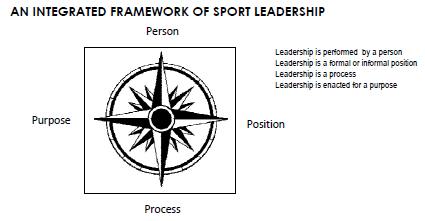
Embedded in the seven assumptions above are the four P’s of team leadership. The framework highlights the integration of the four key domains of leadership. The framework answers the question What is Leadership? Leadership is a position, it is a process, and it is performed by a person for a purpose.

Too often leadership is narrowly defined exclusively as a person. Conceptually this leads us back to a focus on the leader, her traits and disposition. But leadership is more than the idiosyncratic actions taken by a chosen person. It is a process. A process is simply a
coordinated way of doing things. Can student‐athletes, including those that don’t possess the so‐called necessary traits, learn a process for doing leadership things? Of course they can.

Leadership is also a position. In The Academy for Sport Leadership’s way of doing things we suggest giving each student‐athlete a “role” to on‐board them into the leadership team building development process. You’ll see this later when I introduce you to my 8 Roles of Teamwork. A leader’s words and deeds provide purpose, a compelling vision of the future. Effective team leadership answers, for all team members, the questions, “why am I doing this?”

The four P’s, like the compass that they form, are only a tool for answering the question “What is leadership.” Each student‐athlete (and coach too) brings his or her own unique values, skills, experiences, and personality to the leader role; and each student‐athlete has his or her own personal way of making change happen. The compass is a simple model that represents the key domains of an effective leadership development program.

To find out more about and order Sport Leadership Books authored by Dr. Dobbs including Coaching for Leadership, click this link: The Academy for Sport Leadership Books

If you would like to learn more about the book that this excerpt came from click: A Leader in Every Locker

Filed Under: Leadership

Humility is Not Optional

June 16, 2018 by

Humility is not Optional.  It’s a Necessity

Cory Dobbs, Ed.D.  The Academy for Sport Leadership

“Humility is not thinking less of yourself, it’s thinking of yourself less.” –C.S. Lewis

As we descend deeper into a society characterized by polarization and division, cooperation is increasingly a curious characteristic.  First, let me suggest that cooperation is a product of humility, a dispositional drive of a selfless ego.  I introduce cooperation here to set it up as a desired individual behavior to be exercised in a team environment.

Consider humility to be a serious personality characteristic; one that is geared toward the positive construction and building of healthy relationships.  But don’t align humility with meekness or shyness—as is usually the case.   Resist the temptation to dismiss humility simply because it hasn’t been lionized like “grit,” or “mental toughness.”

One of the biggest mistakes coaches make is thinking that humility means a lack of self-confidence or a personal shortcoming such as a fragile sense of one’s self.

In team relationships humility shows through by the team members’ commitment to serve and support one another, through showing appreciation for the contributions of teammates, expressing encouragement, and acceptance of each other.  The person possessing a healthy dose of humility is generous with his or her support of others as expressed through loyalty and respect for teammates.

The humble teammate displays a strong sense of duty to the team.  Let me be clear: humility is the social glue that holds the team—a fragile eco-system—in balance.  Humility always contributes to unity.

It is worth exploring how to mesh cooperation with competition.  Competition—a cherished quality in the field of sport—is often considered to be the opposite of cooperation.  Competition is the drive and compulsion to win, to earn, to get, to have, to do.  Sports and competition are synonymous.  Yet, an ego attuned to only competition breeds a self-interested ego.  At this point I’m sure you’re saying…”and so?”

We live in a culture with a high tolerance for individualism.  This breeds status and ego.  It promotes selfishness (might I get creative and say “selfieness”), and an “It’s all about me” attitude.  Society rewards those who use self-promotion to stand-out.   Of course, many young people have bought into this approach to life.  However, there is often a darker side to ego.  Ryan Holiday, author of Ego is the Enemy, reveals:

“The ego we see most commonly goes by a more casual definition: an unhealthy belief in our

                own importance.  Arrogance.  Self-centered ambition….The need to be better than, more than,

recognized for, far past any reasonable utility—that’s ego.  It’s the sense of superiority and certainty that exceeds the bounds of confidence and talent.”

An ego out of control can and often does promote a sense of self-justification giving an individual the “freedom” to say and do whatever is in their best interest.  Ego driven people often are self-absorbed and seek only individual fulfillment.  Certainly such behavior can and often is displayed on the playing field.

However, don’t confuse this with a default proposition that competitiveness is bad; it’s clearly not.  But when an ego (triggered by a social or psychological event) is out of touch with reality it can quickly put a person on a path to self-destruction.  And when this happens good luck reaching the person; you likely won’t until they meet with a fall that humbles them.  Reality meets humility.

A humble person, one driven by a strong and stable sense of humility, is simply more likely to help a teammate, to regard others as equals and worthy of a deep, close relationship.   Simply said, the humble person who practices humility keeps their accomplishments, gifts, and talents in a proper perspective. They possess self-awareness, avoid self-serving distortions, and are keenly aware of their limitations. They value the welfare of teammates and have the ability to mindfully attend to the uniqueness of each team member.  Humility always contributes to unity.


About Cory Dobbs, Ed.D.

Cory Dobbs is the founder of The Academy for Sport Leadership and a nationally recognized thought leader in the areas of leadership and team building.  Cory is an accomplished researcher of human experience. Cory engages in naturalistic inquiry seeking in-depth understanding of social phenomena within their natural setting.

A former basketball coach, Cory’s coaching background includes experience at the NCAA DII, NJCAA, and high school levels of competition.  After a decade of research and development Cory unleashed the groundbreaking Teamwork Intelligence program for student-athletics. Teamwork Intelligence illuminates the process of designing an elite team by using the 20 principles and concepts along with the 8 roles of a team player he’s uncovered while performing research.

Cory has worked with professional athletes, collegiate athletic programs, and high schools teaching leadership and team building as a part of the sports experience and education process.  As a consultant and trainer Dr. Dobbs has worked with Fortune 500 organizations such as American Express, Honeywell, and Avnet, as well as medium and small businesses. Dr. Dobbs taught leadership and organizational change at Northern Arizona University, Ohio University, and Grand Canyon University.

“Tell me and I’ll forget. Show me and I may remember. Involve me and I will care.” -Your Student-Athlete The world of coaching is changing. In Coaching for Leadership you’ll discover the foundations for designing, building, and sustaining a leadership focused culture for building a high-performance team. To find out more about and order Sport Leadership Books authored by Dr. Dobbs including Coaching for Leadership, click this link: The Academy for Sport Leadership Books

Filed Under: Leadership

How to Turn a Negative Culture Around

May 29, 2018 by

This post was provided by Coach Dawn Writes

By Dawn Redd-Kelly, Head Volleyball Coach at Beloit College

If you’re not happy with the culture of your team, how are you working daily to change it around?  As was said over at Leadership Freak, “Toxic environments are the result of neglecting culture-building and tolerating toxicity.”

When we find ourselves with a negative team culture, it’s easy to blame the athletes, but we hold some accountability as well.  We’ve both neglected the culture and tolerated the things that are counter to our beliefs.

So what now?

5 quick tips for building a culture of positivity:

  1. Encourage your athletes to express gratitude: for practices, for getting coached hard, for their teammates, etc.
  2. Find ways to honor culture builders: if you’ve got an athlete who has bought in, whether they’re a starter or bench dweller, point them out!
  3. Reward those who are on board: perhaps you can create a weekly team award for the athletes who best represent the qualities you’re trying to instill with your team.
  4. Remove the worst offenders: if you’ve worked and worked with them…sometimes they just have got to go.
  5. Show interest in your athletes as people: crazily enough, our athletes have other interests besides our sport…find out about them.

Be a culture hawk for your team!  Not only will your athletes enjoy coming to practice more each day, I’d bet your outcomes in the win/loss column will also turn from negative to positive.

Filed Under: Leadership, Program Building

5 Ways to be a Better Leader

May 19, 2018 by

This post was provided by InnerDrive, a mental skills training company

How do we become better leaders? An effective leader is someone who can create an inspiring vision, motivate and inspire their team, manage the delivery of that shared purpose and then coach and improve that team in order to achieve that end goal. So what are the best leadership skills, and what are the keys to becoming a better leader?

1. UNDERSTANDING YOUR LEADERSHIP STYLE
According to research, there are loads of different leadership styles and they vary between men and women. However, 4 main styles have been commonly agreed. These four leadership styles include autocratic, democratic, laissez-faire and transformational. By finding out what type of leader you are, you will then be able to identify your strengths and areas in which you need to improve.

For more ideas on how to help your team members develop and improve, have a look at our page on how to improve metacognition.

Autocratic

This leadership style includes, close supervision, lack of input from followers, complete control and solo decision-making.

Democratic

This leadership style includes, shared decision-making responsibilities, social equality, creativity and high engagement from group members.

Laissez-faire

This style includes, little direction from the leader, lots of freedom for group members, team members are responsible for making all decisions and a great deal of autonomy.

Transformationala-better-leader

People who have this leadership style are often described as energetic, passionate, enthusiastic, trustworthy, creative and intelligent.

A more in-depth description of these styles can be found here.

2. Be a role model

This doesn’t necessarily mean leading from the front, as keeping a watchful eye from a distance can allow your team to develop their own forms of leadership and management strategies. This point refers to the way you, as the leader, exemplify your behaviours and characteristics for your team to follow. Your actions can have a profound impact on the behaviours of your team. Research has shown that by showing your organisation what is possible, a leader can empower them to develop their own skill sets.

3. Be authentic

Being authentic in your approach to leadership provides your group with a true understanding of who you are as a person, away from your professional role. Research has shown that by doing what is promised, being visible to your organisation and being honest helps manifest a sense of trust within the group you’re leading. Be true to your values and in doing so, your team can understand the direction you want to take them in.

4. Listen to, and communicate with, your team

Research has shown that non-verbal cues like body language, facial expressions, eye movement and hand motions are an important form of communication. Matching your non-verbal cues to your actions and words can help with authenticity.

Whilst verbally and non-verbally communicating with your team, it is also important to listen to what they have to offer. Be an active listener, in doing so approach conversations with concentration and regard for the speaker’s thoughts and considerations. Likewise, studies have shown that skilled listeners also pick up on the speaker’s underlying thoughts and concerns by tuning into their non-verbal cues, showing genuine care for the person’s feelings and morale.

5. Motivate your team

Leaders can motivate people in various ways, but by making sure the individuals inside the team understand that their investment of time and effort is something worthwhile, and can encourage the desired actions. Evidence indicates that this can be done by providing recognition and praise, offering rewards, inclusion and by being passionate.

Final thought

John F. Kennedy once said, “Leadership and learning are indispensable to each other.” Highlighting how leadership is a constant learning process and that it can most definitely be taught. Anyone can become a great leader as long as you are willing to listen and learn.

Filed Under: Leadership

  • « Previous Page
  • 1
  • 2
  • 3
  • 4
  • 5
  • 6
  • …
  • 22
  • Next Page »

© Copyright 2026 Athletic Performance Toolbox

Design by BuzzworthyBasketballMarketing.com

Privacy Policy