Athletic Directors Toolbox

  • Home
  • Leadership
  • Mental Toughness
    • Mental Skills
  • Motivation
  • Professional Development
  • Program Building
  • Sports Performance
  • Team Building

Everything They Don’t Tell You About Being A Coach

November 21, 2022 by

This video is courtesy of Glazier Academies

In the 2-minute video, Frank DeLano delivers a powerful message taken from his full presentation “Everything They Don’t Tell You About Being a Coach” from Glazier’s Head Coach Academy.

Being put in the middle of difficult situations is seemingly a daily occurrence for coaches. There is no one answer or policy that is a guide to working through these tough calls, we can all benefit from having the mindset to examine all problems that deal with kids from as many sides as we can.

In this video, Coach Delano gives us his thoughts on dealing with the following scenario:

One of your athletes is an at-risk student who really needs to be a part of something that you can offer them. At times, those needs can conflict with what is best for the team.

Coach DeLano has won six state championships and definitely plays to win. As you will see in the video, he also has the heart to serve students.

My lesson from the video is that we need to look for a third alternative that helps the individual and that we are still able to do what is best for the team.

Click the play arrow to see the two-minute video.

Here are a few more of my takeaways from his entire presentation on Everything They Don’t Tell You About Bring a Coach:

  • Dealing with everything they didn’t tell us is not in our job description.  However, putting thought and concern into each individual challenge that you are faced with is what will allow us to achieve maximum impact for our athletes.
  • Coaches must adopt a fireman-like mentality.  Firemen train themselves to run toward fire to be able to put it out.  Coaches need to have that same mindset when dealing with issues that affect their athletes and their program.
  • No matter what is going on around us, as coaches we need to remain calm.  More importantly than that, we need to help everyone else to remain calm.
  • Try as we might, there will still be times when there is no resolution.  When faced with that, we need to be the leader in the healing process.
  • No matter how many people are around us during our workday, having to make decide what is the best course of action can lead to a feeling of being alone and lonely as a coach.

To close, I offer a thought that I heard from That Matta (former Ohio State and current Butler Men’s Coach) at a coaching clinic in 2001. That was when we were both “young coaches.” 🙂   I made it the number one priority for our program.  He said, “I am very goal-oriented.  The number one goal for our coaching staff is to establish a life-long relationship with our players that can never be broken.”

Helping coaches develop a way of thinking that can be applied to all the issues they face is the purpose of Glazier Academies. The curriculum provides coaches across all sports and at all levels with the preparation and tools to tackle the most challenging and important issues they face today.



Filed Under: Professional Development

BORING is good when you want to be good

April 13, 2021 by

BORING is good when you want to be good

Written and contributed by Dr. Chris Hobbs ( Follow him on Twitter @Dr_ChrisHobbs)


My youngest daughter is a 14 year old aspiring athlete. Early on in her sport endeavors she’s demonstrated strength, grit, commitment, and some explosive athletic ability. I don’t know how accomplished she’ll become but she puts her all into her athletic participation. She loves it. Practices, games, tournaments, and training sessions are why she gets out of bed each day. Much of me agrees with her; like father, like daughter! She recently came home from an after-school strength training session with the qualified strength coaches we have at our school. I asked her how her session was. ‘Dad, it was boring. We do the same exercises every time.’

This made me smile. We have highly qualified and passionate strength coaches and an elite weight room so the workouts were not my concern. What my daughter was experiencing was the paradox that boring is good when you want to be good. We live in a day and age when we have almost no tolerance for boredom. If something becomes boring, we move on quickly. We can skip commercials, check a different social media network, communicate with whomever we want whenever we want, or scroll our phones while standing in lines.

We have almost completely purged boredom from our lives and that has consequences. One of those consequences is we have forgotten how many boring repetitions it requires to become proficient in a task or skill. Skill development in athletics is a great example, but it has many other applications like earning a degree, losing weight, or saving money for a big purchase. Getting good is boring!

As I worked through my doctorate, I would estimate that 75% of the things I was involved in were boring, but it would not have developed the understanding of content or process necessary to do what was required to finish the doctorate (write a dissertation) if I had not navigated a lot of boring. Boring is not bad if you want to be good at something.

There are a couple of ways to navigate boring while pursuing something good.

1. Check off the completion of tasks as you are working through boring phases. Jerry Seinfeld used to keep a calendar above his desk and cross off each day that he spent 30 minutes working on new jokes. His goal was to create as many unbroken rows of x’s on his calendar as he could. I’m sure writing jokes day in and day out go boring, but we don’t have the humor of Jerry Seinfeld without his tolerance for boring.

2. Develop practical reminders of where you are heading. Post it notes on mirrors, home screens on phones, and daily journals are all great ways to remind yourself of why you started on a boring path to something good.

3. Do boring with other people that are headed your same direction. I spent 3 years working towards a particular goal in strength training during my 30’s. There was a lot of boring days, hard lifts, and failed programs. I kept going many times because I was having a blast being miserable with the two guys I was training with. We did boring together and it was quite so boring.

Mother Theresa is quoted as saying, ‘be faithful in the little things because it is them that your strength lies.’ Boring is hard to tolerate when it comes to commercials and lines but that doesn’t mean that boring is bad. Boring is good when you want to be good. Ironically, when you remember that boring is required to be good, boring becomes exciting!

Keep on, keepin’ on, friends!

‘Bite Down and Don’t Let Go’ is a collection of writings on being intentional about life in a way that produces great persistence. Read about it more here.

Dr. Chris Hobbs is an educational leader and Director of Athletics at The King’s Academy in West Palm Beach, Florida. He’s earned a few degrees and won some awards. He’s happily married to his high school sweetheart and they have three teenage children. Life is messy and complicated most of the time. You can follow him on Twitter for all sorts of inspirational thoughts and good laughs.

Filed Under: Professional Development

Sandglass Sport Success

January 26, 2021 by

This article was provided by Bjorn Galjaardt

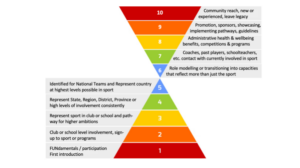
Okay, a catchy phrase for something that might actually be a double pyramid model. However, time is of the essence and clubs, coaches, athletes, parents or caretakers and stakeholders can act now. The Sandglass Sport Success model is a blueprint that poses challenges of ‘participation’, ‘early specialisation’ and ‘high-performance’. In fact, in various sports, people find the same challenges and opportunities but may find friction in or from certain levels of the ‘sandglass’. The sandglass works from a broad FUNdamental base to a narrow high-performance climax, that eventually will mirror success. Interested? Let me take you through a journey of a blueprint in sport success.

First pyramid:
The first pyramid is based on the basics and needs of the participants. It is like a combination of Maslow’s hierarchy of needs and Balyi Long-Term-Development-Model, but then for all sport needs involved! From associations to clubs and from grassroots to high-performance interests. Active Start.

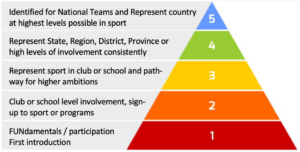
1. Statistics shown that most participants join an introduction program, whether it is through the school, club, association or similar. On average, globally, around the age of 8 years old. Some have gone through ‘mandatory’ programs (e.g. learn-to-swim), while others try sport based activities for the first time. Some will join at a later age as they may transition from other sports (e.g. swimming to water polo), like to try something new or it is part of a (curriculum) activity. Fun is the main driver: FUNdamentals

2. Other or the same participants either transition to the next phase or begin here. The second most important layer. In both layers, there could be some sort of competitive component involved, but the majority want to play the sport with friends, try something new or really want to learn more about the sport. Learn to train.

3. Phase 3 is where the ‘fun’ starts to form a different dimension. Training starts to get serious for some. Perhaps there is an appetite for more, perhaps the club has a history of being a more performance driven club, perhaps there are other reasons. The main idea is to offer multiple levels for multiple participants, which shall now be called players. This base layer of phase, or stage, 1, 2 a 3 is needed to provide adequate opportunities for all players involved. Whether it is a once in a week game with a BBQ after or 5 times a week training with an A division team. If we lose those crucial ‘hot’ levels (hence the colours red, orange and yellow), there will be no phases or stages after this. High-Performance is bound to those first 3 crucial levels. Train to Train.

4. As the pyramid layer shrinks, the level of players become thinner. Players shall now be called athletes, whether they are emerging or close to elite. They play representative and they want to continue to do well. Some are happy to already perform on this level, others want more. Most of them specialise into this sport alone, others may drop out and it is crucial to capture them and nurture them on the level that they feel valued and welcome. Some may have educational sponsorships or still depend on parents or stakeholders. Train to compete.

5. This is the level with the least athletes. The financial structure depends on professional sponsors or government support. The quality is assumed to be higher and for that matter, perhaps high key performance indicators are on stake. Train to win.

Second pyramid.
The reflection of the first pyramid, or better the expansion.

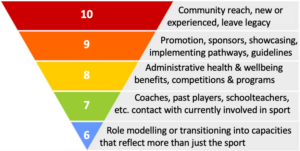
6. Coaches, athletes or coordinators and managers who have gone through phases or stages 3, 4 or 5 and are a current or past identified role models, could be utilised for those levels to inspire those that are close to that same level. Learn from their experiences and share their stories. Sure, when high stake medals were won this would leverage the strength of this phase. However, there are many examples of successful club programs and sponsor packages that others have never seen, just because it was not shared with the right people. Who in your club has a success story that people could learn from? Perhaps a community members’ father, who won the Football Premiers… Share to perform.

7. All members from all levels can inspire, not just your top performers. There are great coaches out there who never represented any country but touched many lives and build a club. Past players who actually never thought of doing something for the club or program, because they perhaps never been asked, therefore never had considered it. Who in your club or program knows a person that perhaps has an interest to inspire a current or next generation? Teachers can introduce water polo into schools or schools into your water polo program. Share to inspire.

8. People who currently play or have transitioned from playing and are in roles that could have a positive influence on your sport. Health and wellbeing is a hot item currently with more attention to it than a few decades ago. Develop a think tank with administrators in the sport area to evaluate competition, programs for clubs and schools and see what you can offer them. This may as well open connections and create transparency, perhaps there is even a need that was not identified before. Now maybe financial benefits are mutual! Inspire to develop.

9. By showcasing the sport there needs to be mutual benefits as mentioned in phase 8. This can be done by a combination of previous phases. Some benefits may run short term, other long term. To establish improvement a holistic approach needs to be considered. Created to be improve for the next few years if not for the next generations. Inspire to improve.

10. Once all stages or phases have been experienced, the reach to the community will be the foundation stage for the outreach of the sport. The sandglass can be built on again with stage or phase 1. New or current participants will become players, athletes and hopefully stay involved for life. Becoming new administrators, coaches, referees, sponsors and passionate supporters. Leaving a legacy. Active for Life.

SUMMARY: THE SUNGLASS SPORT SUCCESS MODEL

As time slips by, we would hope that the levels of support and interest in your sport will always continue. The reality is that time seems to runs out. New rules, organisational structures, players moving clubs, athletes dropping out and participants choosing different sports. What if we could improve the current structure and leverage of what we are doing now? Often the perception is that this comes at a price, e.g. winning medals, attracting good players, etc. This is not necessary the truth. What we need to do is stop early specialisation, keep pushing youngsters to limits that only others would like to see of them, and stop pointing fingers to above and below. Use what we have to keep a sport we all love. That does not mean that we cannot be competitive; we just do not need (the same level of) competition for everyone. We do not need to specialise and train 20 plus hours a week in an early stage of life. We only need to provide the right opportunity. There are many factors like different maturity ages, social-economic impact, etc. and some of these factors can be used to benefit and support the first pyramid effects.

What we need to do is leverage what we have done; evaluate, anticipate and generate in order to execute. This means a shared responsibility, ownership of tasks and goals as well as transparency and working together. This starts within the capacity and placing of your phase or stage in the pyramid. High-performance cannot be sustainable on it is own, but without high-performance we also miss the pathways and need for the few who can be role models and use our sport as a promotion. Adapt to trends in sport, but with a feel what the community wants and what the sport needs. Let us use the Sandglass Sport Success model in order to keep building and improve our sport. Leave a legacy and turn the sandglass with the ease.

AUTHOR

Bjorn Galjaardt (B.ed) studying Master of Sports Coaching with 12+ years coaching and managing experience from grassroots to elite level. Held roles in program management and currently delivering online and in person performance services at Blended Performances.

Filed Under: Professional Development

Seven Coaches, one answer: Person beyond the Player

January 26, 2021 by

This article is contributed by Bjorn Galjaardt

Does coaching means to achieve results and reach set targets? Coaching to win! However, this is only one perceived idea on coaching. True, there are goals that need to be achieved. The reality is that most coaches view coaching as a complex process that contributes to multiple facets of the individual and thus team.

Filled with curiosity about the concept of coaching, I picked the brains of seven highly regarded coaches from various backgrounds and industries. Posing the difficult question: ‘Can you describe in a few sentences what coaching means to you’?

Mrs. Gonny Farley-Reijnen. Lecturer Sport Institute CIOS | Culture Coach Royal Dutch Baseball and Softball Association. Coaching for me is creating a positive performance culture. One in which everyone knows their tasks and responsibilities. A coach is there to lead everyone to the right behaviour, ensuring that they continue to grow, have the freedom to succeed and have relationships that they value. This applies to the individual as well for the team. Embrace the process!

Mr. Jay Ellis. Sports Performance / Business Academic | Academic Lecturer Australian College of Physical Education | High-Performance Consultant. My single thought: Coaching for me is all about people skills. Understanding the athlete is vital! Our job as coaches should be to develop the person before the athlete (the second will come).

Mr. Simon Daley. Head Water Polo Coach | Founder of Academy Water Polo & Goggle Project. It is the ‘self-felt joy’ of being given an opportunity of unlocking a player’s potential, so as to maximise their own performance towards success. This not only involves their on-field skill requirements but having a guide to their off-field achievements post their sporting career.

Ms. Martine Tobe. Director at Children’s Perspective Foundation | Founder Lifebook for You(th) | Board member FICE Netherlands. For me coaching is especially focussed and designed to provide a perspective for the future. Asking questions and providing a mirror to allow for self-reflection. Using positive psychology and recognising traits together to further develop. The coaching basis is providing attention to ‘growth’ possibilities. I like to focus on the qualities and contribute to a positive feeling in doing so.

Mr. Grant Jenkins. Performance Coach | Presenter | Educator | Coaching Athletes | Accelerating careers | Developing businesses. To improve the mindset of the person I am working with so they can achieve their long-term goals in life.

Mr. Bob Beusekom. Executive Director at The Executive Nomad | CFO Bright Zebra | Board member True (Family Planning Queensland). “Beat your yester self”. My view is that coaching style leaders do not only focus on the role performance of their staff. They also aim to develop their staff’s ‘self’, ideally considering the whole person, in a safe environment, on a plate of trust and respect, with a sauce of authenticity and vulnerability. Through coaching, as a leader, you can help reduce blind spots and self-limiting beliefs, giving your staff confidence and insight in their ‘selves’, purpose, and roles in life.

Mrs. Anna Wood. Women’s High-Performance Coach Australian Canoeing | Musculoskeletal and Sports Physiotherapist. As a HP coach I need to know my athletes’ goals, dreams and beliefs, their doubts and fears, basically what makes them tick… Between coach – athlete – team we strive for a foundation of trust and respect with room for individuality. If this foundation is firmly embedded into our culture, we are able to provide honest and constructive feedback, achieve full commitment of every team member and hold each other accountable. I believe this is the pathway to success.

SUMMARY:

Coaching as described by the business, education and sports coaches above is focused on ‘the person beyond the player’. Goals are merely milestones to provide an indication in the process of coaching performance. Whether it is improvement in one context, say technical aspects, there are other contexts like life skills, study/work balance and so on. Coaching is a meticulous process that is continuously managed and reviewed. A portfolio of this perspective on coaching will include a range of foundational strategies. For example, focus on personal development, growth mindset, and creativity. Furthermore, allowing room for self-reflection, mutual respect and understanding. Coaching comprises an arsenal of believes, methods and strategies to create a culture of trust and commitment for people to flourish. Coaching the person, equals coaching the process: ‘Fuelling the engine for optimised coaching’.

Special thanks goes out to the contributing coaches for this article.

AUTHOR

Bjorn Galjaardt (B.ed) studying a Master of Sports Coaching with a focus on Olympic education. He has 12+ years coaching and management experience from grassroots to elite sports level. Currently delivering online and in person performance services at Blended Performances.

Filed Under: Professional Development

Seven Rules for Success and Achievement

December 1, 2019 by

This article was provided by Coaches Network

By Micah Kurtz

Doubt in an individual’s mind is the cancer that kills dreams and prevents individuals from pursuing and achieving their ambitious goals.

Dream big. Starting quarterback. All-state. College scholarship. Academic All-American. Professional career. Encourage your student-athletes to set big goals that might be a bit intimidating.

Once you have given your student-athletes permission to set mountain-sized goals, teach them the recipe to succeed. Teach them to understand the key principals to self-improvement. High achievers don’t focus on the goal that inevitably compares their ability to their competition. Instead, high achievers focus on what they can control. They focus on maximizing their own potential.

By shifting one’s focus from major milestones and comparative status labels to the simple, ever-changing target of maximizing one’s own potential, we allow our student-athletes to remove the doubt associated with whether a goal is possible and focus on something that’s realistic. That is being our personal best.

Focusing on maximizing individual potential also accomplishes something that’s counterintuitive. By removing set numbers, destinations and ceilings, a student-athlete can dream even bigger goals (the student-athlete may have the potential to be a hall of famer instead of just another pro). Many goals equate to a destination that needs to be moved upon accomplishing the goal, but maximizing one’s potential is a lifelong pursuit with mere milestones along the way.

Being the best one can be affords that person with a realistic goal of doing as much as they can to get better each and every day. Focusing on improving in the present while pursuing an ambitious goal allows the student-athlete to enjoy the process of practice and sacrifice. This also allows the student-athlete to live with no regrets so long as they can look back on their athletic career knowing that they did everything they could to maximize their potential.

Here are seven rules for success and achievement that any coach can teach their student-athletes.

1. Chase your dreams and your passions.

Make sure your goals align with daily activities that you enjoy and care about. If you’re not passionate about your craft and determined to pursue your goals, then best-case scenario is that you will quit. Worst-case scenario is that you spend years of hard work pursuing a goal only to obtain it and realize that you don’t really want it.

2. Surround yourself with people you want to be like.

Author Jim Rohn tells us, “You are the average of the five people you spend the most time with.” If you need to improve your work ethic, surround yourself with friends who are motivated. If you need to be more positive, find someone who is happy-go-lucky.

To accomplish something great, you must be willing to be different than others. You cannot let everyone else negatively influence you or distract you from what’s important. Surrounding yourself with good influences is directly related to effective use of your time. Individuals in your circle need to contribute value to you, and you need to bring value to the people in your circle.

3. Focus on what you can control.

You control the following: your work ethic, your attitude and how you treat others. Don’t stress about what you cannot control.

4. Set big goals, but focus on maximizing your own potential.

The end goal is a byproduct of the daily work necessary to reach that goal. Become the best at getting better.

5. Embrace discomfort.

Comfort is the enemy of growth. If achieving a goal is easy, everyone would obtain that achievement and it wouldn’t be worth sacrificing for. Between goals and achievement is discipline and consistency.

6. Don’t share your goals with those who won’t support, encourage and help you.

Sharing goals is an intimate thing. You should not share them unless you know the person supports you, or you’re determined enough not to care when people tell you your goal is impossible. The vast majority of people have given up on their dreams, and many of them don’t want to see you achieve your dream.

7. Repeat rule No. 1.

By learning how to chase your dream and pursue your passions, you succeed on a daily basis. You repeatedly find success in your life. Your athletic and academic career will come to an end at some point, but if you know how to chase your dreams, you will be ready to succeed in whatever excites you next in life.


Micah Kurtz (MS, CSCS, RSCC*D, FMS, USAW, NASE-CSS) was named the 2016 National Strength Coach of the Year by the NSCA. He is in his ninth year as the director of strength, conditioning and athletic development at AC Flora High School and serves as the strength and conditioning consultant coach to the nine-time high school basketball national champs, Oak Hill Academy. Luke Kurtz is the vice president of legal affairs for U.S. Sugar. He played and coached professional football for the Corinthians football club in São Paulo, Brazil. Learn more at www.TheAthleteMaker.com.

Filed Under: Professional Development, Team Building

  • 1
  • 2
  • 3
  • …
  • 24
  • Next Page »

© Copyright 2025 Athletic Performance Toolbox

Design by BuzzworthyBasketballMarketing.com

Privacy Policy