Athletic Directors Toolbox

  • Home
  • Leadership
  • Mental Toughness
    • Mental Skills
  • Motivation
  • Professional Development
  • Program Building
  • Sports Performance
  • Team Building

The Extra Mile

September 13, 2017 by

By John O’Sullivan, founder of  Changing the Game Project

This article is written to athletes. It is something you can share with them to help motivate them to set their goals high.

The extra mile is a lonely place, but it is the only path to greatness.

There are no fans lining that mile. No cameras. No bright lights.

Most of your teammates won’t join you there, because your dreams belong to you, not them.

Many of your “friends” will tell you that you are wasting your time, because how could they know how badly you want it? They have no idea.

Your coaches and parents may inspire you, but they can’t do the reps. Only you can.

It’s easy to say “I want to be a college athlete” or “I want to be a pro,” because the dream is free. But the hustle? That will cost you. What are you willing to pay? How long are you willing to struggle? Are you willing to experience the pain, the disappointment, and go toe-to-toe with failure? That is what it will take to achieve your dream.

When Steph Curry had to change his shot technique in high school, do you think his friends cared how late he stayed up practicing? How many of his friends were willing to show up an hour early to practice, or stay after, waiting for him to swish five straight free throws before calling it a day? When does your practice begin? When are you satisfied enough to call it quits for the day?

When 2x world and olympic decathlon champion Ashton Eaton takes to the track, he isn’t the favorite because he was born an elite track star (just look at his first pole vault). He made a decision. He decided to become a decathlete and he refuses to let anyone work harder than him. Are you outworking everyone you compete against?

Michael Phelps could have stopped at 19 gold medals, but he wanted more, and he wanted them bad enough to be at the pool day after day at 4am. “I can’t remember the last day I didn’t train,” he said. Can you?

No one would have blamed Heather Dorniden for quitting when she fell flat on her face with one lap to go in the Big 10 600 meter Championship, but she got back up and finished. She hadn’t run so many extra miles simply to give up. Have you?

Greatness require sacrifice.

You must embrace the struggle.

You must embrace it when it makes you smile.

You must embrace it when it makes you cry.

You must embrace it when it tears your heart out, and makes you question everything.

You must embrace it because you are on that lonely journey to the top.

The struggle is a privilege.

You have the privilege of working your tail off when everyone else has called it a day.

You are in the arena. You are spending yourself on a worthy cause.

At best, you may become a champion.

At worst, said Teddy Roosevelt, “at least you will fail while daring greatly, so your place will never be among those timid souls who know neither victory nor defeat.”
If you want to be great at anything in life, then you have to be willing to go the extra mile again and again. The extra mile is a lonely place, but once you go there, you will soon realize it’s the only place you were meant to be.

And when it’s all over, your only regret, if you have one, will be that you didn’t go there more often.

Enjoy the privilege.

Coach O’Sullivan is offering a free video series</strong> that is part of his Coaching Mastery Program. Click on the image for more information about this free offer from  Changing the Game Project
 

Filed Under: Professional Development

Stop Working on Dumb Stuff

August 22, 2017 by

This article was provided by Busy.Coach

By Mandy Green, University of South Dakota.

The Pareto principle states that 20% of a person’s effort generates 80% of the person’s results. The corollary to this is that 20% of one’s results absorb 80% of one’s resources or efforts. For the effective use of resources, the coach’s challenge is to distinguish the right 20% from the trivial many.

Identify the high-payoff activities within your program.  High-payoff activities are the things you do that bring the greatest value to your program, team, or staff.  They are the three to five activities that lie in your “sweet spot.”  You do them with excellence.  These activities could be building relationships with recruits, making phone calls to parents, sending emails to recruits, managing your current team, etc.  They are your unique discipline or distinctive skills and abilities that distinguish you from other staff members.

Being able to prioritize your personnel, time, and energy will allow you the freedom to produce more efficient results.

Here are a few exercises taken from John Maxwell’s book Developing the Leader within You that should get you started:

Task Priorities

Determine what 20% of the work gives 80% of the return. These activities could be building relationships with recruits, making phone calls to parents, sending emails to recruits, managing your current team, etc.  They are your unique discipline or distinctive skills and abilities that distinguish you from other staff members.

Make a list of the tasks that you are working on today, this week, and in the near future.

Place each task next to the appropriate category below.

  • List of things to do now (High Importance/High Urgency). Tackle these tasks first;
  • List of things to do (High Importance/Low Urgency). Set deadlines for completion and get these tasks worked into your daily routine
  • List of things to delegate (Low Importance/High Urgency). Find quick, efficient ways to get this work done without much personal involvement. Delegate it.
  • Low Importance/Low Urgency: Busy or repetitious work. Delegate it.

Staff/Team Oversight and Leadership Development

  • Determine which people are the top 20% producers. Start by making a list of everyone on your team.
  • For each individual, ask yourself, if this person takes a negative action against me or withdraws his or her support from me, how big will the impact be?”
  • If their absence would hinder your ability to function, put a check mark next to that name.
  • When you finish making the check marks, you will have marked between 15 and 20 percent of the names. These are the vital relationships that need to be developed and given the proper amount of resources to grow your program.
  • Meet one-on-one with the people you checked above.
  • Spend 80 percent of your “people time” with the top 20%
  • Spend 80 percent of your personal development dollars on the 20%

Sit down and spend the time to find out how this principle applies within almost every aspect of your program, and you have the power to set the vital priorities which will mean the difference between failure, survival, and success. This principle will save you time, effort, money and resources, and take you further down the road to success.

Knowing what your high-payoff activities are and actually doing them, however, are two very different things.  Many surveys that I have read over the past several years have shown that the average American worker spends only 50-60 percent of the workday on activities specified in her or her job description.  That means that workers waste 40-50 percent of their time on low-payoff activities, tackling things that others with less skill or training should be doing.  Are you in this category coach?

By disciplining yourself to clearly identify your high-payoff activities, and then by filling your calendar with those things and appropriately delegating, delaying, or dropping the low-payoff activities, you can and will get more productive things done everyday, reduce your stress, and increase your happiness.

The more time you spend doing the high-payoff activities, the more value you will bring to your team, program, and staff.  By disciplining yourself to clearly identify your high-payoff activities, and then by filling your calendar with those things and appropriately delegating, delaying, or dropping the low-payoff activities, you can and will get more high-payoff activities done everyday, reduce your stress, and increase your happiness.

Filed Under: Professional Development

How To Receive Feedback Effectively

August 14, 2017 by

This article was provided by InnerDrive, a mental skills training company

Editor’s note from Brian: I hope that you can use this whether you are a head coach receiving feedback from your administrator, an assistant receiving feedback from your head coach, or to help players as you coach them.

How To Receive Feedback Effectively

So what advice can we give? How can we help people learn to receive feedback better?

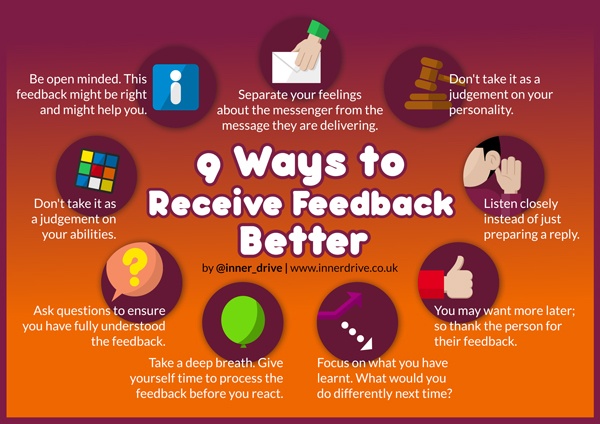
Be Open Minded – The feedback you are being given might be right and might help you. Countless learning opportunities are lost by people entering the situation with a very fixed and closed mind. Being open to possibilities and difference of opinions is a good launch pad for learning.

Distinguish Between The Message and The Messenger – It is important to separate your feelings about who is giving you the feedback from the message that they are actually delivering. Just because you like someone doesn’t mean their feedback is helpful. Likewise, just because you dislike them doesn’t mean the feedback is redundant. Focus on the point, not the person.

It is Not a Judgement – The feedback you are being given is not a judgement on your personality or on your future ability. See it for what it is, which is advice on how to get a bit better. This is one of the cornerstones that growth mindset theory is built on. Once you start to see feedback on a task as a judgement on our self-identity, it can lead to rejecting the feedback and lead to a fear of failure.

Listen Closely – There is a titanic difference between listening intently and being silent whilst preparing a reply. By focusing more on your reply, you are disregarding some of the feedback. If you have asked someone for feedback, and if they have taken the time to offer you advice, you should maximise your time with them by listening carefully.

Check For Understanding – The person giving you the feedback may think they have been very clear on what they have said. You may be pretty sure you have understood them. However, it is easy for misunderstanding and miscommunication to occur. Asking them one or two questions to check for understanding may take 1 minute longer, but can save you much more time in the long run.

Take a Deep Breath – This gives yourself time to process the feedback before reacting. This can really help, especially if things are tense or you feel under pressure. Chances are, your emotional response is unlikely to the best one and you don’t want to make a permanent decision off a temporary feeling.

Focus on What You Have Learnt – Feedback that doesn’t result in anything changing is as effective as not having received any feedback at all. Asking yourself ‘what would I do differently next time?’ is a great way to ensure you have learnt something.

Say Thank You – Even if you don’t agree with the feedback on this occasion, you may want more later. And it’s just good manners.

Filed Under: Professional Development

Go in Reverse When Trying to Break a Losing Streak

July 31, 2017 by

Coach Mike Schauer begins his presentation by starting off explaining the ups and downs of trying to turn a losing program around. Coach explains the first step in addressing the problem is to first evaluate your coaching and approach and evaluate if you can change course and improve. Secondly coach shares his thoughts on the fact the problem isn’t always discipline problems or no athletes. Coach gives a great explanation for when you don’t know how to fix and get your program turned around. Whenever turning a losing program around you must be able to confront existing problems and the possibility when problems can’t be corrected without changing personnel. This is an excellent presentation for coaches looking for possible answers and solutions for turning losing programs around.

This video is provided by Glazier Clinics’ Head Coach Academy

You can also checkout more videos like this one at the Glazier Clinics Online Learning Vault

Please make sure that your sound is on and click on the video to play.

PUT YOUR CURSOR OVER THE LOWER RIGHT CORNER OF THE VIDEO AND CLICK (IMAGE LOOKS LIKE THIS) TO WATCH THE VIDEO ON FULL SCREEN TO BE ABLE SEE LARGER DIAGRAMS AND VIDEOS

Click the play arrow to view the video.

Filed Under: Professional Development

Making a Coaching “Not to Do” List

July 12, 2017 by

By Mandy Green

Mandy is the Head Soccer Coach at The University of South Dakota. She is also an Author, Speaker, Trainer and Consultant. She has posted many useful tools for coaches on her site Busy.Coach

I’m sure you have either had or will have shortly a conversation with your staff about your priorities and what you want to accomplish for the season.  I just did this recently by myself and my list ended up being about 25 things that I wanted to work on.

After jotting down my initial list, I then met with my staff to review the list and we circled the top five that were most important to us for this season. As I expected, we initially struggled to narrow down everything, and it took some time to make a decision on what our top 5 would be.

Finally, when we decided on our top five, we next needed to ask “Now what are we going to do with the other 20 things on our list?”

Hesitantly, my assistants responded: “Well, the top five things are our primary focus. The other 20 things are not as urgent, but we can still plan to work them into our practices.”

Sounds like a reasonable answer right?

What I said next surprised them.

“I believe that is a mistake that we have made in the past. I think that everything we didn’t circle just became our ‘avoid at all cost’ list.”

We all have so many things in our coaching life that we want to do and accomplish. Who wouldn’t want to succeed at 25 different things? I learned the hard way that when we chase after 25 things at once with our team, we run the risk becoming a jack-of-all trades, but a master of none.

Items 6-25 on your list are probably all very important things, and things that could make your team better. But when it comes to Items 1-5, Items 6-25 are a distraction.

As James Clear writes, “Spending time on secondary priorities is the reason you have 20 half-finished projects instead of 5 completed ones.”

In my study of high performers over these last few years, avoiding distractions to focus on what matters has been a HUGE key to their success.

What sets apart high achievers is not the number of ambitious things they plan to get done, it’s the ability to avoid distractions in order to focus on accomplishing the things that matter.

“People think focus means saying yes to the thing you’ve got to focus on. But that’s not what it means at all. It means saying no to the hundred other good ideas that there are. Innovation is saying no to 1,000 things.” — Steve Jobs

Creating a NOT To-Do List
We’ve all familiar with creating a to-do list to increase our productivity and that is the first list I want you to create. The 2nd type of list that will jump start our productivity is the not-do list – things we shouldn’t do. By being conscious of what to avoid, it’ll automatically channels our energy into things that we want to do. Doing both hand in hand will maximize our performance.

HOW TO CREATE YOUR OWN “NOT TO DO” LIST

Put away your phone, your planner, your to do list apps, and your timers. Instead, take out a sheet of paper and go through this exercise which will help you make your own Not To Do List.

The steps are easy:

  1. Write down your top 25 goals for this upcoming season.
  2. Circle your top 5 goals
  3. Avoid working on any goal that is NOT circled at all costs

Once you have your two lists, focus all your efforts on dominating your top 5 goals and ruthlessly eliminate the 20 less important goals.

It couldn’t be simpler than that.

Whether you’re looking to bring about progress into your program or you’re seeking a way to simplify your coaching life. Creating a Not To-Do List will help you focus on the projects that matter.

Seeing through on your do-not-do list ultimately may take sheer force of will. Like everything, you will get better with practice.  Jim Collins writes, “The real question is… do you have the discipline to do the right thing and, equally important, to stop doing the wrong things?”

When you get stuck on your not-to-do list, you waste time and end the day frustrated because you didn’t progress on your important top 5 goals.  Make your list and post it where you can always see it to remind yourself of what you should not be doing.  Enlist the support of co-workers to help keep you on track.  If you find yourself doing something on your do-not-do list, get up, walk around, refocus, and then get back after your important to-do list items.  Good luck!

I’d love to hear what makes your list!  Please email me your list at [email protected]

Filed Under: Professional Development

  • « Previous Page
  • 1
  • …
  • 8
  • 9
  • 10
  • 11
  • 12
  • …
  • 24
  • Next Page »

© Copyright 2026 Athletic Performance Toolbox

Design by BuzzworthyBasketballMarketing.com

Privacy Policy