Athletic Directors Toolbox

  • Home
  • Leadership
  • Mental Toughness
    • Mental Skills
  • Motivation
  • Professional Development
  • Program Building
  • Sports Performance
  • Team Building

Developing Your Leadership Program

July 12, 2017 by

The information presented here was provided to me by another coach and I know how important it is to develop our young athletes into leaders not only for the present but also for the future wanted to share this with you because it says so much that can help assist in developing a leadership academy in anyone’s athletic program.

Editor’s Note from Brian: The purpose of this post is not to say that you should copy this program as is.  It has some aspects that are sport specific, but I feel there are many ideas that can be applied to any sport. You should take the ideas that you like and adapt them to fit what you think is best.  It also can be scheduled when you are able to do it.  The post is to give you ideas, not necessarily a blueprint.

Leadership Academy Purpose:

1. Raise awareness of the importance of quality leadership
2. Increase Leadership skills of athletes
3. Share the leadership workload
4. Develop the character of athletes

Value

Coaches often pin success on superb leadership; therefore, teams should not wait for leadership to cycle in on it’s own. Instead, like developing technique, strength, or speed, coaches should implement a plan for teaching and developing leadership skills in their players. Since captains and leaders spend much more time interacting with teammates than coaches, they can significantly impact the performance of a team. Thus, strong leadership will increase team production. Moreover, many competitions will create stressful situations for athletes. Building emotional and mental resiliency in athletes will help them to perform at their best despite high pressure situations. Finally, developing character and leadership in the school and in the community will improve the quality of life for all. Students, recognizing the virtue of high character, will be more apt to make ethical choices. Teachers will be better able to focus on teaching rather than behavior management, and coaches can worry less about losing players for conduct violations.

Meeting Schedules

The Leadership Academy will meet every two weeks for dinner, from 6:00pm to 7:30pm, at various players and coaches’ houses. The meeting day will vary in order to work around basketball, hokcey and track practices / competitions. Meetings will begin the second week of January and last until the last week in May. At these meetings, participants will discuss readings from Jeff Janssen’s Team Captain’s Leadership Manual, and also identify leadership and character weaknesses that the team should improve. From May to August, the Leadership group will meet once a month to discuss team issues or progress toward goals. During the season, they will meet once a week to discuss team moral, personnel issues, and logistical matters.

Curriculum

Week 1
The group will explore the concepts of leadership. By defining leadership, discussing the risks and
rewards of leadership positions, and reflecting on effective and ineffective leaders in the past, the group will establish a context from which to build new skills. In addition, players will self-evaluate their leadership as indicated by their commitment, confidence, composure, and character, as well as their ability to function as a servant, confidence builder, refocuser, team-builder and enforcer.

Week 2
The group will examine ways to motivate themselves. Participants will evaluate their own commitment level based on Janssen’s “Commitment Continuum” (Janssen, 29), as well as asses every team mate’s commitment level. The group will discuss why they placed each player at that place on the continuum and brainstorm ways to motivate players at the “resistant-reluctant-existent” (Janssen, 29) level.

Week 3
The group will explore the concept of confidence. Participants will look at confidence’s relationship with sense of self and the want to perform under pressure. We will discuss the four sources of confidence: preparation, strengths, past success, and praise, and also discuss ways to be resilient to events that threaten confidence.

Week 4
The group will learn to how maintain composure in pressure situations. Using a “traffic light analogy” (Janssen, 52), players will learn to recognize emotional states. In addition, we will discuss refocusing strategies like slowing the pace of play, controlling the controllable, and focusing on the present, the positive, and the process.

Week 5
The group will explore the concept of character. By discussing the importance of exhibiting character in the sport, in the classroom, in social life, and in the community, participants will raise their awareness of how their character establishes their credibility as leaders.

Week 6
The group will examine ways to function as servant leaders. In order to prevent leaders from becoming overbearing, we will discuss how helping younger players, preventing hazing, and completing day to day work creates a healthier team dynamic.

Week 7
The group will explore ways in which they can build the confidence of their team mates. Each squad leader will complete a “mental game assessment” (Janssen, 91) form on the players in their squad. As a group, we will discuss strategies for increasing the confidence and mental resilience of players. For example, leaders can let them know what to expect, remind them of their strengths, remind them of past successes, establish perspective, and encourage their teammates (Janssen, 93-94).

Week 8
The group will learn ways to refocus their teammates when faces with adversity. In essence, we will revisit the concepts from week 4, and discuss ways to teach others how to refocus.

Week 9
This week will focus in strategies for team building. We will revisit the team’s vision and mission statement, “clarify the commitments and standards” (Janssen, 112) necessary to achieve this vision, and discuss ways to help teammates accept their roles. In addition, we will brainstorm and create a teambuilding calendar to schedule events like an intersquad basketball tournament, a softball game, whitewater rafting trips, and team BBQ’s.

Week 10
This week will cover strategies for serving as the enforcer. We will address the reality that conflict is inevitable and that leaders must be prepared to handle it effectively. We will discuss approaches like encouraging first, then reminding and refocusing, then drawing the line, and, finally, involving the coach (Jansses, 126-127).

Squads

Purpose for squads:
1. Shared leadership amongst several instead of few. Share the load.
2. Provide more efficient methods of communication
3. Build stronger team relationships
4. Create healthy competition
5. Establish accountability for each other

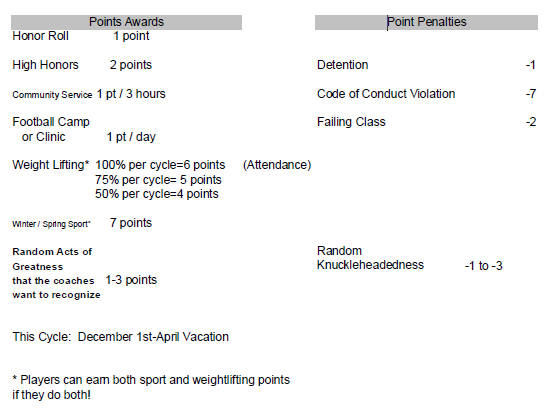
Ways to earn points:
1. Successfully completing task (earning passing grades on quizzes, selling gold-cards, achieving set and measurable goals)
2. Winning competitions (Relay race, newspaper article, etc)
3. Citizenship (Community service…approved by one of the coaches)
4. Work ethic (Strength gain, measurable speed increase)

Ways to lose points: (and $1’s!)
1. Not completing required tasks (Team assignments, locker room cleanup) -1
2. Tardy -1
3. Unexcused absence -2
4. Violation of code of conduct -10

At the end of the season, the winning squad will finance a meal of their choice. The last place team will serve it to them!!
About the Author of this post:

Jerry Campbell has over 30 years of high school and college coaching experience. He has experience as a head coach, offensive coordinator, and various position coaches. He has written numerous football coaching articles in various publications, is the author of over 30 books on coaching football, and has produced 12 coaching video series. Additionally, he is a nationally sought after speaker on the coaching clinic circuit.

Filed Under: Leadership

Leadership Strategy For Your Team

July 9, 2017 by

This article and other helpful coaching tools can be found at Coach Dawn Writes

By Dawn Redd-Kelly, Head Volleyball Coach at Beloit College.

One of the coaches I work with always says that we’re the CEO’s of our sport…we’re running the show.  So when I ran across this article (Why Every Company Needs a Leadership Strategy), it made me think about all of us head coaches who work so hard to create a winning culture, environment, and winning expectations.

We know we need leaders.  We know we should train them, but how?  Beyond that, do our athletes know our coaching priorities?  What will consider to be “success” at the end of the season?  Is it only winning?  Does winning without honor count?  Do they know why they’re on your team instead of at another school?  If not, we’ve got to create an information/training strategy that ensures that the same information is passed down year after year, team after team.

How about amongst your staff?  Is everyone on the same page as far as what you’re looking for?  Not just positions, but what about personalities?  Do you need more gritty players?  Or maybe enthusiastic players?  How will you tailor your recruiting schpiel to increase the odds of filling your team needs…both tangible and intangible?

There are three requirements for an executable leadership strategy with our teams:

  1. A leadership selection system, to ensure the team gets the leaders it really needs.  How do you pick your captains?  Does the team vote?  Do the coaches decide?  Does the team understand the requirements of being a team captain?  Are they able to opt out?
  2. Leadership development efforts that support leaders so they can adapt to the team’s needs.  Once you’ve got team captains, what training is involved?  How often do they meet with the coaching staff?  Are they given decision-making authority? (It could be something as small as deciding where to eat after the game.)
  3. A succession management process that identifies, accelerates, and supports the identification and accelerated growth of the next generation of leaders. That’s super business-y sounding, but it’s true.  We’ve got to identify future captains and groom them so they’re ready once they’re elected.  What would that process look like? Would it entail formal or informal training?

Personally, I need to think a bit more critically about how me pick, educate, and cultivate leaders on our team.  For many reasons: to make sure we’re being fair, to make sure the staff isn’t blinded by personal bias (sometimes you just love a player, but they’re not ready to be a captain), and to make sure the team buys in to their captains.

I’ll be back next time to discuss a communication strategy from this same article that will help us make sure the entire team is on the same page.


Filed Under: Leadership

Characteristics of Highly Successful Coaches

June 20, 2017 by

John McCarthy
Author / Speaker
Former College Head Coach, Former College Athletic Director, and NAIA administrator

This presentation provides excellent insight on the characteristics of successful coaches from around the country. This presentation provides motivation and insight for what successful coaches have in common with each other. John McCarthy also shares his thoughts and insight on the inter-self and the reasons we coach and the why’s for integrating life experiences in coaching. John McCarty also shares how values become an integral part in a coaches Character and how our athletes gauge what our character is really like to them. Mr. McCarthy also gives a detailed and defined meaning of success which he measures by the content of our character, leadership and contribution to the betterment of our families, communities, and the world. This is an excellent presentation on the insight for developing character and leadership both for coaches and athletes.

This video is provided by Head Coach Academy Clinics.

You can also checkout more videos like this one at the Glazier Clinics Online Learning Vault

Please make sure that your sound is on and click on the video to play.

PUT YOUR CURSOR OVER THE LOWER RIGHT CORNER OF THE VIDEO AND CLICK (IMAGE LOOKS LIKE THIS) TO WATCH THE VIDEO ON FULL SCREEN TO BE ABLE SEE LARGER DIAGRAMS AND VIDEOS
Click the play arrow to view the video.

Filed Under: Leadership

Does Your Team Have Grit?

June 11, 2017 by

This article can be found at the Coaches Toolbox, a great resource for coaches of all sports

Living with a 99% Effort

I got this list from entrepreneur and business author Harvey Mackay’s book “Dig Your Well Before You’re Thirsty.” (If you click on the name of the book, you can see a portion of the book from Amazon) In the book, he gives credit to Armond Bouchie for using this list in his job application portfolio.

If we had to live with 99% effort, we would have:


One hour of unsafe drinking water every month,

Two unsafe plane landings per day at Chicago’s O’Hare Airport,

16,000 pieces of lost mail every hour,

22 checks deducted from the wrong bank account every week,

500 incorrect surgical operations every week,

12 babies given to the wrong parents every day,

20,000 incorrect drug prescriptions each year, and

800,000 credit cards with incorrect information.

A 100% effort makes sense.


This next portion of the post contains some of my takeaways from Texas A&M Women’s Assistant Bob Starkey’s Coaching Blog Hoop Thoughts Blog

HOW DO YOU MEASURE ON THE “GRIT” SCALE?

Mitch Cole

Some educational researchers have defined GRIT as “passion and perseverance to achieve long term goals”. When struggles come, do you get more DEJECTED or more DETERMINED?

Studies have shown that the attribute of GRIT, is one of the most powerful indicators of success. The most GRITTY people usually succeed on and off the playing field or court.

Teams can become selfish during good times and turn on each other during tough times. Teams that stay together can resist the temptation to be selfish, can withstand tough times, and even conquer insurmountable odds.

Most people can appreciate a team or athletes that refuse to give up no matter what the circumstance. Resilience is the ability to bounce back from difficulty and in some cases, be better than before. This can happen when the other team goes on a run and things look most bleak, or even within a season. Teams that “Fight” and show tremendous Resilience over and over again have the best chance for sustained success.

When winners get knocked down, they get up, champions get up a little faster.

“Being relentless means constantly working for that result, not just when drama is on the line. Clutch is about the last minute. Relentless is about every minute.” -Tim Grover From “Relentless: From Good to Great to Unstoppable”

U of Penn Duckworth Lab study found that “grit” (passion & perseverance for long-term goals) is best predictor of success. “Grit is unrelated w/ talent.”

The Duckworth Lab focuses on two traits that predict success in life: grit and self-control. Grit is the tendency to sustain interest in and effort toward very long-term goals. Self-control is the voluntary regulation of behavioral, emotional, and attentional impulses in the presence of momentarily gratifying temptations or diversions. On average, individuals who are gritty are more self-controlled, but the correlation between these two traits is not perfect: some individuals are paragons of grit but not self-control, and some exceptionally well-regulated individuals are not especially gritty. While we haven’t fully worked out how these two traits are related, it seems that an important distinction has to do with timescale: As Galton suggested, the inclination to pursue especially challenging aims over months, years, and even decades is distinct from the capacity to resist “the hourly temptations,” pursuits which bring momentary pleasure but are immediately regretted.

In terms of Big Five personality, grit and self-control both load on the conscientiousness factor, which also encompasses dependability, punctuality, and orderliness, among other facets.

Some educators typically prefer the umbrella term “social and emotional learning,” whereas many other educators, as well as philosophers and positive psychologists, embrace the moral connotations of “character” and “virtue.” So, grit and self-control are facets of Big Five conscientiousness, but are also conceptualized as dimensions of human character, social and emotional competency, and non-cognitive human capital.

That Extra Effort

For another angle on the importance of a 100% effort, click on the image below for a very inspirational video:

think you are really going to like this video that shows us that there is not a lot of physical difference between top performers and also rans. The big difference is in their mental strength and persistence! Click on the icon to see the video. You will need scroll to the bottom of the page after you click.

Filed Under: Leadership, Professional Development

A Leader in Every Locker

May 8, 2017 by

The End of Yesterday
By Dr. Cory Dobbs
The Academy for Sport Leadership

Excerpt from A Leader in Every Locker

“I’m not used to supposing. I’m just a working man. My boss does the supposing . . .”

This quote is a line from the classic movie 12 Angry Men. During the opening dialogue among jury members, each feeling out their place and role in the deliberation of the fate of a young man’s life, a blue‐collar working man makes this declaration of powerlessness. The implication is that all the power—at least that of “supposing” rests in the hands of his superior. Just a movie? Hardly.

It’s been the rule for over a century in team sports to install a hierarchical leadership structure. This is accomplished by appointing a couple of players as team captains (as well as modeled by the hierarchy of the coaching staff). Surely everybody knows that on any sports team only a few players are able to really perform peer leadership. This is the team captain axiom, the basic axiom of traditional team leadership.

An axiom, of course, is a truth so self‐evident it doesn’t need to be proved. After all, everybody knows an axiom is accurate and correct. So then, it’s indisputable that you need a pecking order in order to get things done.

Not too fast, things are not what they always seem to be on the surface. The bad news is that far too often our intuitive ways of thinking about the world are wrong. Yes, axioms can be wrong. The good news is that it’s possible to set them right.

What’s self‐evident, what’s obvious, what everybody knows, has deep roots and of course isn’t in need of change. Yet, paradoxically that which is self‐evident hides something–covers over what might be a deeper truth. Axioms, by their nature, are anti‐learning. Nobody ever questions an axiom. Nobody ever discusses an axiom (save for a few propeller heads). It’s just taken as a given. And nobody ever talks about the possible counterproductive consequences of what everybody knows. The fish, after all, never questions the water he lives in.

Then, all of a sudden, someone comes along with a breakthrough idea and turns the old axiom upside down. The taken‐for‐granted truth, it turns out, wasn’t really the truth after all. “The world is flat,” was the truth people lived by for thousands of years. Then, along comes Nicolas Copernicus who proves to the world the old axiom to be wrong.

Twenty years ago, to choose a different model of team leadership was unthinkable. In elaborating on the end of two decades as a premier athlete Kobe Bryant had much to say when asked the question, if he could go back in time and offer advice to himself as a rookie, what would he say? His response: “It’s hard to tell somebody ‐‐ a player at that age ‐‐ to understand compassion and empathy, but that would be my advice.”

Why of all things would Bryant endorse caring, compassion, and empathy? “Well,” Bryant continued, “because that’s the biggest thing about being a leader, I think, and winning a championship is understanding how to put yourself in other people’s shoes.” “That’s really the most important thing. It’s not necessarily the individual skill you possess. It’s about understanding others and what they may be going through. And then, in turn, when you understand that, you can communicate with them a little bit better and bring out the best in them. Bringing out the best in people isn’t passing them the ball and giving them open shots. It’s about how to connect with them, how to communicate with them so that they can navigate through whatever issues they may be facing. That’s a very, very hard thing to do.”

I’ve never been a fan of Kobe Bryant, and I seldom look to professional sports for deep insights and understanding on leadership, but it appears that the wisdom in Bryant’s words fit hand‐inglove with today’s call for a more heartfelt approach to coaching and leading. So what’s the way forward in this brave new world?

Don’t worry. While you’ve been trapped in the axiom of team captaincy, I’ve been turning over rocks to find a better way of designing a high‐performing team, its culture, and of course, leadership. I’m not done yet. It might be another decade or so before I’m finished. But this workshop workbook is a start.

So, What is Leadership?

There has been a long running debate in scholarly circles about whether people learn to lead from their experiences or if leadership is something a person is born with. Today, however, most academics agree that leadership is best considered as a set of skills and qualities that can be learned and developed along within a wide‐range of personal styles. It’s widely agreed that all people have the potential to develop leadership skills. I point this out because it is also clear that leadership is viewed and valued differently by various fields, disciplines, and cultures.

So then, what is leadership? This is the big question that every person, group, team, organization, community and society seeks to answer. Our American culture, which of course includes a heavy dose of sporting influence, exalts the lone ranger, the hero, the charismatic leader. We see this in the election and glorifying of politicians, the deifying of business tycoons, and the adoration and idolization of great coaches and athletes. This notion falls in line with the traditional ideas of leadership—that it is the make‐ up of the leader that makes all the difference. Individual determinism has been and will continue to be an easy and favored explanation of things. But traits such as self‐confidence, intelligence, and a can‐do attitude—favored qualities of a leader—do not always predict the effectiveness of a leader; rather, they can be very misleading.

However permeable the traditional mental model of leadership seems, it does not provide a path to sustainable effectiveness as it leaves out the detail and nuance of the context in which a leader takes action. It also ignores the fact that it tends to reduce followers to passive participants; resulting in deliberate apathy and often conscious withdrawal from the leadership provided by one’s peer. Careful examination of this aspect of team captaincy suggests it may promote the discounting or dismissing of the potential of all members of the team to learn and perform in a leadership role.

Both the context and followers are foundational to leadership and are central to The Academy for Sport Leadership’s search for a new conceptualization of team leadership. The leader in every locker approach to team leadership is, no doubt, a paradigm shift. Paradigms, as you know, are the common patterns and ways of looking at things in order to make sense out of them. Leadership has long been presented as an elusive phenomenon available to only a select few. It is my contention, however, that understanding the relational nature of leadership and followership opens a team up to an immensely practical and dramatically richer form of team
member involvement.

The basic foundation of any leadership process is relational. As leadership expert Margaret Wheatley notes, “None of us exists independent of our relationships with others.” At the core, it is a relationship which comes into existence because of some sense of commitment by people to a common purpose. Thus, the ASL framework for answering the question “What is leadership?” begins by grounding it in the following core assumptions:

1. Conventional views of leadership are changing. Leadership is not limited to a chosen few; it is an educational component of participation in student‐athletics and must contribute to the growth and development of all athletes. A leader in every locker embraces the potential of all student‐athletes to take on leadership roles now and in the future.

2. Leadership is a relational process. That is, leadership is a socially constructed phenomenon consisting of student‐athletes working together to accomplish something.

3. Team leadership is distributed. Leadership is not the sole responsibility of the coach, coaching staff, or selected team captains. The best team leadership results from the actions and activities of those best positioned to provide leadership contingent on the context.

4. Leadership is a process to create change. Leadership is about making things happen; transforming people and programs. Effective leadership accelerates change. Change is necessary for growth, development, and improvement in performance.

5. Leadership growth and development is personal. There is no time frame related to progressing through stages of development. It’s also recognized that all potential leaders begin at a different starting point. Leaders grow and develop through deliberate practice, informal practice, roles, reflection, and the observation of role models.

6. Leadership is a process that involves followership. All coaches and student‐athletes participating in a leader in every locker understand and embrace both roles—leading and following. Followership implies a relationship to the leader, but does not imply one that places the follower in a less important position.

7. Leadership develops over time. There is no one way to lead. The practice of leadership involves the continual practice of finding the best way to lead with the particular capabilities that the student‐athlete possesses at a specific time, while constantly working to improve and expand those capabilities.


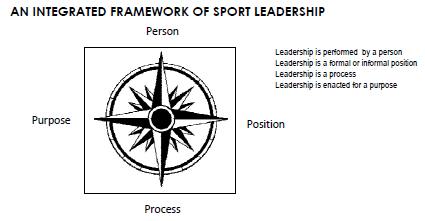
Embedded in the seven assumptions above are the four P’s of team leadership. The framework highlights the integration of the four key domains of leadership. The framework answers the question What is Leadership? Leadership is a position, it is a process, and it is performed by a person for a purpose.

Too often leadership is narrowly defined exclusively as a person. Conceptually this leads us back to a focus on the leader, her traits and disposition. But leadership is more than the idiosyncratic actions taken by a chosen person. It is a process. A process is simply a
coordinated way of doing things. Can student‐athletes, including those that don’t possess the so‐called necessary traits, learn a process for doing leadership things? Of course they can.

Leadership is also a position. In The Academy for Sport Leadership’s way of doing things we suggest giving each student‐athlete a “role” to on‐board them into the leadership team building development process. You’ll see this later when I introduce you to my 8 Roles of Teamwork. A leader’s words and deeds provide purpose, a compelling vision of the future. Effective team leadership answers, for all team members, the questions, “why am I doing this?”

The four P’s, like the compass that they form, are only a tool for answering the question “What is leadership.” Each student‐athlete (and coach too) brings his or her own unique values, skills, experiences, and personality to the leader role; and each student‐athlete has his or her own personal way of making change happen. The compass is a simple model that represents the key domains of an effective leadership development program.

To find out more about and order Sport Leadership Books authored by Dr. Dobbs including Coaching for Leadership, click this link: The Academy for Sport Leadership Books

If you would like to learn more about the book that this excerpt came from click: A Leader in Every Locker

Filed Under: Leadership

  • « Previous Page
  • 1
  • …
  • 9
  • 10
  • 11
  • 12
  • 13
  • …
  • 22
  • Next Page »

© Copyright 2026 Athletic Performance Toolbox

Design by BuzzworthyBasketballMarketing.com

Privacy Policy