Athletic Directors Toolbox

  • Home
  • Leadership
  • Mental Toughness
    • Mental Skills
  • Motivation
  • Professional Development
  • Program Building
  • Sports Performance
  • Team Building

Mental Toughness and Clutch Performance

August 19, 2016 by

These thoughts on clutch performance are from Spencer Wood Icebox Athlete Sports Performance Resources. Click that link to see his Mental Toughness Edge website. There are some articles on mental training and other resources as well.

According to a study based on professional athletes in the NBA, NFL, and NHL, the following eight traits were found to constitute the ultimate athlete:

  1. Ability to work hard and sustain intensity.
  2. Competitiveness.
  3. Athletic ability.
  4. Sacrifice for the team.
  5. Coping with criticism, failure, and success.
  6. Clutch performance, poise, and focus.
  7. Ability to execute game strategy.
  8. Passion for the sport and commitment to excellence.

Five of the above traits are mainly mental attributes.

There isn’t a coach in America who would say that mental skills and toughness isn’t critical to clutch performance. But how many coaches devote fifty percent of their time developing mental skills?

Misconception that mental skill and toughness only need to be worked on if there’s something wrong.

We must give our athletes an actual skill set to work on. A crisp definition of what is expected.

Mental Toughness = The Four C’s:

  1. Composure.
  2. Concentration.
  3. Confidence.
  4. Commitment.

What happens to the brain under stress?

Perceived threat leads to a fight or flight reaction.

  1. It’s important for our athletes to realize that this process is common.
  2. Not too many athletes are going to acknowledge they’re nervous.
  3. Take time to talk with your athletes about what happens to your mind and body in clutch situations.

Four things occur in clutch situations:

  1. Heart rate changes.
  2. Breathing pattern changes.
  3. Digestive system breaks down – blood from digestive system is rerouted to the prime movers of the body in preparation for fight or flight.
  4. Muscular tension – effects fine motor skills (e.g. shooting).

How does this effect performance?

  1. 8% differential between practice free-throw percentage and game free-throw percentage in NCAA.
  2. 13.6% difference in free-throw percentage between regular season and playoff NBA games.

Fight or flight is not all bad.

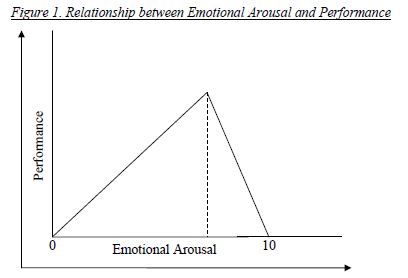
  1. There is a direct relationship between emotional arousal and performance.

Emotion Arousal (EA):

  1. Coming out of the locker room before a game, or coming out of a key timeout in a clutch situation, an athlete’s emotional arousal level increases.
  2. As emotional arousal increases, performance potential increases. However at a certain level, emotional arousal reaches a level where performance potential is maxed (as identified by the dotted line in figure 1).
  3. Once this level of optimum emotional arousal is passed, performance potential tanks.
basketball practice

  1. Different players may perform best at different levels of emotional arousal.
  2. Some young coaches pride themselves on their ability to jack up their team without knowing that two of their studs may play better at a level two or three of emotional arousal.
  3. Ray Allen for example seems to perform best at a very low emotional arousal level. You could have a player with an emotional arousal level of three who looks like they don’t even care.
  4. There is nothing on Earth that you should let take you out of your optimal arousal zone.

Determining a player’s optimal EA level:

  1. It is critical to ask the athlete what EA level they think they perform best at.
  2. Ask your athletes to think back to the three or four best games of their career, and there will be some continuity to the level of arousal they were at during those performances.
  3. Also challenge your players in practice. Manipulate their arousal levels and see at what level they perform the best.
  4. Don’t confuse arousal level and intensity. Intensity must always remain high for optimal performance.

Maintaining optimal emotional arousal

  1. There is a big difference between finding a players emotional arousal level and maintaining that level.
  2. Once an athlete has identified their level, teammates and coaches can help the player reach that level before a game
  3. It is up to the athlete to not let anything take them out of their optimal emotional arousal zone.

Mistake Management:

  1. You can tell a lot about a players emotional arousal level by how they react to mistakes.
  2. Train your athletes on how to react to mistakes.
  3. Great athletes aren’t great because they are perfect. They are great because they have the perfect reaction to their mistakes.
  4. Screaming after a miss is the ego saying I usually make that. However it reveals a level of frustration to our opponents.
  5. The external reaction of screaming is nothing compared to what is going on under the surface.

Take out the trash:

  1. With every single mistake made on the court, take out the trash.
  2. Remove the mistake from the mind of the athlete.
  3. There has to be a cognitive process to remove the mistake from the mind. Otherwise it remains with players, erodes confidence and kills clutch consistency.

Two step process:

  1. Take out the trash (erase the mistake from the mind like burning a photograph).
  2. Visualize the correct image.

When you see an image in your mind, whether it is real or imagined, you have a greater chance of reciprocating that image.
Three rules for using imagery before a game to improve a young person’s skill level:

  1. A goal has to be set.
  2. Visualize from an inside out view.
  3. Activate all five senses in the visualization (smell the popcorn vendors, hear the sound of sneakers squeaking on the floor, see the colors of the jerseys).

There is a huge difference between an outside-in view and inside-out view

  1. Outside-in view is like visualizing the action as if you were watching from the stands.
  2. Inside-out view is as if you are the one performing in the competition.

Self Vocalization:

  1. Positive self speak.
  2. We need to put the right words and images together.
  3. There are words that we can use that will help us perform at our best.

If we took a mediocre NCAA basketball player, and one of the greatest players in NCAA history and a mediocre player, and compared their self speak, would there be much of a difference? Yes the difference would be immediately apparent.

The inner voice of the mediocre athlete is like this:

  1. “Oh no this is a big one,” “don’t screw up now,” “don’t you choke,” and “I can’t miss this one, my contract is on the line here.”

The elite athlete’s self speak is like:

  1. “Oh yeah, I’m at my best when it counts the most,” “I’m one of the best players in the league,” and “I am so consistent in the clutch.”

If you could take down everything Michael Jordan said to himself during a game it would be owe inspiring.

There is a process to marry the right words and the right images to enhance clutch performance.

1. Set the goals.
2. Keep the statement positive and realistic:

    1. “I never miss in the clutch” – negative and unrealistic.
    2. “I always make free-throws in the clutch” – positive but unrealistic.
    3. “I am so consistent in the clutch” – positive and realistic.

Law of Dominant Thought:

  1. Mind doesn’t always distinguish between do and don’t do.
  2. Important to keep this in mind when we’re coming up with these key sentences for our internal script.
  3. “I never a miss a free-throw in the clutch” vs. “I always make my clutch free-throws. The first is negative, the second is positive.
  4. It may seem complicated to come up with the right words and the right sentences, but once an athlete devises a script, and practices it, it will be with him forever.

Channel Selection for Focus:

  1. There are seven different things that we can focus on.
  2. The first five are our senses (hearing, vision, touch, taste, smell).
  3. The 6th channel is our imagination – our ability to see images from the past and the future.
  4. The 7th channel is our inner voice.
  5. You can only effectively focus on one channel at one point in time.
  6. Our mind oscillates between these channels.
  7. If we just focus on one channel that sense is heightened.
  8. Most sports success is played in the visual channel.
  9. 90% of success played in the visual channel.

With a mediocre player, focus switches between channels more often in clutch situations than an elite level performer.

In timeouts get the players to switch to their audio channel.

Is it alright during a timeout to say: “If we make the free-throw we’re in this, if we miss the free-throw we’re in that?”

  1. Absolutely, you have to scenario plan, players need to have instruction. However understand the difference between giving these instructions during the timeout, and a player focusing on the worse case scenario while attempting clutch free-throws.

Have you ever seen a player use negativity to fuel a better performance?

  1. Negative motivation can have just as much positive effect on performance on gross motor skill output as positive motion.
  2. However for fine motor skill coordination there is a huge disparity between positive motivation and negative motivation.
  1. Choking has nothing to do with the outcome.
  2. If you lose one or more of the 4 C’s of performance you have choked.
  3. It’s not possible to determine if someone has choked without knowing what went on in their mind. It could be a physical breakdown.

Clutch attitude – Fear of failure / choking vs. focus on important cues:

  1. Focusing on outcome brings you that much closer to losing,
  2. Focusing on the variables responsible for success (The 4 C’s) will bring you that much closer to winning.
  3. Define what choking is and what it is not with your athletes.
  4. Focus should be on the present and not the future (ramifications of winning / losing).
  5. Build a team culture of “STEPPING UP.”

Educating your athlete on what choking is puts them in a different mindset when it comes to taking that final shot.

The question now is not whether I’m the G.O.A.T. or not if I miss this, the whole focus is on maintaining the 4 C’s which will in turn increase the probability of success.

Filed Under: Mental Skills

Mental Game

July 11, 2016 by

This article was provided by the Coaches Network

By Kevin Bryant

I have attended the Oregon Athletic Directors Association annual conference every year since 1999. This past spring, there was a first: A break-out session led by a sports psychologist. At these outstanding annual meetings, we’ve learned lessons on a broad spectrum of topics, but never before had attendees been introduced to mental skills training.

Implementing sports psychology into high school sports has been slow for several reasons. First, mental training can seem like a “mystical” area, so we do not have much confidence in it. Second, many coaches feel that spending practice time on techniques and tactics offers greater payoff.

But I believe the time has come to invest in mental skills training (MST) at the high school level.

Consider this quote by inventor Charles Kettering: “There exist limitless opportunities in every industry. Where there is an open mind, there will always be a frontier.” Sport psychology is a frontier that can provide limitless opportunity in our “industry” for life-long impact and influence. It is a program for those of us looking to establish a lasting legacy and to invest our best in the lives of coaches and student-athletes.

WHAT IT OFFERS

The overarching goal of a basic MST program is to help athletes become self-directed in their approach to sport and life, which leads them to be their best competitive and academic selves. Many coaches work hard to motivate their players each and every day. With MST, athletes learn how to motivate themselves, based on their unique personalities and goals. This will impact both individual and team performance.

Author and veteran tennis coach Ronald Woods sums up the objective nicely: “Place the responsibility directly on the players so that they realize that they can control their own destiny and future development,” he wrote in “The Mental Side of High School Tennis,” an article published in the Journal of Physical Education, Recreation, and Dance.

The empowerment Woods speaks of easily carries over to academic goals, making for stronger student-athletes overall. “When athletic programs offer both physical and mental skills training, they provide a better argument that participation in competitive sport can also be a valuable educational experience,” wrote Weinberg and Williams in Applied Sports Psychology. Students can use the mental techniques they learn in class, at work, or in negotiating their next steps in life, and these skills will last long after their competitive sports careers are over.

For the here and now, MST leads to effective goal-setting, better focus on the task at hand, and an ability to adjust to adverse situations. This can be just what a teenager needs, as they struggle with uncertainty, immaturity, and a lack of self-confidence during the often difficult high school years.

But of course, the benefits do not manifest overnight. Coaches must spend time teaching mental skills just as they do physical ones. The most effective plan for implementation includes four stages: education, acquisition of skills, implementation, and evaluation.

EDUCATION FIRST

The best way to integrate MST into a high school athletic department is to start with the coaches. Ideally, an athletic director can conduct a training session in the late spring so that each coach has the summer to put a program in place for his or her specific teams in the upcoming year.

From there coaches can introduce MST to student-athletes. Initial steps should include sending a letter home to parents that describes the training and holding a few sessions with student-athletes. Depending on the school culture, a meeting with parents might also be a good idea.

At the first meeting with athletes, coaches should educate by outlining the four key mental skills. They include the following:

Goal setting provides direction, increases motivation, directs attention, and raises self-confidence. Athletes can be taught about the different types of goals—season-long vs. weekly, individual vs. team, practice vs. competitive, process vs. outcome.

Imagery helps athletes create a blueprint for performing a skill. This may include body position, sequencing, timing, and specific movements. Incorporating as many senses as possible makes it easier to create a more vivid image.

Energy management allows athletes to perform at their best emotionally. They learn to manage emotions during competition and gain a sense of control over a situation. This can ensure that energy is directed toward becoming focused and not wasted on corralling one’s feelings. It can also lessen anxiety and apprehension and boost positive expectations.

An interesting aspect of energy management is learning to suppress the judgmental impulse. We spend a lot of effort on evaluating ourselves and our surroundings. During competition, this can be counter-productive, taking an athlete’s focus away from the task at hand.

Self-talk assists athletes in reaching their ideal mental state. It entails finding cue words to help players focus and keep a positive outlook. We all have to deal with “the critic” in our heads, and self-talk gives us responses to the negative statements we have about ourselves.

Another aspect of the education phase is to administer an initial assessment of the student-athletes’ mental skills through the Athletic Coping Skills Inventory (ACSI). Its questions delve into the following areas:

• Coping with adversity

• Coachability

• Concentration

• Confidence and achievement motivation

• Goal setting and mental preparation

• Peaking under pressure

• Freedom from worry.

Each athlete’s test results provide baseline data on his or her mental skills. By answering the assessment’s questions and then self-scoring, the athletes gain an understanding of their weaknesses in mental skills and why such skills are necessary. (See “Resources” on page 49.)

CLASSROOM PRACTICE

The next part of the program is the acquisition phase—team sessions revolving around the development of the four key skills. I suggest conducting four 30-minute meetings, with each focusing on one skill. The best way to teach these techniques is to keep things simple and use examples that your student-athletes will understand.

Consider starting with something to catch their attention. For instance, to introduce the session on energy management to a tennis team, a coach could show a short clip of the final few points of the 2010 Wimbledon match between John Isner and Nicholas Mahut, which lasted 11 hours and 5 minutes over three days (the final score was 6-4, 3-6, 6-7(7-9), 7-6(7-3), 70-68 for a total of 183 games). After viewing this video, ask the athletes, “So why might energy management be important in tennis?”

From there, coaches can lead athletes through a discussion on the emotions they feel when they find themselves at certain junctures in a match. For example, have the players think about what they feel when they are up 5-2 in the third set. Then have them think about being down 2-5 in the third set. Prompts can include:

• What is going through your mind?

• How do you overcome the anxiety that accompanies being down 2-5?

• What strategies focus you on the task at hand and not the score?

• How can you suppress the impulse to be judgmental?

Lesson plans should differ depending on the sport and maturity level of participants. The coach should also gauge how fast or slow to present the information based on the particular make-up of the team. (See “Lesson Plan” on page 46 for a sample.)

MST INTO PLAY

The implementation phase is where the skills learned are put to use. Coaches should prompt athletes to do this with quick reminders before practices and games. But it will ultimately come down to each athlete incorporating the techniques moment to moment.

It can help to take 30 minutes weekly for discussion. This can be scheduled as part of practice or accomplished whenever there are down times such as during bus rides or a weather delay. Having honest discussions as a team about the challenges and successes related to exercising basic mental skills will result in growth, just like discussing proper technique in sports skills enhances physical performance.

The final stage of an MST program is the evaluation phase, in which coaches monitor progress through several avenues. One is by having athletes complete feedback forms after the initial education sessions, at the mid-point of the season, and as the season comes to a close.

A second tool is weekly comment and observation sheets where athletes share how the program is working for them and what specific help they need to become more proficient in the use of mental skills. Keeping a log of thoughts, successes, and failures will allow athletes and coaches to gain awareness and to improve. (See “Resources,” below, for access to a sample player log.)

The goal of this basic MST program is for high school athletes to acquire the mental skills necessary for success in their sport and in life. Further, the program will help our young people become more self-activated, invested in their personal growth, and effective on any field of play.

Kevin Bryant, CMAA, is the founder and owner of HSADHELP.com, a company focused on assisting, encouraging and challenging high school athletic administrators to be their best. He is a former president of the Oregon Athletic Directors Association

Filed Under: Mental Skills

Mental Toughness and Excuses

July 2, 2016 by

Written by Brian Williams

IMO, one of the most important life lessons coaches can teach their athletes is the lesson of refusing to make or accept excuses. I have assembled some quotes in this article that I hope will help as you work with your athletes to eliminate the use of excuses in your program.

Excuses allow us to stay in our comfort zones.  But for growth and improvement to take place, we have to move out of our comfort zones.  By refusing to accept the option of making an excuse, you hold your athletes accountable and force them to move out of their comfort zone to complete the skill, drill, play, workout, or whatever your objective is–and then take responsibility for the results.

If your athletes know that you will not accept excuses, they are more likely to strive to find a way to succeed through perseverance and extended effort rather than giving up on themselves and their teammates too soon by taking the easy way out of looking for an excuse.  Many times, we find success on the other side of simply making one more intelligent effort.

A No Excuse team rule also teaches the lesson of not being afraid to accept failures and defeats and not feeling the need for rationalizing with an excuse.  Setbacks and mistakes are a part of the improvement process, and as such should not be feared, but rather learned from.  No one can learn from mistakes if they offer an excuse because they are attempting to cover up the mistake rather than embracing the opportunity to learn from it and get better.

I hope that you can find a few words in here that you can apply to your program!

Excuses are the nails used to build a house of failure. ~Don Wilder and Bill Rechin

Don’t make excuses – make good. ~Elbert Hubbard

He who excuses himself accuses himself. ~Gabriel Meurier

Several excuses are always less convincing than one. ~Aldous Huxley

Maybe you don’t like your job, maybe you didn’t get enough sleep, well nobody likes their job, nobody got enough sleep. Maybe you just had the worst day of your life, but you know, there’s no escape, there’s no excuse, so just suck up and be nice. ~Ani Difranco

How strange to use “You only live once” as an excuse to throw it away. ~Bill Copeland

Don’t do what you’ll have to find an excuse for. ~Proverb

No one ever excused his way to success. ~Dave Del Dotto

Excuses are the tools with which persons with no purpose in view build for themselves great monuments of nothing. ~Steven Grayhm

And oftentimes excusing of a fault. Doth make the fault the worse by the excuse. ~William Shakespeare

A lie is an excuse guarded. ~Jonathan Swift

Hold yourself responsible for a higher standard than anyone else expects of you. Never excuse yourself. ~Henry Ward Beecher

Whoever wants to be a judge of human nature should study people’s excuses. ~Hebbel

There is no such thing as a list of reasons. There is either one sufficient reason or a list of excuses. ~Robert Brault

We have more ability than will power, and it is often an excuse to ourselves that we imagine that things are impossible. ~François de la Rochefoucauld

Difficulty is the excuse history never accepts. ~Edward R. Murrow

Pessimism is an excuse for not trying and a guarantee to a personal failure. ~Bill Clinton

I attribute my success to this: I never gave or took an excuse. ~Florence Nightingale

We are all manufacturers – some make good, others make trouble, and still others make excuses. ~Author Unknown

One of the most important tasks of a manager is to eliminate his people’s excuses for failure. ~Robert Townsend

Success is a tale of obstacles overcome, and for every obstacle overcome, an excuse not used. ~Robert Brault

An excuse is a skin of a reason stuffed with a lie. ~Billy Sunday

Bad men excuse their faults; good men abandon them. ~Author Unknown

He that is good for making excuses is seldom good for anything else. ~Benjamin Franklin

It is wise to direct your anger towards problems – not people, to focus your energies on answers – not excuses. ~William Arthur Ward

It is better to offer no excuse than a bad one. ~George Washington

We have forty million reasons for failure, but not a single excuse. ~Rudyard Kipling

The person who really wants to do something finds a way; the other person finds an excuse. ~Author Unknown

If you always make excuses to not follow through you deserve the weight of anxiety on your chest. ~Author Unknown

Justifying a fault doubles it. ~French Proverb

A man can fail many times, but he isn’t a failure until he begins to blame somebody else. ~John Burroughs

The best day of your life is the one on which you decide your life is your own. No apologies or excuses. No one to lean on, rely on, or blame. The gift is yours – it is an amazing journey – and you alone are responsible for the quality of it. This is the day your life really begins. ~Bob Moawa

Never ruin an apology with an excuse. ~Kimberly Johnson

Filed Under: Mental Skills

Fear of Failure

June 29, 2016 by

“The Fear of Failure” was originally posted at CoachesNetwork.com and was reposted by permission.  The site has hundreds of articles of interest to coaches and is definitely worth checking out!

By Bill Cole

How does an athlete react when they make a mistake, or when they fail? Do they have a plan for using failure to help them succeed? Top-achieving performers and achievers have developed powerful mental strategies for bouncing back from seeming defeats and to catapult themselves to the next level of success. You can learn those strategies too.

I’ve been helping people turn failure into opportunity for the past 30 years as a mental game peak performance coach. The way lies in having powerful, tested mental game peak performance strategies at your disposal. What your mind believes you will achieve.

Ten Powerful Turn-Failure-Into-Success Strategies

Henry Ford believed that “Failure is only an opportunity to begin again more intelligently.” Woody Allen says, “If you’re not failing, you’re not trying anything.” And Winston Churchill held that “Success is going from failure to failure without loss of enthusiasm.” All these great men know that dealing with failure successfully is part of a winner’s mind set. Here are my top ten mental strategies that winners use to keep them strong and take them towards success.

  1. Winners Realize That Every Human Being Makes Mistakes: Richard Whately said, “He only is exempt from failures who makes no effort.” Even seemingly perfect, famous people make mistakes every day. If they fail, so can we. And we can move on from those errors to reach our potential.
  2. Winners Attempt To Make Fewer Mistakes: “The greatest general is he who makes the fewest mistakes.” Napoleon Bonaparte was right. In sports, the team making the fewest errors usually wins. Most battles are won through error containment. Make your mistakes, but limit when you do them and how often.
  3. Winners Correct Their Mistakes: St. Augustine said “It is human to err, but it is devilish to remain willfully in error.” Confucius said, “A man who has committed a mistake and doesn’t correct it is committing another mistake.” Winners take mistakes as an opportunity to make good, to move on, and to learn from the situation.
  4. Winners Take Responsibility For Their Errors: “Do not blame anyone for your mistakes and failures” Bernard Baruch meant that to grow and change, we must see all of reality and we must deal with that reality. The first step in gaining control over our errors is admitting that they exist.
  5. Winners Don’t Make The Same Mistake Twice: “He that’s cheated twice by the same man is an accomplice with the cheater.” Thomas Fuller said this to encourage us to learn from a mistake, vow to never repeat it, and to move on without reservation or fear of making other mistakes.
  6. Winners Fail Fast And Move On: Business guru Tom Peters says “Only with failure can you verify wrong ways of doing things and discard those practices that hinder success.” Winners cultivate an attitude of “lead, follow or get out of the way”. They are voracious for success, and devour any mistake that can take them closer and faster to that success.
  7. Winners Create A Lifetime Self-Coaching System: Baruch said that “The art of living lies less in eliminating our troubles than in growing with them”. Develop a self-coaching system that helps you see your errors, define them, accept responsibility for them, improve them and to do all that with a positive attitude.
  8. Winners View Failure As Just A Detour, Just a Delay: “I think and think for months, for years. Ninety-nine times the conclusion is false. The hundredth time I am right.” Albert Einstein knew that persistence was key in being “creative”. The answer did not just drop out of the sky. He worked at it. He stayed with it.
  9. Winners Know That Failure Is The Teacher Of Success: John McEnroe says “The important thing is to learn a lesson every time you lose”. McEnroe won more than any other tennis pro of his era, yet even he knows that errors are the sign-posts to success.
  10. Winners Know That Admitting Failure Shows You To Be A Secure Person: Pro golfing legend Lee Travino said, “We all choke, and the man who says he doesn’t choke is lying like hell. We all leak oil.” The person trying to project an image of perfection is setting up a fragile reality, ready to burst at the wrong time. Be secure in your human imperfection. It’s easier than building an image that can’t be maintained.


Filed Under: Mental Skills

Overcoming Slumps

June 28, 2016 by

How to Avoid or Overcome Performance Slumps

Reposted with permission from CoachesNetwork.com

Editor’s Note from Brian:  Even though the examples are from other sports, they are with giving some thought to for your volleyball team.

By Dr. Wade Gilbert

Whether coaching, or competing as an athlete, there inevitably comes a time during the season when performance and energy levels dip. Few teams are as fortunate as the record-setting Golden State Warriors in the NBA to be sailing along, seemingly on a smooth path for a deep run in the playoffs. Similarly, in more individual sports, rare is the wrestler, golfer or swimmer who doesn’t have at least a few poor matches, rounds or meets and could benefit from proper support from a coach.

Experienced championship coaches like Bill Self at the University of Kansas understand that periodic slumps are normal and don’t panic or rush to make big changes: “Everybody goes through funks like this. I mean, the Royals won the World Series. Didn’t they have a crappy end of August and early September? That’s what happens in sports.”

As coach Self notes, everyone can be expected to have ‘bad days’. However, these are not slumps. Performance slumps are defined as unexplained drops in performance that go beyond normal performance fluctuations.

Performance slumps create adversity, but successful coaches believe that adversity simply creates opportunity. This is the message 5-time national football championship coach Nick Saban gives to all of his teams: “When obstacles are placed in front of you, don’t say ‘Why me?’ Instead, say, ‘How can I overcome this?’”

Coaches can help their athletes avoid, or overcome, a performance slump by first understanding the root cause of slumps. Performance slumps typically can be attributed to physical and mental fatigue. Watch for the natural tendency when struggling during a slump to push athletes with more training and harder workouts. This inevitably only accelerates athlete exhaustion and frustration.

The easiest and most effective way to prevent or end a slump is to adjust the training schedule as the season progresses. In fact, legendary basketball coach John Wooden always held his longest practice sessions at the start of the year and gradually shortened practices throughout the season. Although practices can be shortened across the season, the intensity should remain high to help athletes stay sharp.

Coaches should also consider replacing some physical practice with mental practice as the season wears on. Standard mental practice techniques include imagery and meditation. For example, after mid-season 90-minute physical practices could be split into 75 minutes of physical practice and 15 minutes of mental practice. Coaches need not fear a loss of conditioning with this approach as long as they keep physical practice intensity high. Furthermore, research shows that when athletes combine imagery with physical practice they outperform athletes who rely solely on physical practice.

Athletes can use their imagery or meditation time to visualize themselves performing the skills needed to achieve the desired performance outcome. The focus should always be on the steps needed to achieve the next win, not winning. For example, Nick Saban always tells his teams, “Every time you think of winning the national championship – stop. Instead, think of what you have to do to dominate your opponent for sixty minutes.”

If an athlete makes a big deal over an ‘off day’ performance, they may fall victim to negative self-talk and come to expect poor performances, and increasingly become more pessimistic. This can lead to learned helplessness – or giving up.

Listen to how your athletes talk about poor performance. If they say things like ‘We never can hold a lead’ or ‘I can never make that play’ that shows they are starting to believe the poor performance is an expected and normal pattern. Teach them to acknowledge the poor performance as momentary and fixable, and design follow-up practices to specifically address performance gaps.

The negative self-talk that can creep into athlete’s head after poor performance should also be countered with positive self-talk. For example, baseball players have been found to work their way through hitting slumps by using self-talk statements such as:

– You’re at this level for a reason

– Keep telling yourself you are a good hitter

– You know that you are good enough

– Slumps are a natural part of the game

Finally, teach your athletes that the occasional ‘off day’ is normal but temporary if they don’t panic or lose faith in their training. A great way to help athletes learn this lesson is to let them hear from other athletes who have successfully overcome a performance slump. Consider bringing in former members of the team or reading them stories about famous athletes who have overcome adversity or performance setbacks. This is a valuable strategy for building mental toughness and works particularly well with young athletes who may be experiencing a performance slump for the first time.


Filed Under: Mental Skills

  • « Previous Page
  • 1
  • …
  • 3
  • 4
  • 5

© Copyright 2026 Athletic Performance Toolbox

Design by BuzzworthyBasketballMarketing.com

Privacy Policy