Athletic Directors Toolbox

  • Home
  • Leadership
  • Mental Toughness
    • Mental Skills
  • Motivation
  • Professional Development
  • Program Building
  • Sports Performance
  • Team Building

10 Tips to help Control Your Emotions

October 4, 2017 by

This article was provided by InnerDrive, is part 1 of a two part post.

What does it take to really excel in the world of elite sport? The ability to deliver your best when it matters the most is a fundamental part of performing under pressure. Can this ability be taught, learned and developed?

We have previously explored why some athletes perform better under pressure than others and what it takes to thrive in a pressurized environments.  However, what makes emotions in sport so complicated is that no emotion is truly good or bad during competition. For example, anger can make you try harder, but it can also make you lose focus on the task at hand.

Even two people experiencing the same emotion can react in different ways. So a  footballer who is embarrassed about missing too many shots may shy away from receiving the ball, whereas another might react by calling for it more to get a chance to redeem themselves.

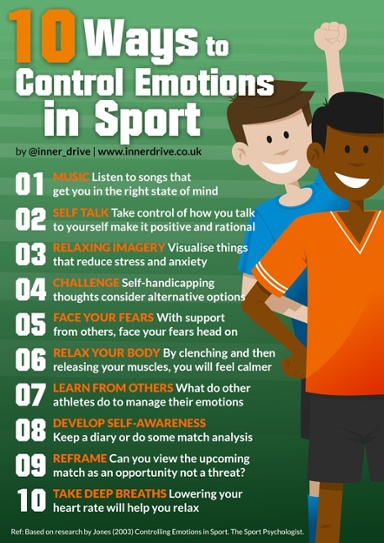
Research by Professor Marc Jones at Staffordshire University offers fascinating insight into how athletes can better manage their emotions when competing. In this two part blog series, we are going to look at 10 tips to control emotions in sport based on his research.

How to control emotions music.jpgMusic: Listening to music is a great way for an athlete to get into the zone. Upbeat or inspirational music for example improves an athlete’s confidence and motivation, leading to better on pitch performance. Music acts as a way to boost arousal levels whilst also helping to block out distracting thoughts.

Self-Talk: Negative self-talk leads to a poor emotional state, which in turn hurts athletic performance. Replacing it with positive self-talk such as “I played really well in my last match” or “I’ve succeeded at this before, I know I can now” counters negative emotions and creates positive ones too.   This positive self-talk creates helpful emotions such as happiness. As many as 76% of elite level figure skaters utilise this technique to cope with the stress of competition. For more tips on how to talk to yourself, check out our blog on it here and how self-talk is linked to growth mindset.

Relaxing, Positive Imagery: If you find yourself stressed out over competing or are worried about failing,  try imagining positive scenarios like scoring a goal. As a young athlete, Wayne Rooney used to lie in bed imagining himself scoring goals and dribbling around defenders.  He uses these visualization techniques this day and credits them for his accomplishments.
It has been found that Imagery focused on toughness, control, and confidence leads to increased motivation, emotion regulation, and self-belief. This is a great technique to do the night before a match or just before you go out to compete.

Challenging Self-Handicapping Thoughts: It’s important to consistently review your behavior both on pitch and off to ensure it is helping, not hindering your performance. If you are exerting energy and focus on behavior that is hurting you, you’re wasting energy.

One elite tennis player in this study was asked how many times in her career she argued with the referee and how often it had actually resulted in a call being changed (very rarely). The massive difference in the energy wasted compared to the result she gained, helped her realise there were better things to choose to focus on.

Face Your Fears: As discussed in our blog on The Fear of Failure, psychologists believe that there are three ways people cope with situations. These are Avoidant, Emotional and Problem Focused. Let’s say you are worried about snakes in your garden. You could decide to never go into your garden again (avoidant focused), or convince yourself that having snakes in your back garden isn’t that bad (emotion focused) or go into your garden and get rid of the snakes (problem focused).

Whereas avoidant and emotional focused coping may provide a short relief, problem focused coping addresses the issue head on, allowing you to make long term gains. Don’t be an ostrich and bury your head in the sand. If something is worrying you, work out how you can make it better.

Make sure to check back in a few weeks for part two of our blog on how athletes can better manage their emotions. We would like to massively thank Professor Jones for allowing us to blog about his research.

If you’d love some more great sports psychology tips to keep you going until then, check out our another great post from Inner Drive:  What to Think About Before a Match.
Filed Under: Mental Skills

Mental Strength: 14 Ways to Build it in Your Players

September 4, 2017 by

By Dawn Redd-Kelley, head volleyball coach at Beloit College

The following post was originally published on her coaching blog, Coach Dawn Writes

Coaches ask for a simple, but very hard, thing from our athletes: complete focus for a couple of hours each day. I think this is a difficult mental task for our players to manage…I also think it requires practice. I don’t know if it’s fair of us to ask our players to do these things without giving them the space to practice these mental skills. Here are fourteen ways our athletes can break “focus” down and take control of their mental headspace:

14 powerful ways our teams can build their mental strength

  1. Perspective.  A great mental challenge of being on a team is putting the team’s goals first…even when those goals are in opposition to a player’s personal aspirations.
  2. Readiness for change. Athletes and coaches have to be nimble, flexible, and adaptable…that’s the only way to beat a savvy opponent.
  3. Detachment.  This is a call to not take things personally, but to focus on what they can accomplish, not any perceived slights from the coaching staff.
  4. Strength under stress. This one is the name of the game, right? Competition is stressful and, ideally, we’ve equipped our athletes with the tools to manage themselves so that they can shine under the bright lights.
  5. Preparation for challenges. No season is without twists and turns, use the good times to prepare for the inevitable downturn.
  6. The right attitude toward setbacks. I want my athletes to embrace their personal setbacks, because that means they’ve tried to get better. If they never experience frustration/failure/setbacks, then they’re not pushing hard enough.
  7. Self-validation. Many times, I tell my players that only they know how hard they’re working. I can come up with tough workouts, but it’s up to them to make them as challenging as possible. Working hard is a mental exercise and it’s their opportunity to push when perhaps they could get away with not pushing.
  8. Patience. Every player on every team at every school wants to win on the first day of practice. Special players and teams have the patience to work every day over the course of a long season.
  9. Control.  Is your athlete grumpy because you corrected them in practice? Are they disappointed they’re not playing with the first team? It’s our job as their coach to remind them that they, and only they, are in charge of the attitude they present at practice.
  10. Endurance in the face of failure. Quite honestly, our athletes’ goal should be to fail every day. I want my players operating at the outer edges of their ability—where failure is more likely—because I want them to challenge themselves to do what they didn’t think they could do.
  11. Unwavering positivity. We have to encourage our players to be a positive light on the team. There is always a Negative Nelly on the team, hopefully our athletes will have the guts to stop them in their tracks.
  12. Tenacity.  Never give up. Come in early, stay late…be relentless about getting better.
  13. A strong inner compass. This is a great locker room skill. When others may be grumbling, this athlete challenges themselves to do the right thing and support the direction the coach is taking the program.
  14. Uncompromising standards. The standard is the standard, regardless of how hot it is, or how many injured players your team has, or how well other teams are doing. Our athletes shouldn’t bring the standard down, but rather rise up to the standard.

What if we challenged our teams to do a few of these each day? What if, when presented with a mental challenge, we reminded our athletes that this was getting them mentally tougher for a future opponent? What if we posted this up wherever we practice so that our teams have a powerful reminder of what is required of them…beyond the skill they’re trying to master? What if we framed our disappointment with their lack of engagement/focus/whatever with an opportunity to be mentally better than our opponent?

Check out this Inc. article, which served as inspiration for this post.

About the Author of this Post

Dawn Redd-Kelly is the head volleyball coach at Beloit College.  Her volleyball teams have earned the best winning percentage in school history.  She has coached at the high school, club, Division I and III levels…taking her first collegiate head coaching job at age 24 with the University of Rochester.  She played volleyball at the University of Wisconsin-Madison. Coach Dawn Says: “I believe in the power of sport to teach winning and losing with grace, to inspire its participants to excel, and to create a common goal for the greater good.”

Filed Under: Mental Skills

What To Think About the Night Before a Match

August 4, 2017 by

This article was provided by InnerDrive, a mental skills training company

What should athletes be thinking about before a match?

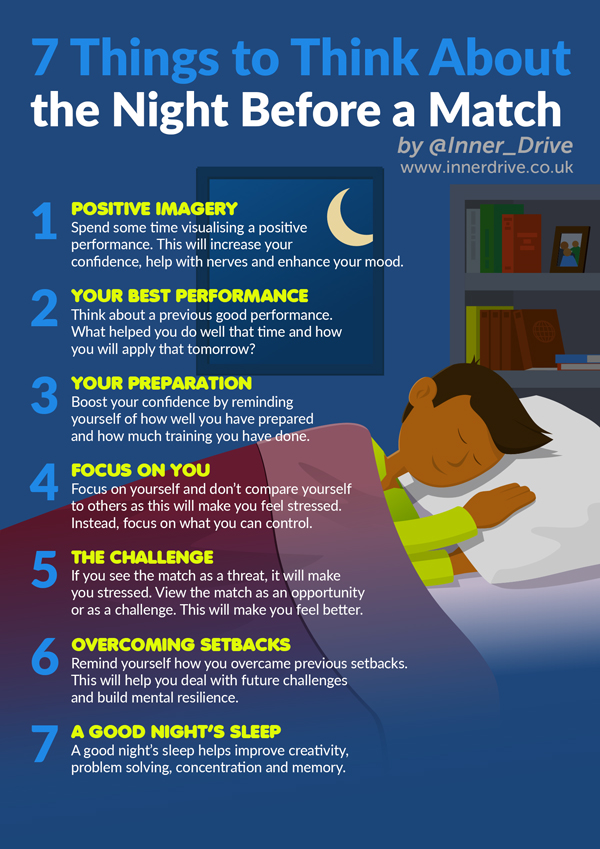
Are some thoughts more helpful than others? We’ve looked through the research from the world of sport psychology to find 7 tips to help people achieve the right mindset before a big match.

Positive Imagery – Visualising successful performance has been found to increase confidence. Spending time imagining a positive experience will also help students manage nerves. Pictures are better than words. Picturing yourself doing well has been found to be more effective at enhancing mood and reducing anxiety than telling yourself you will do well.

It is worth noting that there are some potential downsides to daydreaming about your future success, as discussed here, but these relate to behaviour and self-control strategies over a long period of time. Thinking positively for a few minutes before you compete (and once you’ve put in the hard work) shouldn’t affect this and will help boost your mood.

Remember Your Previous Best – Thinking about previous positive experiences will help improve confidence. Athletes should remind themselves of a successful performance to help them feel more confident about an upcoming one. They should think about what helped them do well in the previous match and how they can apply that now.

Remind Yourself Of Your Preparation – How well you have prepared for a task is an important source of confidence. Controllable sources of confidence such as preparation will lead to more enduring confidence levels. Getting athletes to remind themselves of the preparation work they have put in will increase feelings of confidence and control in the build up to performance.

Focus On Yourself and Don’t Compare to Others – When athletes compare themselves to others their confidence is dependent on those around them, and is not within their control. This is stressful and increases fear of failure. Alternatively, focusing on themselves and what they can control will increase confidence. Reminding themselves of what they can do will help them to feel more confident in their ability to perform.

How You Have Overcome Setbacks – Research into mental resilience of Olympic champions has shown how overcoming setbacks has helped them deal with future challenges. Encourage athletes to think back to previous setbacks that they have had and what was successful in helping them overcome these.

See the Competition as a Challenge, not a Threat – If something is perceived as a threat, it is more likely to cause stress. Athletes who reframe an event as a challenge, as opposed to a threat, increase their performance. Instead of thinking about the potential negative consequences of losing, they should reframe the exam as an opportunity to succeed. The increase in stress caused by focusing on ‘what could go wrong’ will also hinder their sleep quality the night before a match.

Get a Good Night’s Sleep – Sleep duration and quality have a significant impact on how you feel and subsequently how you perform. It’s linked to creativity, mood and concentration. Be sure not to make the 9 common sleep mistakes and you’ll feel fresh and ready for tomorrow’s competition.

Filed Under: Mental Skills

Strategies to Defeat Adversity

July 20, 2017 by

By Juan Pablo Favero.

Originally published on the Coach and Athletic Director site and republished with permission of both parties.

It’s frustrating for athletes when they’re running on fumes, feeling like they have nothing more to give and that no matter what they do there is nothing left to push past a seemingly insurmountable wall. They can feel hopelessness, discouragement and defeat knocking at their door.

Whether the exhaustion is physical, emotional, mental or a combination of the three, we have all experienced what it’s like to “hit the wall.” While the wall is definitely not a good state to be in, there are two important facts we must remember for our own sake as well as that of the groups or teams we lead or coach.

First, athletes must understand that these moments can be overcome. They do have more in the tank if they grind it out. Second, when we don’t quit and we overcome these walls, they serve as a catalyst for growth and potentiate future success in a way that we, and our teams, would otherwise never experience.

In overcoming personal and professional walls, as well as helping athletes and teams overcome their walls, I have developed a very practical list of strategies over the years that I trust can assist both you and your teams to overcome obstacles.

Here are 10 ideas you can use with your own programs.

1 One step at a time. A popular sports cliché is “one game at a time.” This mentality is imperative for individuals and teams to succeed. When we hit walls, the finish line can seem very distant and the goal, which started out as a motivating force, can instantly become overwhelming and even demotivating.

We must remember that the emotional and physical tank is already running low when the wall comes into the forefront, so the time to focus on the big picture is not now. For this reason, it is imperative to just take the next small step, whichever it may be.

One more action stripped down to the most simple of levels allows us to regain momentum toward the direction we set out when we began. Once you complete that next step, the focus can move to the following step and so forth. Before you know it, you have overcome the wall by taking several small steps forward.

2 Positive self talk. The power of our internal dialogue is well researched and documented. There is no other moment as important as this to use this cognitive skill.

When you or your team struggles, the battle has to be waged and won inside the mind. The cognitive-behavioral cycle above helps explain how our thoughts give birth to every result we experience.

Every thought is a seed that grows into an attitude or mindset. Our attitudes in turn guide our actions or behaviors, which then yield consequences or results. Our results reaffirm and strengthen our thoughts and the cycle goes on.

If we want to have a different outcome, we must first change our “mental playlist” from negative, defeatist thoughts to positive, conquering ones. The use of cue words and affirmations both silently (internally) and out loud (externally) does indeed begin to energize us towards overcoming the wall and allow us to push past it, thus creating a different result.

The key is to remain positive, even in the midst of difficulties and challenges. This is the choice we, and our teams, must make.

3 Help one another. The beauty of being part of a team is critically important during the difficult moments. The accountability, encouragement and synergy that come from others pushing you forward should never be underestimated.

A relevant metaphor is “iron sharpening iron.” The positive voice of someone with whom you have a good relationship can be an energizing force to propel you past the wall. We must teach and encourage our teams to do this for each other. When you combine the use of positive self-talk and encouraging, uplifting communication, you create a contagious force that builds positive momentum.

4 Visualization. This is another very effective technique. At its most foundational level, visualizing simply means seeing yourself in the place you want to be. It is taking our positive thoughts and using our imagination to paint powerful pictures in our mind’s eye. By imagining ourselves successfully overcoming the challenge and believing that we can do it, we unleash the inner power inside our minds to fill our bodies with the belief necessary to continue our climb.

A quote I heard in grad school is, “Belief is the mother of all reality.” I would add that belief followed by action leads to the new reality we are seeking. Visualizing oneself and our teams being successful sets the stage for the materialization of success. Unfortunately, the opposite is also true.

5 Mental strength. There is no substitute to sheer will power, desire and the determination to see things through to their completion. Whether this is innate doesn’t really matter as much as the fact that any person can indeed develop and strengthen this kind of grit.

As leaders, we must assist our teams in the development of this skill by setting up challenging tasks for them to overcome. Mental strength, like a muscle, must be exercised and built little by little. It is forged only when we come face to face with walls — maybe small ones at first — and successfully overcome them.

The more we and our teams will ourselves to not give up and quit, the more mental strength we develop, allowing us to take on steeper challenges.

6 Past achievements. Whenever doubt kicks in and thoughts of quitting start to circle our heads, one quick way to evict these is to recall and focus on instances where we have successfully overcome past challenges. It may be the same or a similar experience, but focusing on previous successes and the positive feelings and emotions associated with them gives an instant boost of confidence, energy and motivation to keep going. Because the wall is a place of doubt, we must help our teams remember triumphs of the past in order to regain the confidence needed to experience success in the present.

7 Minor victories. This goes hand-in-hand with the first strategy of taking one step at a time, but the emphasis here is on the importance of celebrating a successful step in the right direction or an approximation to the desired outcome.

There is much research on the power of positive reinforcement and rewards, but the most practical concept I have seen and used on the matter is “catch them being good,” as explained in the book with the same title by Dr. Colleen Hacker and Tony DiCicco.

Simple yet very specific and genuine reinforcement related to an athlete’s effort and achievements goes a long way and helps build momentum.

8 Push past the pain. When we reach that point of wanting to give up or surrendering to the obstacle, we must push ourselves past our discomfort and pain. Much like a runner’s high produces instant gratification and a release of endorphins, pushing past the pain barrier creates the same kind of euphoric high, which serves as fuel. This mindset also propels our teams from bad to better, from good to great, and most of all, into their personal and collective best.

9 Focus on the why.
 The “what” is the goal, the “how” is the process, but the “why” is where the secrets lie. It’s important to distinguish that the “why” is not the goal itself but the reasons why we pursue a goal to begin with.

We must help our teams find and define their “why” long before the moment when the wall stops our forward momentum. The “why” gives purpose, and it’s the reasons behind the mission and the vision. Therefore, our job as leaders is to help define the team’s joint “why.” If the “why” is not clear, people won’t fight, won’t push and won’t persevere.

When the “why” is clearly communicated and defined, it serves as a force that pulls our teams toward the goal and past the walls they face.

10 Reward yourself and the team. The final step is to simply stop and smell the roses when the goal is achieved. I discovered that when this is done in a tangible and meaningful way, it serves to recharge both emotional and physical energy needed for the next challenge.

One suggestion here is to find ways to commemorate and symbolize big achievements. Whether it’s an autographed ball, a photograph or something more intricate, memorializing a triumph has a way of both acknowledging past victories and motivating for success over future walls.

A final thought to leave with you has to do with attitude. We, and our teams, must not allow for an outlook of fear and trepidation toward facing walls and obstacles. We must instead develop a mindset and culture where walls are looked at as not only opportunities but embraced as a blessing, as something meant to be overcome, and to bring out the best in us.

In the short film “The Butterfly Circus,” featuring Nick Vujicic, a quote that resonated deeply within me envelops what our mindset ought to be toward any wall we may face: “The greater the struggle, the more glorious the triumph.”

I wish you and your teams the struggles necessary to bring forth the memorable triumphs.

Filed Under: Mental Skills

The Psychology of Deliberate Practice

May 7, 2017 by


This article was provided by InnerDrive, a mental skills training company

Why do some athletes improve at a faster rate than others? The answer it seems may (partly) lie in how they train. Researchers have been exploring the psychology of practice to explore what helps athletes develop quicker.

Psychologists use the phrase ‘Deliberate Practice’ to describe the type of training that yields the best results. It is defined as ‘engagement in structured activities created specifically to improve performance’. When it comes to training, it’s not just how much you do, but what you do and how well you do it that really counts.

HOW IMPORTANT IS DELIBERATE PRACTICE?

How much difference does engaging in deliberate practice make? Some have claimed it makes all the difference (i.e. the person who practices will be the best). These people would be wrong.  After reading Malcolm Gladwell’s book Outliers, Dan McLaughlin quit his job as a photographer to start clocking up his 10,000 hours of deliberate practice in golf with the aim of becoming a golfing champion.

So what does the research actually say about the impact of deliberate practice? The most comprehensive and thorough review of the research on deliberate practice, which included almost 90 studies and over 11,000 participants, found that it accounted for 18% variance in sporting performance.

This is no small number. 18% variation is a big amount. But not the 100% Dan McLaughlin is hoping for.  The researchers conclude that ‘deliberate practice is important, but not as important as has been argued’.

Much of this misunderstanding of how much impact deliberate practice can have on your performance has stemmed from journalists misinterpreting the work of psychologist Anders Ericsson (his seminal work on elite musicians and how much deliberating practice they do is often seen as the genesis for this 10,000 hour myth).

Click the play arrow for a You Tube video of the concept of Deliberate Practice.

Keen to put that right, he has recently released his book ‘Peak: Secrets for the new science of expertise’. This book is set to be very popular in both sport and education circles. (For a comprehensive review, see Daniel Willinghams thoughts here).

HOW TO MAXIMIZE TRAINING AND PRACTICE

Knowing that deliberate practice accounts for 18% of variation in sporting performance (and not 100%) is interesting. The shift from interesting to useful comes via the tips that Anders Ericsson gives in his book on how to maximize training. What are some of the criteria to ensure you are engaging in deliberate practice?

Be targeted at improving a specific part of your game – imagine you are practicing a song on an instrument and struggle with the middle section. Would it be better to practice the whole song through, or focus on the part you struggle with? The answer is definitely on the latter. With limited time, you want to target your training and focus on specific parts.

Take you out of your comfort zone – you don’t want to step so far out of your comfort zone that your ambitions far exceed your abilities. Stretching yourself means trying to improve to an amount that is just possible if you push yourself.

For example, it is difficult to improve at sports like tennis if you are always playing weaker players.

Likewise, if your opponent is so much better than you, then it is unlikely you will improve. Playing a slightly stronger opponent will help you improve the most.

Reinforce and build on previous training – A random scatter gun approach is unlikely to yield to long term games. Being able to link to and build upon previous training sessions will help solidify information into your long term memory. Psychologist often call this ‘scaffolding’ as it literally helps you build upon previous experiences.

Provide feedback on what you are doing – Feedback is the guide that athletes can follow to better performance. The voice of an older, wiser and more objective person can offer a perspective and vision that may be difficult for individuals to come up with themselves, especially if they are so engrossed in the task itself.

Strengthen your weakness and build on your strengths – Some athletes and coaches prefer to work on their weaknesses. The rationale being that this can make your harder to beat. Others prefer to work on strengths. This can help boost confidence and also provide athletes with real ‘weapons’, hopefully meaning they are more likely to win. Which you do will depend on the situation, context and the individual. This is where coaching becomes more of an art than that of a science. Whichever you choose, having a clear focus and rationale for why you are doing it matters.

Require hard work, intensity and full concentration – You can only maximize training if you give it your full focus. Developing skills is hard. By not putting in maximum effort, it’s unlikely that you are doing the other points previously mentioned (i.e. taking yourself out of your comfort zone). As the saying goes, ‘Hard work beats talent when talent doesn’t work hard’.

FINAL THOUGHT

It is interesting to note that the previous review on the impact of deliberate practice (the one that found it explained 18% variance in sport) concluded that it only impacted up to 4% of performance in education. This research is undoubtedly very valuable. It indicates how to maximize training and practice. It just seems that this knowledge is more valuable in the sporting rather than the education world.

For athletes looking to maximize their training in order to improve, the above tips provide a handy checklist to ensure that they are doing it right. If not, they may be working hard, but are unlikely to be working smart.


Filed Under: Mental Skills

  • « Previous Page
  • 1
  • 2
  • 3
  • 4
  • 5
  • Next Page »

© Copyright 2026 Athletic Performance Toolbox

Design by BuzzworthyBasketballMarketing.com

Privacy Policy