Athletic Directors Toolbox

  • Home
  • Leadership
  • Mental Toughness
    • Mental Skills
  • Motivation
  • Professional Development
  • Program Building
  • Sports Performance
  • Team Building

Developing Leadership Capacity in Athletes

January 9, 2018 by

Many student-athletes are reluctant to take actions or to speak up or speak out for fear that their actions may be held against them by teammates. To neutralize such fears it’s in your best interest to create a psychologically safe environment.

By Cory Dobbs, Ed.D.

It didn’t dawn on me that there might be anxieties and risk involved in team learning until I put a few work teams at a Fortune 100 company under a microscope. To say the very least, what I observed was a wide-range of defensive and protective processes which ultimately closed off the team’s members from learning and instead created a variety of dysfunctions anchoring the team’s collective efforts in the harbor of mediocrity.

As a result of this work I decided to take a closer look at how student-athletes learn in a team setting, and in particular how the context influences the perceived risk involved in learning to lead one’s teammates. Upon closer inspection it became obvious that many of the risks involved in team learning in the corporate world are mirrored in the athletic world. Likewise, learning to lead in a team environment is risky business.

So, how do you get student-athletes to learn together? There are no simple answers. However, knowing that the context greatly affects learning is a step in the right direction if you’re serious about your players learning how to lead.

Leadership Development and Psychological Safety

When a student-athlete takes on a leadership role it’s important to understand that he or she will learn primarily through trial and error (which is why I firmly believe in deliberate practice—scrimmage—as a way to reduce perceived risks). If a student is learning physical geography he or she will learn in private with no one else aware of his or her mistakes. However, learning to lead in a team setting requires learning by trial and error in interpersonal interactions. Learning this way is certainly not learning in private and the consequences of actions always involve one’s teammates. Therefore, team leaders perceive risk in appearing ignorant and or incompetent in front of their peers.

Because most student-athletes have little experience at leading, which includes making mistakes in front of teammates, such fears as embarrassment and rejection are always present. And many student-athletes are reluctant to take actions or to speak up or speak out for fear that their actions may be held against them by teammates. To neutralize such fears it’s in your best interest to create a psychologically safe environment.

Let’s start with what I mean by psychological safety. It is a shared belief by all team members that the team is an environment where everyone has a sense of confidence that others will not embarrass, disrespect, disregard, or punish someone for taking action or speaking up or speaking out. All members understand that a supportive learning environment is necessary to build a psychologically safe team context.

The central idea is that a psychologically safe team environment will produce higher performing team learning and team leadership. Expressed as a formula it looks like this:

formula

At the heart of the growth of a team leader is the leader as a learner, the learning process, and the context which together form the cornerstone of leadership development. Always keep in mind that the team leader is engaging in learning a new mind-set as well as a new skill-set. That is, the student-athlete as a team leader is undergoing a tremendous transformation and that is why creating a psychologically safe environment is necessary.

Creating a Psychologically Safe Learning Environment

Years ago, during a seminar the late Peter Drucker asked an elite group of executives “How many of you have deadwood in your organization?” referring to those employees that had retired on the job. The hands of every one of the high-profile CEOs went skyward. He then asked “Were they that way when you brought them into your organization?” The implication was obvious, if they were then the leader was at fault for hiring them, and if they weren’t then something inside the organization “caused” the employee to basically give up on improving and become organizational deadwood. The point is that the context has a much more profound effect on how people behave than most leaders
realize.

The question, then, is what can you do to create a psychologically safe environment for team leaders learning to lead? The first step is to understand your team environment as it is and how it interacts with the internal achievement drive of your team leaders. To do this, use the model below.
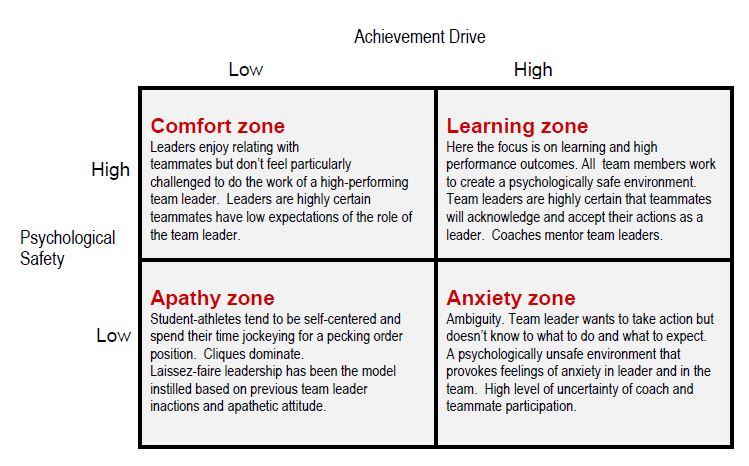
matrix

Hopefully the matrix above can provide a window into your current team context and how it is affecting the development of your team leaders. Psychological safety is an important component of creating an effective learning space for you and your team. The purpose of this brief article is to provide an introduction into the practice of developing a team leader’s capacity to lead through the process of team learning. When you involve all members of the team in the learning of leadership you’re more likely to create an effective learning environment.

Let me issue a quick reminder that leadership is a social influence process in which team leaders work to motivate or persuade teammates to achieve specific individual and team goals. As such, the norms, beliefs, and values that emerge from team member interactions will create team dynamics that will influence the social structure and social processes that will either enhance or inhibit team learning. Your goal as the chief architect of the environment should be to create a psychologically safe learning zone.

Ultimately, you have more to do with a team leader’s learning to lead—or not learning—than you probably thought you did. If you’re not growing team leaders, then it’s likely the problem is not the seed, it’s the soil.

To find out more about and order Sport Leadership Books authored by Dr. Dobbs including Coaching for Leadership, click this link: The Academy for Sport Leadership Books

About the Author

A former basketball coach, Cory’s coaching background includes experience at the NCAA DII, NJCAA, and high school levels of competition. While coaching, he researched and developed the transformative Becoming a Team Leader program for student-athletes. Cory has worked with professional athletes, collegiate athletic programs and high schools teaching leadership as a part of the sports experience and education process. Cory cut his teeth as a corporate leader with Fortune 500 member, The Dial Corp. As a consultant and trainer Dr. Dobbs has worked with such organizations as American Express, Honeywell, and Avnet.

Cory has taught a variety of courses on leadership and change for the following universities:

Northern Arizona University (Graduate Schools of Business and Education)

Ohio University (Graduate School of Education / Management and Leadership in Sport)

Grand Canyon University (Sports Marketing and Sports Management in the Colangelo School of Sports Business)

Visit www.corydobbs.com to read Cory’s leadership blog.

Filed Under: Leadership

8 Principles to Infuse Your Team with Passion

December 20, 2017 by

This article may also be found at the Coaches Toolbox, a collection of free resources for coaches of all sports.

by Dr. Cory Dobbs

To help lift your team’s performance look for ways to infuse your team with passion. Help teammates believe in themselves. Build their confidence and self-esteem. Check out these 8 Principles to Infuse your Team with Passion

Every team has players who always do less than they are asked; still others who will do what they are asked, but no more; and some who will do things without anyone asking. What every team needs is more of the third group, players who serve to inspire those around them to do things that will make the team better. These are the players who constantly renew their commitment to being their best for the team and whom others would do well to model.

A fun and energizing environment is much more productive than a routine and stale environment. Student-athletes who enjoy their sport and their teammates come to practice with moare energy—more passion. And this can be contagious.

To help lift your team’s performance look for ways to infuse your team with passion. Help teammates believe in themselves. Build their confidence and self-esteem. Search for ways to make your teammates feel important and appreciated. Celebrate and get excited about
the successes and accomplishments of your teammates. Make it a daily goal to point out the strengths and contributions of those around you.

You can infuse your team with passion by the acting out the following eight principles in your daily activities:

1. Keep Your Fire Burning. Fill your energy tank frequently. Your teammates feed off your fire. Avoid burn-out by regularly relaxing and refreshing your mindset.

2. Take Charge of Your Moods. Recognize your present mental and emotional state and take time to reflect on how your attitudes impact and influence your teammates.

3. Listen to Teammates. Spend time with your teammates and attempt to understand their feelings, perspectives, and experiences. Make it a way of life rather than a onetime event.

4. Be There for Others. Team building is about recognizing, respecting, and appreciating your teammates. Your friendship can be just the encouragement a teammate might need to make it through a challenging time. The smallest gesture, a simple act of kindness, at just the right time can make a big difference.

5. Act with Integrity. Blaming, finger-pointing, and accusing others will lead to negative reactions. Do what you say you will do. In other words, walk the talk. Your attitudes and actions should be consistent with your words.

6. Be Genuine. Your teammates will see right through you if you are phony and superficial. They want you to care about them and help them achieve their goals. Belief in your teammates will breed trust and healthy relationships. Point out others’ strengths and contributions—daily!

7. Refrain from Excuse-Making. Players that are committed to excellence identify what top-notch performance looks like and then take action steps towards that standard, never making excuses for disappointments and failures along the way.

8. Mend Broken Fences. Great teammates are those willing to admit mistakes. Durable and enduring relationships are built by pushing through adversity. Conflict is natural. Restore relationships where conflict has caused tension. Be patient, persistent, and pleasant when restoring a relationship.

To find out more about and order Sport Leadership Books authored by Dr. Dobbs including Coaching for Leadership, click this link: The Academy for Sport Leadership Books

About the Author

Dr. Cory Dobbs is an accomplished researcher of human experience–a relentless investigator always exploring “how things work.” He is the founder and president of The Academy for Sport Leadership and A Leader in Every Locker and has written extensively on leadership development of student-athletes.

Filed Under: Leadership, Team Building

Team Leadership Model

December 12, 2017 by

The Team Leadership model creates an environment in which members are accountable not just to the coach, but to the team as a whole. If you are willing to give up some control, and believe that all team members can inspire each other, your team will reap the benefits

This article can also be found on the Coaches Toolbox, a collection of free resources for coaches of all sports

Cory Dobbs, Ed.D., The Academy for Sport Leadership

One thing I know is true: everyone I meet has more learning and doing capacity than I am aware of, just like the mighty oak hidden in every tiny acorn.  My work with The Academy for Sport Leadership has led me to conclude that a shared leadership system is far more productive than the hierarchical model embodied in the traditional team captain model.  I call the participative model, which rests on the practice of mutual learning, the Team Leadership Model.

The Team Leadership Model promotes the processes of team leadership and team building as growth opportunities.  It advances the assumption that all members have the ability to inspire others, to reflect on their actions, to increase self-awareness and to leverage their relational capabilities and build positive, impactful relationships.   

At the heart of the leader in every locker framework is the core belief that every student-athlete has the ability to learn and develop leadership skills.  The transformational coach encourages every student-athlete to reach into their reservoir of beliefs about what is possible for them to accomplish when engaging in learning how to lead and team build.  When the student-athlete does this they come to believe that more is always possible.

The coach with the ability to see more than a small capped nut will always be rewarded.  More importantly, his players will grow in ways that can only happen in the right environment.

Teams that I’ve worked with that have utilized the team leadership framework—a leader in every locker—have enhanced interpersonal activity and collective effectiveness in the four domains of team sport—the physical, intellectual, emotional, and social domains.   The essence of the leader in every locker model is that student-athletes learn to teach and learn in an interactive way so everyone grows individually while expanding the technical and the relational capacity of the team.

The Team Leadership model creates an environment in which members are accountable not just to the coach, but to the team as a whole.  This sounds good to coaches, but very few actually practice the Team Leadership concepts.  The reasons coaches balk at the idea of Team Leadership—leadership from every locker—is that, in general, they are either hooked on control or of the firm belief that leaders are simply born which leads to the conclusion that leaders are in short supply.

Some coaches will admit this, many won’t. The old way of thinking is comfortable and less time consuming.  But, let me say again, my research strongly suggests the traditional captain mode is very limited.  The team captain model as practiced by most coaches is a sink or swim proposition.

When you choose to make leadership and team building skills and abilities for all players a priority, not only do you increase responsibility and reliance on one another, you change how your student-athletes interact as leaders and followers.

Okay, lift the hood.  Kick the tires. Compare the assumptions that undergird the two models.

The Two Major Leadership Frameworks

Traditional Team Captain Model (Rank-Based)     VS.                          Team Leadership Model (Peer-Based)

Starts from a position that leadership is exclusive; leaders possess the “right stuff” Starts from a position of leadership as inclusive; everyone is invited to lead self, others, and with others to create individual and team well-being
Fixed mindset; leadership can be learned to some extent, but mostly a unique genetic endowment Growth mindset; basic and advanced qualities and skills can be cultivated
Scarcity mindset Abundance mindset
Grounded in leadership as a “power” position Grounded in leadership as an “influence” position
Hierarchical command and control over others Peer-based influence as a source of strength
Performance oriented Participant- oriented
Leader accountable to coaching staff; invested in pleasing coaches Leader acts from deep sense of responsibility and accountability to others
Leadership learning “passed” down to future leaders Individualized leadership development
Followers are recipients of an act of leadership Followers are central to any act of leadership
Leader-centric (focus on person) Leadership-Centric (focus on process and context)


About the Author

Dr. Cory Dobbs is a national expert on sport leadership and team building and is the founder of The Academy for Sport Leadership.  A teacher, speaker, consultant, and writer, Dr. Dobbs has worked with professional, collegiate, and high school athletes and coaches teaching leadership as a part of the sports experience.  He facilitates workshops, seminars, and consults with a wide-range of professional organizations and teams.  Dr. Dobbs previously taught in the graduate colleges of business and education at Northern Arizona University, Sport Management and Leadership at Ohio University, and the Jerry Colangelo College of Sports Business at Grand Canyon University.

NEW RESOURCE

Coaching for Leadership: How to Develop a Leader in Every Locker. ($24.99)


The Academy for Sport Leadership

The Academy for Sport Leadership’s underlying convictions are as follows: 1) the most important lessons of leadership are learned in real-life situations, 2) team leaders develop best through active practice, structured reflection, and informative feedback, 3) learning to lead is an on-going process in which guidance from a mentor, coach, or colleague helps facilitate learning and growth, and 4) leadership lessons learned in sport should transcend the game and assist student-athletes in developing the capacity to lead in today’s changing environment.


Filed Under: Leadership, Team Building

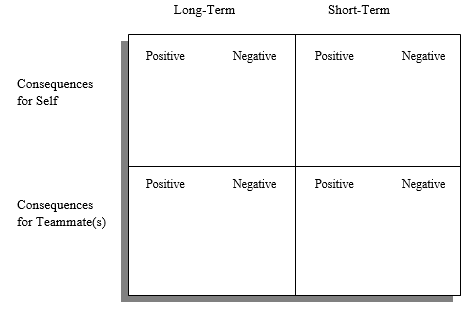
Consequences Matrix

December 9, 2017 by

By Dr. Cory Dobbs

A short, but very powerful post to share with your athletes.

How Will Your Decisions Help or Hurt Your Teammates?

You will make better decisions if you focus on how the consequences of your actions affect your teammates.  While this is only one criterion which can and should be applied to any decision you make, it is an important one.  You begin by asking “What will happen to my teammate(s) if I act upon this decision?   Over time, such reflective thinking will become habit.


Decision-Making
-I should act on this decision.
-I should not act on this decision.
-I cannot decide at this time (Need more information, time, etc.)

Using this matrix will not guarantee that your decisions will be good ones.  However, the consideration of the consequences of a given decision in terms of one’s self and one’s teammates in the near and distant future should increase the probability that harm to relations and relationships can be avoided.


Reflection and Discussion Questions

    • Do you agree with the idea that the best decisions are those that have the most positive consequences for you and your teammate? And that the poorest decisions are those that have the most negative consequences?  Give an example to explain your reasoning.
    • How do you know positive consequences will result from your action(s)? Inaction?
    • How do you know negative consequences will result from your action(s)? Inaction?
    • In which of the four quadrants would you find the most “immature” behavior? Why?
    • As a team member, how can you use this matrix to help your teammates make better decisions?

About the Author

Dr. Cory Dobbs is a national expert on sport leadership and team building and is the founder of The Academy for Sport Leadership.  A teacher, speaker, consultant, and writer, Dr. Dobbs has worked with professional, collegiate, and high school athletes and coaches teaching leadership as a part of the sports experience.  He facilitates workshops, seminars, and consults with a wide-range of professional organizations and teams.  Dr. Dobbs previously taught in the graduate colleges of business and education at Northern Arizona University, Sport Management and Leadership at Ohio University, and the Jerry Colangelo College of Sports Business at Grand Canyon University.

NEW RESOURCE

Coaching for Leadership: How to Develop a Leader in Every Locker. ($24.99)


The Academy for Sport Leadership 

Filed Under: Leadership

The Process of Leadership

December 3, 2017 by

It’s All About Style
Mobilizing Purpose and Possibility with Transformative Leadership

Dr. Cory Dobbs, The Academy for Sport Leadership
Coaching Maxim:  Leadership demands we make decisions that define who we are and how we interact with others.

We often talk about a leader having a “style” of leadership, a distinctive way of thinking, feeling, and acting.  And it is true; coaches do have a style that shapes who they are and what they do.  The relationship between style and leadership is expressed as a systematic process in how a coach gets things done and inspires his or her players to be their very best.

Over the past decade I have watched many coaches in action and have detected a distinct difference between two dominant leadership styles.  There are many ways to describe the leadership habits of coaches, but it appears to me that as leaders most fall into one of two categories—drivers or builders.   Drivers tend to be what leadership experts refer to as transactional leaders while builders fall pretty naturally into the category of transformational leaders. Drivers and builders have two very different leadership mindsets and skill sets.

Drivers are generally after impressive achievements, especially the attainment of fame, status, popularity, or power.  Not that there is anything wrong with that, as Jerry Seinfeld would say.  Drivers view success to be mastery of the technical and tactical aspects of their sport. Builders commit to their calling and enjoy the human development side of coaching.  For them, significance is found in contributing to the lives of their players.  It’s not that they don’t want to win; it’s simply that winning includes building self-confident people who will succeed away from the playing field.

Coaching is a major factor in any team’s success.  Most players recognize this.  They’ve been coached since they were tots playing in youth leagues.  And for the most part they’ve believed in and trusted their coaches to teach them to play the game while instilling life skills and personal values.  However, many adults reveal years later that they learned little from coaches they encountered in their student-athletic experience.  Generally, the coaches that fail to have a long-term impact on student-athletes are transactional leaders.  Many former student-athletes view their experience as being a pawn in the game of student-athletics.

Transformational leaders (builders) do more with and for their student-athletes than transactional leaders (drivers).  These leaders tend to empower student-athletes with challenge and persuasion and actively engage in supporting and mentoring the holistic development of their players.  Transformational leaders seek to inspire their followers to commit to a shared vision of how student-athletics can enhance their lives.  For the transformational leader the sport situation offers an opportunity for the participant to learn such life skills as perseverance, character development, relationship building, and goal attainment.

Transactional leaders, on the other hand, are those that prefer to set up simple interactional exchanges or agreements with their followers, often investing little in building relationships.  They manage players through the use of carrots and sticks—offering a reward (usually playing time) for a desired behavior.  These leaders are those that often use the maxim “the bench is my best teacher.”

This is a prime example of contingent reinforcement—you do “X” and I’ll give you “Y.”  A transformational leader, while certainly not shy to use the bench as a learning tool, would not view the bench as a teacher—that’s a role they cherish.  The transactional coach keeps his or her distance from the athlete, preferring to have a “distant” relationship.  Some coaches will fake the relational process, but the lack of authenticity is quickly recognized by the student-athlete.  The transformational coach is more likely to spend time building relationships with players and showing them he or she cares.  Their mindset is that people aren’t going to care about you and your concerns unless they know you care about theirs.

Transformational leaders don’t do this just to be nice, they understand it to be an effective and appropriate way to deal with young and developing student-athletes.  Building relations is not a road block to success as many coaches find that because they show they care about the person, they can ask for and demand more performance.  Think about it.  Are you more likely to extend yourself for someone you care about or someone you don’t like and care for?

Coaches do many things.  They inspire and motivate, they teach and instruct, and they set an example.  More than anything else, however, coaches help the student-athletes make sense of some of life’s most important lessons.

Over time many coaches move from a driver dominated way of coaching to that of a builder.  Take for example Westmont College men’s basketball coach John Moore.  “Coaching and teaching is more meaningful for me today than it was eight to ten years ago,” said Moore.  “It is more significant because of the kinds of things that are important in coaching.  Someone once said to me, ‘You don’t have a philosophy of coaching until you get to 15 years as a head coach.’ I discounted that originally, but there was a point for me, and it was in that 15-year range, that I realized that I had a philosophy of coaching – that makes it more meaningful for me and more meaningful for my players.”

Being a driver, a transactional leader, can be very effective in producing immediate results.  However, the constant pounding and intimidating of your student-athletes will reduce the motivation of most student-athletes.  Student-athletes prefer to be guided and seek motivation from the collaborative process of coaching.  Even the most self-motivated player will lose their drive if you don’t provide them with positive reinforcement and a sense of worth.

Transformational coaches appeal to players by working with the athletes to create a compelling and collective purpose; a purpose beyond individual ambition that enriches the possibilities of each team member.  By valuing both relationships and results, a builder’s influence leads to higher levels of trust, empowerment, and community.

For builders, the real definition of success is a life and work that brings personal fulfillment, lasting relationships, and makes a difference in the world in which they live.

Are You a Driver or a Builder?

Drivers  / Dominant Leadership Style: Transactional Builders / Dominant Leadership Style: Transformative
  • Put results first. Relationships are subordinate to results, a means to an end.
  • Put people first.  Relationships are priorities to producing results.
  • Make the decisions. Drivers like being decisive and in control.  Drivers set the agenda.
  • Stress team capabilities.  Builders want to build systems and talent.
  • Possess a controlling spirit.  They feel if they can control people, they’ll maintain absolute authority.
  • Get others involved.  Builders seek input from other coaches and value input from players.
  • Resort to more regulations.  Drivers use rules and regulations to enforce compliance.  Drivers want things done their way.
  • Let solutions emerge.  Builders don’t try to tackle every problem knowing that some problems solve themselves.
  • Crack the whip.  Drivers keep pressure on for accountability.  Come down hard when goals aren’t attained.
  • Take a long-term focus.  Builders assemble players, programs, and processes.
  • Take a short-term focus.  Drivers tend to focus on the day’s or week’s results.
  • Are mission driven. It’s the mission that sets the priorities.
  • Focus on “what” have you done for me lately? Enough said.
  • Are servant leaders. What’s my contribution?  Builders possess a mental model stimulated by a “What can I contribute to the lives of my players” approach to leading.
  • Get “in your face.”  Drivers thrive on confrontation.  “My way or the highway”.
  • Embrace empowerment. Builders work to prepare others for leadership roles.
  • Are more critical than positive.  Drivers find it difficult to accentuate the positive.
  • Support identity of team. No two teams will ever be the same.  Builders see value in the diversity of personalities.
  • Power trip.  Fear giving away power.  Empowering student-athletes to become team leaders is not a priority.
  • Vision is the main course, not an appetizer.  Builders weigh the costs of today’s decisions on  tomorrow.
  • Span of vision.  Concern is for results today regardless of costs tomorrow.


About the Author

Dr. Cory Dobbs is a national expert on sport leadership and team building and is the founder of The Academy for Sport Leadership.  A teacher, speaker, consultant, and writer, Dr. Dobbs has worked with professional, collegiate, and high school athletes and coaches teaching leadership as a part of the sports experience.  He facilitates workshops, seminars, and consults with a wide-range of professional organizations and teams.  Dr. Dobbs previously taught in the graduate colleges of business and education at Northern Arizona University, Sport Management and Leadership at Ohio University, and the Jerry Colangelo College of Sports Business at Grand Canyon University.

NEW RESOURCE

Coaching for Leadership: How to Develop a Leader in Every Locker. ($24.99)


The Academy for Sport Leadership 

Filed Under: Leadership

  • « Previous Page
  • 1
  • …
  • 5
  • 6
  • 7
  • 8
  • 9
  • …
  • 22
  • Next Page »

© Copyright 2026 Athletic Performance Toolbox

Design by BuzzworthyBasketballMarketing.com

Privacy Policy