Athletic Directors Toolbox

  • Home
  • Leadership
  • Mental Toughness
    • Mental Skills
  • Motivation
  • Professional Development
  • Program Building
  • Sports Performance
  • Team Building

Staying in Your Lane: Asst. Coaches

September 14, 2016 by

This article is provided by Coaches Network

Assistant coaches are critical to your team’s success. But if they’re overstepping their bounds and focusing on the wrong thing, they can hinder your team’s progress. In this article on breakthroughbasketball.com, Jeff Haefner discusses ways to make sure your assistant coaches know their role and are making a positive impact on your program.

Communication is key: Assistant coaches aren’t going to step on your toes purposely. If they’re crossing into coaching territory you don’t want them to, the problem may simply be that they’re unaware of what your expectations—and their responsibilities—are. Haefner suggests sitting down with your assistants and discussing those expectations with them. That way, you’re both on the same page. “Just like coaching players, you need to give your assistants clear and defined roles and responsibilities,” he writes.

Play to their strengths: However, Haefner also stresses the importance of thinking beyond simply what you need from them. If you know that your assistant excels in a certain area, allow them the opportunity to take ownership of that role. “It’s important to consider your assistant’s strengths,” he writes. “Then it’s your job to put the assistant coach in the position to use those strengths to benefit the program.”

Touch base: Making sure your assistants don’t overstep their bounds isn’t something you can do once at the beginning of the year and then forget about the rest of the season. Check in regularly with your coaches, both formally and informally, to be sure that they understand what their role is.

One solution Haefner offers is to try daily huddles with your assistants. These should only take between five and 10 minutes, but they give you the opportunity to get everyone’s ducks in a row. Ask your coaches what their key priorities are for the day, and talk to them about the metrics you want them to meet. This will ensure they focus on the right things each day.

Management matters: During the season, Haefner suggests writing down and documenting metrics and roles for your coaches, and then scheduling weekly and monthly meetings with assistants to discuss how well they are meeting them. This can provide them with valuable feedback and let them know when things need to change.

“Managing assistant coaches is just like managing employees in a business,” he writes. “You document procedures for an employee. You document and define expectations and roles for that employee. You implement key metrics to measure the performance of that employee. You have regularly scheduled meetings with that employee to review goals, expectations, metrics, performance, and progress.”

Click here to read the full story.
Filed Under: Leadership, Professional Development

Developing Your Team Leaders

September 5, 2016 by

Championship teams have great leadership.

They have great leadership from coaches and players. Coaches must help players become more effective leaders. Teaching leadership is just as important, or more so, than anything else you teach in your program.

Your ability to train your team leaders will be directly correlated to your success.

In the two clips below Greg Dale,Director of Mental Training and Leadership Programs for Duke University Athletics, discuss how to begin the process of developing your team leaders.

The clips are from a DVD entilted The Coach’s Guide to Developing Great Team Captains. For more ideas on developing leaders click on the link above.

The YouTube videos have sound, so please make sure that you have sound and that you have access to the site (some schools may block access to YouTube)


Filed Under: Leadership

Championship Values Leadership Tool

August 30, 2016 by

Cory Dobbs, Ed.D.

Founder, The Academy for Sport Leadership

Championship Values

Values are among the most stable and enduring characteristics of people. They are the foundation on which attitudes and personal preferences are formed. Our core values are crucial in making vital decisions, determining life directions, and behaving in social interactions. Values help define our morality and our conceptions of what is “good” and what is “right.” Many of our behaviors are a product of the basic values we have developed throughout our lives.

However, a problem with values is that they are generally taken for granted. Most of the time people are unaware of their values and how they shape attitudes and behaviors. Unless a person’s value’s are challenged they will remain largely undetected. People are not aware that they hold some values as being more important than others. This unawareness leads to actions or behaviors that are sometimes contrary to values, or even leads to confusion about values.

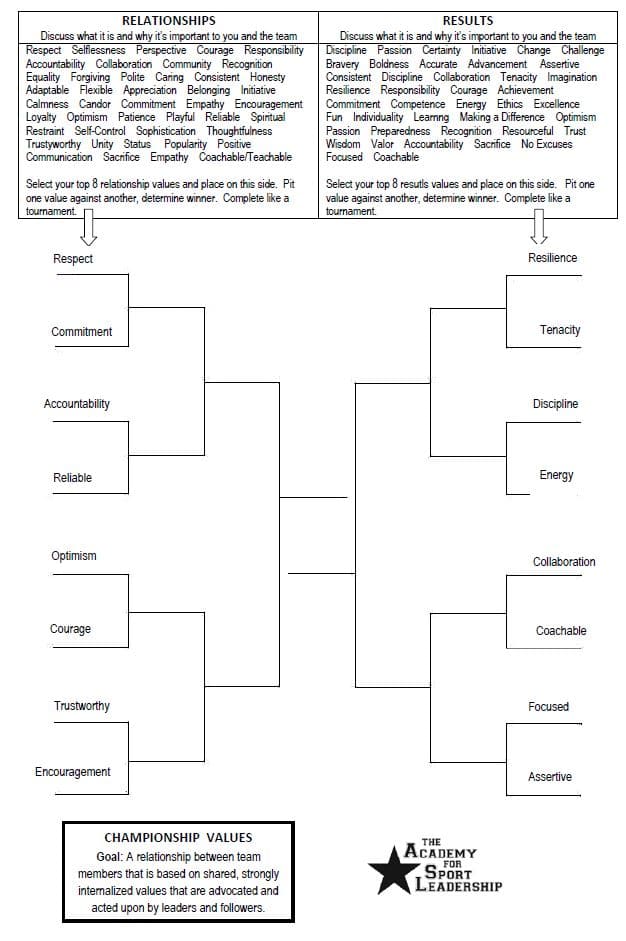
The Championship Values exercise is an interactive tool for you to use in determining your values and those of your teammates. As you work through the eight steps to your team’s Championship Values, keep in mind that sometimes the best way to stimulate discussion of values is to pose a difficult situation that demands a hard look at how a value will help you best resolve the situation. For additional resources for value-driven leadership consider The Academy for Sport Leadership’s Case Studies.

Step 1 Each team member is to think through the values (Relationship Oriented and Results Oriented) and identify circle the sixteen (8 Relationship / 8 Results) most important values—for you as a member of this team. Be sure to carefully think through just what the value is and why it’s important to you.

Step 2 Fill in the brackets with your eight (8) Relationship Oriented values on the left side and eight (8) Results Oriented values on the right side. Do this exercise individually.

Step 3 Pitting value vs. value tournament style. After placing all sixteen values in the brackets,
determine a winner and move the winning values along toward the middle of the chart.

Step 4 Once you’ve completed your Championship Values tournament you’ll have identified your top four values (2 Relationship / 2 Results). Be sure that you’ve thought through the value of each
value!

Step 5 Now split your team into triads (groups of three) and discuss the values. As a triad come to an agreement on 16 values and fill out the brackets. This should take some time as you and your teammates will need to work through personal differences to reach shared values.

Step 6 Once you’ve got the 16 shared values begin your tournament. At each stage engage in
meaningful conversation to identify a winning value.

Step 7 Once you’ve completed your Championship Values tournament as a triad, begin the same process as a team. When you finish your tournament you will have identified four (the final four
values) values that will be strongly internalized, advocated, and acted upon by all team members. The discussion should reveal values a clear-cut set of values for you and your teammates—standards of behavior towards one another and individual and team performance.

Step 8 Do the Championship Values exercise as a complete team. Your goal is a relationship between team members based on shared, strongly internalized values that are advocated and acted
upon by all team members.

Click here to download a blank template of the Tool

leadership

To find out more about and order Sport Leadership Books authored by Dr. Dobbs including Coaching for Leadership, click this link: The Academy for Sport Leadership Books
About the Author

A former basketball coach, Cory’s coaching background includes experience at the NCAA DII, NJCAA, and high school levels of competition. While coaching, he researched and developed the transformative Becoming a Team Leader program for student-athletes. Cory has worked with professional athletes, collegiate athletic programs and high schools teaching leadership as a part of the sports experience and education process. Cory cut his teeth as a corporate leader with Fortune 500 member, The Dial Corp. As a consultant and trainer Dr. Dobbs has worked with such organizations as American Express, Honeywell, and Avnet.

Cory has taught a variety of courses on leadership and change for the following universities:

Northern Arizona University (Graduate Schools of Business and Education)

Ohio University (Graduate School of Education / Management and Leadership in Sport)

Grand Canyon University (Sports Marketing and Sports Management in the Colangelo School of Sports Business)

Filed Under: Leadership

Fearless Followership

August 30, 2016 by

Cory Dobbs, Ed.D.

Founder, The Academy for Sport Leadership

A TEAM LEADER FACILITATED ACTIVITY

NOTE: This exercise is designed to be facilitated by a student‐athlete team leader. Have all members of the team read the short narrative and then answer the questions that follow.

Fearless Followership

Pursuing a Higher Standard of Leadership and Followership

Imagine going to your school’s health office for a visit because you’re experiencing dizzy spells. Before you’ve had a chance to describe your symptoms, the doctor writes out a prescription and says, “Take two of these pills two times a day, and call me next week.”

“Excuse me, but—I haven’t told you what’s wrong,” you say, trying to articulate your condition. “How do you know this will help me?” “Why wouldn’t it?” says the doctor. “It worked for my last patient.” Confused by the doctor’s message and not wanting to offend her you just go along with the doctor’s directive. Rather than confront your doctor you take a sheepish approach and figure that you’ll just wait until later when not in her presence to sort things out.

In this scenario the leader is the doctor with you in the role of the patient. As a patient you are expected to follow the doctor’s directions. To question her is to question her legitimacy and authority. However, as you can see in this scenario, this presents a problem for you as your needs of the moment were neglected.

The traditional stereotype of the follower is of someone that is unwilling or unable to play a significant role in the direction a group desires to go. It is then assumed they are better suited to follow someone willing to provide direction. Generally, the role of followership has a negative connotation. Merely conceptualizing a follower “conjures up images of docility, conformity, weakness, and failure to excel” (Chaleff, 1995). Our culture tends to label followers as passive individuals lacking the “right stuff,” or someone without drive and ambition. However, effective leadership doesn’t happen without dynamic and committed followers.

Followership is important in any discussion of successful team leadership for several reasons. First, leadership and followership are fundamental roles that all athletes will move into and out of depending on the circumstances. It’s a given that as a team leader your primary role is that of a follower of your coaches. Second, just as you expect to influence the attitudes and actions of teammates you should be open to being influenced by teammates. Third, many of the characteristics that are desirable in a team leader are the same qualities possessed by committed and productive followers. Finally, the nature of the leader-follower role in team sports involves you being open to influence and change just as you look to influence and change teammates committed to common goals.

To succeed as a team leader it is essential you appreciate and respect your teammates as followers. One way in which you can do this is to embrace fearless followership. Fearless followership is the courage to take a bold stand and demonstrate the initiative to engage with teammates in an extraordinary way. A fearless follower will challenge a teammate who threatens the cohesiveness, values, or goals of the team. That is, the fearless follower is willing to hold teammates—including a team captain—accountable for team norms, standards, and expectations. Both leaders and followers have got to encourage active and attentive followership and build the relationships needed to move the team forward.

Think of it this way, if you and I agree that team captains should lead with integrity shouldn’t we expect followers to follow with integrity. If a team member falls short of expectations—including team captains—teammates must be comfortable calling them on it, but by letting them know the team needs them. In other words, not attacking the teammate but bringing them into the collective aspirations of the team. Together, team leaders and followers striving toward a collaborative relationship based on fearless
commitment to each other will create a more cohesive team capable of achieving team goals.

Followers want to be:
Accepted Connected Trusted Cared about
Supported Valued Respected A friend
Followers don’t want to be:
Rejected Disconnected Judged Neglected
Disrespected Not Valued Left out A foe
Exercise: Team Leader to Facilitate
Appoint one or two member’s of your team to facilitate a conversation regarding the
following:

The facilitator asks: What do you do when a teammate is:

  • Unfocused
  • Coasting
  • Feeling superior
  • Undisciplined
  • Not coachable at a crucial moment
  • Showing disrespect for teammates
  • Making excuses
  • Showing a lack of respect for competitors
  • Has failed to keep a commitment

*This is a leadership tool created by the Academy for Sport Leadership. The Academy for Sport Leadership is a leading educational leadership training firm that uses sound educational principles, research, and learning theories to create leadership resources. The academy has developed a coherent leadership development framework and programs covering the cognitive, psycho‐motor, emotional and social dimensions of learning, thus addressing the dimensions necessary for healthy development and growth of student‐athletes

To find out more about and order Sport Leadership Books authored by Dr. Dobbs including Coaching for Leadership, click this link: The Academy for Sport Leadership Books

About the Author

A former basketball coach, Cory’s coaching background includes experience at the NCAA DII, NJCAA, and high school levels of competition. While coaching, he researched and developed the transformative Becoming a Team Leader program for student-athletes. Cory has worked with professional athletes, collegiate athletic programs and high schools teaching leadership as a part of the sports experience and education process. Cory cut his teeth as a corporate leader with Fortune 500 member, The Dial Corp. As a consultant and trainer Dr. Dobbs has worked with such organizations as American Express, Honeywell, and Avnet.

Cory has taught a variety of courses on leadership and change for the following universities:

Northern Arizona University (Graduate Schools of Business and Education)

Ohio University (Graduate School of Education / Management and Leadership in Sport)

Grand Canyon University (Sports Marketing and Sports Management in the Colangelo School of Sports Business)

Visit www.corydobbs.com to read Cory’s leadership blog.

Filed Under: Leadership

Developing Team Captains: Being Liked and/or Respected

August 26, 2016 by

Team captains and leaders are extremely influential to any sports team. Their influence can greatly help the team and sometimes their actions can tear a team apart. in the video below sports psychology expert Greg Dale discusses how to help your team leaders with the struggle between being liked and being respected. The clip is a sample from a Championship Productions video. For more information about developing your team leaders click the link The Coach’s Guide to Developing Great Team Captains and learn about a variety of coaching strategies you can implement when it comes to maximizing your squad’s leadership potential, chemistry, and overall success.

The YouTube video has sound, so please make sure the sound is on and that you have access to YouTube. (many schools block access)

Filed Under: Leadership

  • « Previous Page
  • 1
  • …
  • 14
  • 15
  • 16
  • 17
  • 18
  • …
  • 22
  • Next Page »

© Copyright 2026 Athletic Performance Toolbox

Design by BuzzworthyBasketballMarketing.com

Privacy Policy