Athletic Directors Toolbox

  • Home
  • Leadership
  • Mental Toughness
    • Mental Skills
  • Motivation
  • Professional Development
  • Program Building
  • Sports Performance
  • Team Building

Build a Good Team Around You

December 17, 2017 by

This post was provided by InnerDrive, a mental skills training company.

Nobel Peace Prize Winner Al Gore once remarked “that if you want to go fast, go alone. If you want to go far, go together”. So what are the benefits of building a good team of people around you? Why is teamwork important? How exactly does it help?

Author Jim Rohn suggests that you are the average of the 5 people you spend the most time with. If you look at any successful person, in every walk of life, they often have a team around them. One classic example of this is the team at Microsoft. Most people associate Microsoft with just Bill Gates. But as he has said many times, he couldn’t have created it all by himself.

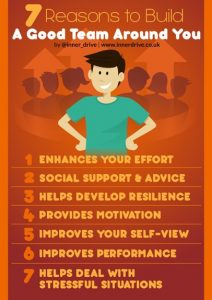
After reviewing the psychological research on the effect of others on personal performance, we highlight 7 main benefits below:


  1. Enhances Your Effort

Legendary American football coach Vince Lombardionce commented that “confidence is contagious”. It turns out, the same is true for effort. That was the finding of a recent journal which found that if the person next to you is working hard then it increases your work ethic. Interestingly, this impact was found to be consistent regardless of whether they were doing an easier or more difficult task then you, or whether the task is similar or unrelated to yours.

As well as improving work ethic, another studyfound that teenagers who had to perform a problem solving task together “engaged in more exploratory behaviour” and “learnt faster from positive and negative feedback” than compared to when on their own.

  1. Social Support and Advice

One of the greatest basketball coaches of all time, Phil Jackson once said that ‘the strength of the team is the individual. The strength of the individual is the team’. We think this is definitely true. A team is comprised of individuals. If we help each individual maximise their talents, then the team gets stronger. However, it is the support, advice and guidance of the team that can help the individuals develop their skills.
Having access to a supportive network of individuals who can offer you social support has been found to act as a stress buffer and improve coping. It has also been found to have a positive impact on your mood and well-being.

Social support comes in many forms; it can be someone giving you advice, some making you feel better about the situation or simply listening to you vent. All three are important. Finding people who can help you satisfy each of those needs is key to building a good team around you.

  1. Helps to Develop Resilience

Having people around you and asking them for support and advice has been found to be a key way that Olympic champions develop their resilience. A problem shared really is a problem halved. It is not just Olympic gold-medallists who get this advantage, a growing body of research suggests that social support can be a powerful predictor of resilience to stress for everyone.

Social support plays a key role in helping students develop their resilience, and self-esteem. All too often, and especially in teenagers, people think that asking for help is a sign of weaknesses. In fact, the opposite is true. Asking for, and actually using, feedback is the hallmark of a mature learner.

  1. Enhances Motivation

Motivation is known to be enhanced by a variety of different things. These include a sense of purpose, choice, mastery and personal belonging or relatedness to a group. For university students in a randomised control trail test, being part of a peer-network helped increase participation in physical activity. These peer networks were more successful than promotional messages in motivating students to participate.

In elite sport, rugby player Jonny Wilkinson talks in his autobiography about the realisation that if he gave himself to the team, then he would get that support back 15 times more, as each player would support him. This realisation helped propel him to international stardom and ultimately winning the World Cup in 2003.

  1. Improves Your Self-View

A fascinating study in education found that how teachers spoke to their students impacted how the students then spoke to themselves and on how they viewed themselves. The authors of this research state that ‘positive statements made by teachers were found to be directly related to positive self-talk and to maths and learning self-concepts’

How other people talk to us has an impact on us, even at a very young age. Researchers have found that the type of praise that we are given age 1-3 years old, can predict our mindset up to 5 years later. We talk more about the importance of praise and the different types here.

  1. Help Deal With Stressful Situations Better

Having a trusted network of individuals who you can turn to can be an extremely helpful coping mechanism for dealing with life stresses. This is why the NHS urge people to connect with others in order to improve their well-being. Other techniques to improve wellbeing include being open to learning, being physically active and giving to others (all of which can be done with other people). This is something we have written about in more detail here.

  1. Can Improve Performance

In arguably the first ever study in sport psychology, researchers found that simply having to perform a task in front of other people made people work harder.  Fast forward a hundred years and we see the same benefit in the work-place. In a study of over 300 people, researchers found that having a deep and meaningful relationships with the people you work with can improve your performance. They found that colleagues who had good personal relationships had more trust, support and pride in their work.

That is not to say there are no potential drawbacks, the authors note that it can be draining having to offer social support to others whilst also doing your work, but on the whole, the benefits to work performance outweighed the costs.

Filed Under: Team Building

Team Leadership Model

December 12, 2017 by

The Team Leadership model creates an environment in which members are accountable not just to the coach, but to the team as a whole. If you are willing to give up some control, and believe that all team members can inspire each other, your team will reap the benefits

This article can also be found on the Coaches Toolbox, a collection of free resources for coaches of all sports

Cory Dobbs, Ed.D., The Academy for Sport Leadership

One thing I know is true: everyone I meet has more learning and doing capacity than I am aware of, just like the mighty oak hidden in every tiny acorn.  My work with The Academy for Sport Leadership has led me to conclude that a shared leadership system is far more productive than the hierarchical model embodied in the traditional team captain model.  I call the participative model, which rests on the practice of mutual learning, the Team Leadership Model.

The Team Leadership Model promotes the processes of team leadership and team building as growth opportunities.  It advances the assumption that all members have the ability to inspire others, to reflect on their actions, to increase self-awareness and to leverage their relational capabilities and build positive, impactful relationships.   

At the heart of the leader in every locker framework is the core belief that every student-athlete has the ability to learn and develop leadership skills.  The transformational coach encourages every student-athlete to reach into their reservoir of beliefs about what is possible for them to accomplish when engaging in learning how to lead and team build.  When the student-athlete does this they come to believe that more is always possible.

The coach with the ability to see more than a small capped nut will always be rewarded.  More importantly, his players will grow in ways that can only happen in the right environment.

Teams that I’ve worked with that have utilized the team leadership framework—a leader in every locker—have enhanced interpersonal activity and collective effectiveness in the four domains of team sport—the physical, intellectual, emotional, and social domains.   The essence of the leader in every locker model is that student-athletes learn to teach and learn in an interactive way so everyone grows individually while expanding the technical and the relational capacity of the team.

The Team Leadership model creates an environment in which members are accountable not just to the coach, but to the team as a whole.  This sounds good to coaches, but very few actually practice the Team Leadership concepts.  The reasons coaches balk at the idea of Team Leadership—leadership from every locker—is that, in general, they are either hooked on control or of the firm belief that leaders are simply born which leads to the conclusion that leaders are in short supply.

Some coaches will admit this, many won’t. The old way of thinking is comfortable and less time consuming.  But, let me say again, my research strongly suggests the traditional captain mode is very limited.  The team captain model as practiced by most coaches is a sink or swim proposition.

When you choose to make leadership and team building skills and abilities for all players a priority, not only do you increase responsibility and reliance on one another, you change how your student-athletes interact as leaders and followers.

Okay, lift the hood.  Kick the tires. Compare the assumptions that undergird the two models.

The Two Major Leadership Frameworks

Traditional Team Captain Model (Rank-Based)     VS.                          Team Leadership Model (Peer-Based)

Starts from a position that leadership is exclusive; leaders possess the “right stuff” Starts from a position of leadership as inclusive; everyone is invited to lead self, others, and with others to create individual and team well-being
Fixed mindset; leadership can be learned to some extent, but mostly a unique genetic endowment Growth mindset; basic and advanced qualities and skills can be cultivated
Scarcity mindset Abundance mindset
Grounded in leadership as a “power” position Grounded in leadership as an “influence” position
Hierarchical command and control over others Peer-based influence as a source of strength
Performance oriented Participant- oriented
Leader accountable to coaching staff; invested in pleasing coaches Leader acts from deep sense of responsibility and accountability to others
Leadership learning “passed” down to future leaders Individualized leadership development
Followers are recipients of an act of leadership Followers are central to any act of leadership
Leader-centric (focus on person) Leadership-Centric (focus on process and context)


About the Author

Dr. Cory Dobbs is a national expert on sport leadership and team building and is the founder of The Academy for Sport Leadership.  A teacher, speaker, consultant, and writer, Dr. Dobbs has worked with professional, collegiate, and high school athletes and coaches teaching leadership as a part of the sports experience.  He facilitates workshops, seminars, and consults with a wide-range of professional organizations and teams.  Dr. Dobbs previously taught in the graduate colleges of business and education at Northern Arizona University, Sport Management and Leadership at Ohio University, and the Jerry Colangelo College of Sports Business at Grand Canyon University.

NEW RESOURCE

Coaching for Leadership: How to Develop a Leader in Every Locker. ($24.99)


The Academy for Sport Leadership

The Academy for Sport Leadership’s underlying convictions are as follows: 1) the most important lessons of leadership are learned in real-life situations, 2) team leaders develop best through active practice, structured reflection, and informative feedback, 3) learning to lead is an on-going process in which guidance from a mentor, coach, or colleague helps facilitate learning and growth, and 4) leadership lessons learned in sport should transcend the game and assist student-athletes in developing the capacity to lead in today’s changing environment.


Filed Under: Leadership, Team Building

Individual vs Team

August 23, 2017 by

This article can also be found on the Coaches Toolbox, a collection of free resources for coaches of all sports.

By Scott Rosberg

Individual vs. Team (Post 1 of 5)

I hate the title of this post. “Why?” you may be asking. “You created it. Why would you create a title that you hate?”

I hate it because of one word – “vs.” (Is that even a word?!) The word “vs.” (or the actual word “versus”) automatically indicates an adversarial relationship between the two things on either side of it. It means there is a battle going on. The Chicago Blackhawks vs. the Minnesota Wild. The Dallas Cowboys vs. the New England Patriots. The United States vs. Russia. Republicans vs. Democrats.  Cowboys vs. Aliens. And the list goes on and on.

In every statement with a “vs.” in it, there is a competition where two entities are competing against one another. In sports, it is a key component. Teams and individuals compete against each other to try to win a contest, supposedly to see who is the best. (The competitions themselves, of course, do not always determine who is the best team/individual. On a daily basis around the world, you have upsets, where the better team/individual loses to the weaker one. It’s just that they were better or played better in that particular moment.)

In all of the instances above, “vs.” is a good thing. It creates the interest, the work ethic, the dedication to improve, the desire to perform, and the determination to overcome and succeed. I don’t have a problem with competition. If I did, I wouldn’t have stayed in coaching for the last 35 years.

“Can’t We Both Just Get Along?”

My problem is the “vs.” that is created in the concept of a person being an individual vs. being a great teammate who puts the team first. Why can’t someone be both? Why does that have to be an adversarial relationship? Why can’t they co-exist? Can’t the two just get along?!

Of course, they can. People can be themselves as individuals with their own personalities, style, and goals, while at the same time sacrificing and putting the needs of the team ahead of their own. Coaches ask players to do this all the time. This kind of sacrifice is at the heart of any team experience. It is critical for team success.

And yet, it is not always easy. I am no behavioral psychologist, but it seems to me that human nature is to be focused first on self and second on others. Yet, we see people all over the world who are “other-centered,” especially those in team settings. Selflessness and being focused on others seems to be more of a learned thing, although some people seem to be more prone to it naturally than other people do.

Selfless Competition

If selflessness is a learned behavior, though, then it is imperative that we as coaches, teachers, and leaders do all we can to stress the importance of it. We must continually focus on the importance of sacrifice for others, for team. Statements like “We over me,” “TEAM – Together Everyone Achieves More,” “Give up the Me for We,” and the myriad of other “team-first” statements are all made to help people remember that we are capable of so much more when we focus on being selfless and helping the entire group before we focus on helping ourselves.

However, in many places, this is a difficult message to instill. For instance, here in America, we are a society that loves competition. We compete against others to rise up and become our best. The image of the individual struggling against adversity and rising up after overcoming obstacles in life is revered as one of the greatest elements of the American spirit. And that is a good thing. It is good to have pride in one’s own work ethic, dedication to improvement, and the success they acquire.

However, it can also make it difficult to get people to completely buy in to the idea of having a “team-first attitude.” We tell players on our teams all the time that for us to have team success, they need to put the needs of the team ahead of their own in every decision they make. Imagine the level of success that a team could rise to if every player did that.

But that is not in every player’s mindset and makeup. From their own innate personalities, to the way they were raised by their parents, to the focus on individual development at their schools and within their friend groups, to the prevailing attitudes of the country in which they live, it is hard to get people to completely give themselves over to others and to team.

The Importance of “Communism” in Sport

I recently had a discussion with a friend of mine who is a fellow coach. We talked about the variety of “-isms” in our lives, and how they often taint a lot of really good concepts and ideas. One of those is “communism.” On the surface, communism would be a great thing, perfectly in line with what we as coaches want with our teams – everyone giving of themselves for the good of all. It is the ultimate in team-first attitude.

However, the concept of communism has been altered, adapted, and tainted through the years by so many leaders, people, and countries, that it carries very negative connotations for millions of people around the world, a terrible thing that we need to not only avoid but destroy, according to many. Because we have carried this feeling about communism for so long, it is hard for people to wrap their minds around the idea that some of the basic foundations of the word are actually good things for people to follow. (It is such an emotional topic that some of you reading this right now have probably lost a little respect for me or are feeling your blood pressure rise a bit because I even suggested this.)

Please don’t misunderstand me. I am not advocating that we become a communistic society. I am merely trying to illustrate that one of the reasons it so hard to get kids/people to completely buy into the concept of team-first is that some of our feelings are deeply ingrained in us as people because they have been ingrained in us in our families, in our social groups, and in our society.

So what do we do? Do we just throw up our hands and say, “Well, I guess we will never get all of our kids to buy in completely to team, so why bother?” Of course not. We must keep working to instill in them that the best chances for success on our teams are when we all understand the importance of focusing on what’s best for all instead of what’s best for the individual. Teams work best and succeed the most when everyone works together in pursuit of the success the team seeks over the success the individual seeks. When we do that, the sky is the limit for where we can go as a team, as a business, and as a country.

My next post will take this concept a step further and look at the importance of stressing Team Goals vs. Individual Goals and how to balance those as an individual.

About the Author of this Article

Scott Rosberg has been a coach (basketball, soccer, & football) at the high school level for 30 years, an English teacher for 18 years, and an athletic director for 12 years. He has published seven booklets on coaching and youth/school athletics, two books of inspirational messages and quotes for graduates, and a newsletter for athletic directors and coaches. He also speaks to schools, teams, and businesses on a variety of team-building, leadership, and coaching topics. Scott has a blog and a variety of other materials about coaching and athletic topics on his website – www.coachwithcharacter.com. He can be reached by email at [email protected].

Scott is also a member of the Proactive Coaching speaking team. Proactive Coaching is dedicated to helping organizations create character and education-based team cultures, while providing a blueprint for team leadership. They help develop confident, tough-minded, fearless competitors and train coaches and leaders for excellence and significance. Proactive Coaching can be found on the web at www.proactivecoaching.info. Also, you can join the 200,000+ people who have “Liked” Proactive Coaching’s Facebook page at www.facebook.com/proactivecoach. Scott can also be reached through Proactive Coaching at [email protected].

Filed Under: Team Building

Defining What it Means to Compete

August 15, 2017 by

This post was contributed by Youth Ice Hockey Coach Karl Norton.

These are Coach Norton’s comments:

We will also be combining this (His 3 on ice objectives for his team) with our culture and compete objectives that we will ask the players to develop. I attended a coaching conference in June hosted by The Way of Champions and Changing the Game Project. There were about 60 coaches involved with a wide range of experience. This was one of my biggest take-aways and I’m looking forward to combining these ideas with my focused goals. The other element is the inclusion of the parents in the team culture so that they know what to support and encourage. This will be quite a challenge!

The intent of the process is to end up with 3 main points for Culture and Compete. A lot of words and phrases are synonymous so they will lend themselves to grouping of key ideas. The really big point is that it comes from the players!

I want to acknowledge where the underlying ideas come from. James Leath, Dr. Jerry Lynch, John O’Sullivan, and Reed Maltbie, as well as many others have been a major influence on my thought process. My own thoughts have melded with those who have ideas that I am attracted to!

Team Culture

At the start of the season, when we have all the players together, I would like to start working with the them on developing their Team Culture and their goals for competition.  What is important to them?  How do they want to play?

Objective #1: Players establish a set of team values.  What is important for your team?  What do you want to be known for?

Divide the players into 2 groups and ask each group to list 5-10 specific things that are important to how they want their team to be.  Combine the groups, discuss the ideas, and establish their team values.

Core values should be inspiring, believable, hold everyone accountable, things that will be rewarded daily in practices and games.

Words that describe great teammates and culture:

Grateful
Team player
Caring
Giving – what can I give for the team effort
Encouraging
Helpful
Good Sportsmanship
Supportive
Respectful
Great attitude
Fearless
Communicator
Positive
Focused
Kind
Gives all-out effort
Loyal
Listener
Trusting
Never gives up
Never loses confidence
Is never defeated – the other team cannot take away their mission


 Objective #2: Players define what it means to Compete.

Establish a Warrior Culture

Internal focus – not immediate outcomes
Process driven
Self-less attitude
All effort
Every day excellence
“When you compete, you’re difficult to beat.”

Divide the players into 2 groups and ask each group to list 5-10 specific ways that, when executed, demonstrate what it means to compete.  Don’t focus on winning, focus on competing “like crazy with your hair on fire!”  Combine the groups, discuss the ideas, and establish how they wish to compete.  This is their Mission.  The “exceptional execution of extraordinary excellence”.

For example:

Scrap for puck
Sprint hard on back checks
Play In-Your-Face tenacious defense
Be “present” on defense
Defend together
Attack together
Identify your man
Head up, feet moving
Communicate
Reaction to mistakes – move on quickly
Work hard
 

All tasks that are controllable, doable and easy to accomplish.

Combine groups and create a master list “This is how we will compete!”

Show up to compete!

Focus on competition – do the little things brilliantly

Controllable
Calm, Relaxed
Focused
Extraordinary performance


Filed Under: Team Building

Standards and Goals

March 20, 2017 by

These articles were written and contributed by Scott Rosberg

Standards and Goals (Post 5 of 5)

This is the final post in this short series on “Individual vs. Team.” If you missed those first four posts, go to the “Blog” page of the Coach with Character website – www.coachwithcharacter.com – and scroll down to the posts – “Individual vs. Team, “Individual Goals vs. Team Goals,” “Aligning Individual & Team Goals,” and “Process & Habits for Achieving Goals.” Although the original intention of what became this series of posts was to focus on the concept of the struggle for team members to maintain their individuality and uniqueness while being focused on their team, the recent posts veered into some thoughts on goals and goal-setting. Today, I will finish up on a thought that I started in the last post on the idea of burning your goals.

Now I am not advocating that people don’t have goals. In the last post, I echoed some thoughts from Joshua Medcalf and Jamie Gilbert from their book Burn Your Goals in which they talk about focusing on the commitment to daily habits that will help you achieve your goal, rather than focusing on the outcome of the goal. Today I want to talk about the importance of focusing on committing to your standards even more so than committing to your goals.

Present or Future?

Don’t get me wrong. Goals are important to have, and they give people something to shoot for in the future. But that is where goals live – in the future. Standards live in the here and now. Committing to living by your standards is committing to doing things every day that are focused on the moment.

When we commit to a standard, we are saying we stand for something, and so these are the actions that people will see from us as we live our standards.  We are not saying that we are committed to something in the future (goal), and we hope to be able to achieve it. We are saying that this is how we are going to live our life right now (standards) because this is what we believe is the best way achieve the goals we seek.

Behavioral Standards Lead to Success

Standards and goals can work together to help teams achieve what they seek. Most teams have a goal to win some type of championship. How do they keep the goal in front of their teams in a positive, meaningful way that doesn’t get old, but that also doesn’t put too much pressure on them?

One way is to focus less on the championship itself and more on the behaviors that will lead them to the championship. This is where standards come into play. Teams need to discuss what behaviors and standards they must exhibit that will lead to the success they seek and then decide which ones are most important to their success. When they live by those standards, they have a better chance at achieving their goals.

While they are not placing all of their focus on winning a championship, by focusing on living by their standards, they have a much better chance of achieving that goal. So while it is good for teams to have goals because they give them something to shoot for, it is even more important for teams to have standards because they are guidelines for how they need to live in order to achieve their goals.

If you like the ideas in here on focusing on your standards more than on your goals, I have a couple of “must-reads” and “must-sees” for you. Go to the Proactive Coaching website and pick up Bruce Brown’s booklet “First Steps to Creating a Successful Team ” and his books Teaching Character through Sport and Proactive Leadership. Also, pick up the DVD Captains & Coaches’ Workshop to see the workshop that helps teams start the process of developing their culture by creating their standards. Click on any of the blue titles above to be taken right to that page on the Proactive Coaching website. Better yet, schedule one of us to come out and do a presentation or the workshop for your team/school in person. You and your teams will be glad you did, and you will be on your way to creating the culture you seek.

Thanks so much for reading this short series on individual vs. team. What started as an idea to talk about the difficulties of balancing individuality with team spirit, branched out into some really important ideas on goals, commitments, habits, and standards. I hope you enjoyed reading these posts as much as I enjoyed exploring each of the topics within them.

If you like these types of posts, I have many more like them on “Blog” page of the Coach with Character website that I think you will like, too. I send them out once a week to all the people who have signed up to receive them. When the red box pops up on the site, just enter your name and email address, and you will start receiving them each week in your Inbox.

Filed Under: Team Building

  • « Previous Page
  • 1
  • 2
  • 3
  • 4
  • 5
  • Next Page »

© Copyright 2026 Athletic Performance Toolbox

Design by BuzzworthyBasketballMarketing.com

Privacy Policy