Athletic Directors Toolbox

  • Home
  • Leadership
  • Mental Toughness
    • Mental Skills
  • Motivation
  • Professional Development
  • Program Building
  • Sports Performance
  • Team Building

3 Ways Coaches Can Inspire Their Athletes

October 12, 2017 by

By John O’Sullivan, founder of Changing the Game Project

A few nights ago I went to a graduation. Not a high school or a college graduation, but one far smaller, and far more personal. In fact, there were only seven kids, one of which was my 9-year-old son TJ. He and six others were being recognized by their amazing teacher for their dedication, hard work, and persistence in overcoming their struggles with a language-based learning disability that strikes one in five children. They all have dyslexia.

The teacher began the ceremony with a talk about self-efficacy.

“Self-efficacy,” he said, “is the belief that your effort and hard work matter. It’s a child’s belief in their ability to achieve their goals and complete tasks. In our schools, in our sports, so many times these kids lose that belief because of a learning disability. They are called slow learners, they are called frustrating, they can’t sit still so they are called disruptive, and yet, in reality, they probably work harder than anyone else in their class. They just have a disability that impedes their progress, through no fault of their own. They work so hard, and yet are led to believe that their work does not matter. So they eventually give up.”

One by one the seven kids were called to the front of the room, and their teacher described their unique gifts, their unique paths, and how they had overcome their own unique struggles in school and in life. He gave each of them an award related to their contribution and development, not just in reading, but in art, in laughter, and in relationships with others. He caught them being good at things and recognized them for it. And as he described each award, I saw an amazing thing: a smile on each kids face that could light up a room.

As the famous conductor and speaker Benjamin Zander says: “Look at their eyes. If their eyes are shining, you know you’re doing it.”

I saw seven pairs of eyes shining that day. Which brings us to an important question:

Are your players’ eyes shining when you coach?

Does your presence make your athletes day a better one?  Do you recognize each and every one of them for their unique gifts and contributions to the team? Or do you only spend time with a few of your players, likely the starters and/or upperclassmen. Have you ever wondered why you had a roster full of talent, but no team? I have.

Many years ago I had a group with lots of talent, but no team. We had players dissatisfied with their role. We lacked effort in training. We were outworked in games. I had front row seats watching our season go down the tubes. Thankfully, I also had a friend and mentor who happened to be a 6x national champion NCAA soccer coach, Jerry Yeagley from Indiana University, whose words stick with me to this day:

“John, coaching isn’t just running practices and X’s and O’s. It’s about culture, and unity, and recognizing every player for what they bring to the table. Your problem is you have a bunch of piano players. Every team needs some piano carriers too, and if you want people to carry the piano in training and games it’s up to you to let them know that they matter too.”

Those words from Jerry nearly two decades ago changed how I coached, how I led, and how I set up my teams. But something far more important happened that day.

The fact that the legendary Jerry Yeagley cared enough to help me – an unknown, unimportant college assistant and youth coach – made my eyes shine.  He made me feel like the most important person in the room. He made me remember how my favorite coaches made me believe in myself and let me know that my contribution mattered. And he made me feel like I was progressing, and I had a future in coaching.

What I realized that day was this: If I can make my players feel like Coach Yeags just made me feel they would run through a wall for me, and for each other. If I could get them to believe in themselves like his words made me believe in myself, then nothing could stop us. I learned that day that coaching isn’t only about X’s and O’s, but about relationships. I realized for the first time that if I could win the relationship game, I could help my teams win the game on the field too.

I realized that I had to make my own players’ eyes shine!

Most coaches ignore the relationship game. They assume that players know when they are doing well and when they are not. They forget how great it feels to get a compliment, or to be trusted and believed in. They forget what it was like as a player to see progress, and have your contribution recognized. Maybe that is the way they were coached, so they assume since they were OK with it, everyone is OK with it. But they are not.

Another mistake coaches make is that they spend too much time focusing on their top performers. Yet what about the other players on the team, the ones who don’t get the recognition? The ones whose names don’t appear in the paper, and may not even appear on the game day roster. They may never score the winning goal, or make the big save, yet they are a vital part of the culture of championship teams. They make practices better. They are the top players #1 fans. They can be your biggest allies, or your worst adversaries. How do we serve them?

I recently had the opportunity to see business and organizational health guru Pat Lencioni  speak about his excellent new book The Ideal Team Player, and he discussed three areas bosses often fail their team members. In essence, he was discussing how we fail to make our people’s eyes shine.

Every athlete, whether a star player or the last one off the bench, needs three things from a coaching staff. The presence of these three things will help get every player to buy in. The absence, or worse, the antithesis, will destroy your culture, and tear your team apart.

Here are three keys to making your athlete’s eyes light up, improving performance, and building a championship culture:

Recognition: Every player on a team needs recognition. I am not talking about trophies for everyone and 8th place ribbons. I am talking about the absolute need for a coach to take the time to recognize the contribution of every player who comes to practice, gives her all, and fulfills a role. I am talking about the need for catching every player being good, and epitomizing core values. You see, the star players usually get plenty of recognition. They win MVP’s and all-league awards, and they get recognized by classmates and fans. But what about the players who don’t get to play? Without recognition, these players see themselves as anonymous. As Lencioni says, “people who see themselves as invisible or generic cannot love their jobs, no matter what they are doing.” The same goes for every player on every team. No matter how much they love a sport, eventually they will grow to hate it if they do not get recognized for contributing something to the effort.

Relevance: Every player needs a role. Some can be top scorer, others the top defender. Some can be leaders, some can be supporters, some can be the smart guy, others the funny guy. But most importantly, every player must be something. Players without a role feel irrelevant. They feel like their hard work and effort don’t matter. A coach who sends his reserves to work with the assistant coach every day and never coaches them makes them feel irrelevant. A coach who never calls a reserve player into the office and compliments them for working hard, raising the level of practice, improving their shooting, something, anything, will lose that player. You must find something about every player and let them know how that contributes to the greater good, and that their work matters. If you believed at your job that no one would miss you if you were gone, chances are you would jump at the chance to do something else, and rarely go the extra mile. If your players feel the same way they will disengage too.

A way to measure their contribution: It’s easy to measure goals and assists, points and defensive stops, tackles, and fumble recoveries. It’s easy to measure a time in a 100 yd dash or a swim meet. But how do you measure things that are harder to measure? Let’s face it, a defender on a soccer team might never have a measurable statistic beyond minutes played, and if a coach consistently touts the goal scorers and shot takers, that defender can quickly start to believe that her contribution doesn’t matter. But at least she is playing! What about the kid who doesn’t play?

You can have players measure free throws made, or juggling in soccer, and chart progress over a season. You can measure who shows up first or leaves last, and give recognition for that. You can also find tangible ways to measure your team core values. If your team values effort, you can give out hustle points in practice. If you value positivity, you can measure how often a player makes a teammate smile, or gives an encouraging word to a player who is struggling. Every sport is different, but the more things you can measure, the more ways you can demonstrate how an athlete is not only progressing, but contributing to the greater good. We value the things we can measure, so find ways to measure how each and every athlete contributes, or doesn’t contribute, so you can measure progress. In the words of Lecioni, “without tangible means of assessing success or failure, motivation eventually deteriorates as people see themselves as unable to control their own fate.”

If your talented team is going down the tubes, before you look at your athletes, you need to look at yourself. If you don’t like what is happening, it’s not only up to your players to fix it. It’s up to you to fix it.

Do all your players feel valued? If not, fix it.

Do all your players have a role? If not, make them feel relevant.

Do you measure everyone’s contribution? If the answer is no, figure out a way how to.

“Who am I being that my players’ eyes are not shining?” asks Benjamin Zander. Who am I indeed.

Let’s make our athletes’ eyes shine. We might just win a championship. More importantly, we might just change a life.

Changing the Game Project  is a site that is your one stop shopping for  the latest and greatest information, research, and best practices regarding high performance, motivation, Long Term Athletic Development, fitness, nutrition, college recruiting, and more.
 

Coach Sullivan is offering a FREE video series which is part of his Coaching Mastery program which includes motivational and team building techniques used by some of the top coaches in the world. To gain access to his free video series click the link below or the image at the left.
Coaching Mastery


Filed Under: Motivation

“I See You”: Three Words Athletes Need To Hear

September 11, 2017 by

This article was provided by Changing the Game Project

By James Leath

“STOP LOOKING AT YOUR PHONE!” yells Tasha, a point guard on the 6th grade YMCA basketball team I was coaching.

Immediately, I smile and start to explain to her that I forgot my watch and I needed to make sure we were on schedule. Tasha rolled her eyes, clearly unimpressed with my response.

“No big deal,” I had thought to myself on the way to practice when I realized I forgot my watch, “I’ll use my phone.” Fifteen minutes into practice, I had pulled out my phone to make sure we were on schedule. Big mistake.

“Can you believe the nerve of that girl?” I thought. “Here I am, the volunteer head coach, staying up late watching videos on drills and strategy, planning practices on my lunch break, staying late for players who parents are delayed picking up their child…and now some kid is telling me to put my phone away when all I am doing is making sure practice is on schedule?”

Reflecting back on that practice later that night, though, I asked myself what did Tasha really want? What was she really asking for?

I realized that she was looking for the one thing kids crave more than anything else. She wanted me to be there, in that moment, in that drill, watching her and her teammates. She wanted my attention.

She didn’t simply want me to care for her, or love her, or teach her how to play the game. She wanted more.

She wanted me to see her!

Have you ever seen the movie Avatar? During the film, the Na’vi race express their affection for each other not by saying “I love you,” but by saying, “I see you.” Isn’t that beautiful? Isn’t that how we should coach our athletes? We can love someone and still be less than present at times. But to “see” someone requires us to be fully engaged and present.

When a child knows you see them, they want to impress you. Changing the Game Project Founder John O’Sullivan’s TED talk teaches parents to say five simple words to your child after a game or practice, “I love watching you play.”

The key word is watching.

Watching is being present and engaged. See the good. See the bad. And yes, it’s OK to even see the ugly. Just see all of it!

“I see you” does not mean coaching from the sideline. It does not mean constantly critiquing or second-guessing. It does not mean only pointing out mistakes. It means simply being present, engaged and watching.

“Were you watching when I made that goal?”

“Were you watching when the coach put me in?”

“Were you watching when I got fouled and the ref didn’t call it?”

“Did you see all my good passes or only the bad ones?”

We live in a world filled with distractions. We are always connected to email, to text, to social media, and have a phone on our hip 24/7. We have all been out to a nice restaurant and have seen a family at dinner, each on their own cell phone, fully immersed in Facebook, or Twitter, or texting, and not at all present with each other. We go to our doctor’s office and they are not looking at us, but typing on their computer as we speak. Eye contact and full engagement seem to be a lost art.

Kids love presents, but what they need, and what they will remember, is presence. They need to know you notice them. They need to see an example of what it means to pay attention. We set that example with our actions.

When it comes to our kids sporting events I see many parents watching every practice, or attending every single game, yet rarely are they fully present. They are watching through the lens of a camera or a smartphone, or staring at their screen instead of their athlete. I see coaches sending texts, or on the side chatting with another coach instead of coaching their players.

Our kids notice when we are distracted. That’s what Tasha was telling me. Even though my use of the phone was legitimate, I forgot that we judge ourselves by our intentions, while others judge us by our actions. How our athletes perceive our engagement is not necessarily how good our intentions are. We are judged by our kids based upon what they see us do. The message I was sending to Tasha and her teammates was one that said “I expect 100% focus, effort and commitment from you, the athlete, yet I don’t expect that of myself.”

Coaches and parents must remember that our athletes thrive not simply on love, but on being noticed. “Do you see me?” and “Watch me do this,” is child-speak for, “I want to show you I’m worthy of your affection.”

Here are 5 ways coaches and parents can make sure your athletes know “I see you”:

1. Be present

Parents, you are not required to be at every single practice or game. Your kids won’t think less of you for not being there all the time. In fact, many of them will appreciate those moments away from a parent’s attention. It allows for freedom. It tells them the experience belongs to them. But when you do go and watch, shut off your phone. Be a fan (no coaching). When you are there, be fully present.

Coaches, I cannot stress enough how important it is to be fully engaged in practice. Far too many coaches:

  • Fail to arrive prepared, on time, or dressed properly for practice
  • Stop coaching and start talking to a parent or fellow coach about unrelated issues, thereby checking out of practice
  • Send texts or check social media during game or practice time
  • Default to more scrimmage time instead of preparing and teaching

What message do you think these above actions send? Great coaching is hard work and needs your full attention before, during and after training. Your actions speak louder than words. Stay engaged, and so will your players.

2. Catch them doing something right…

…and acknowledge it both verbally and non-verbally. I had a basketball player last season that was afraid to shoot because her previous coach would yell at her when she missed. She needed consistent reassurance it was okay to shoot on her new team. After every shot, she would look over to the bench hoping to catch my gaze. Whether she missed or made the shot, she got a thumbs up from me. By the end of the season, she was my leading scorer. Research demonstrates that people perform best when they get five pieces of positive reinforcement for every one correction or critique. As World Cup and Olympic winning soccer coach Tony DiCicco states, the secret to developing successful athletes is to “catch them being good.”

3. Make it safe to fail…

…especially when you catch them doing something wrong. Athletes know when they mess up. Mistakes are inevitable. An adult’s reaction to a mistake can either encourage or hinder risk-taking. When Lionel Messi was a young player at Barcelona, he would try and dribble past four defenders, often losing the ball. Do you think his coaches yelled at him to pass? Nope. They stopped the play, gave him the ball back, and said, “Try that again.”

Coaches, if your players make a mistake, especially when they are fully focused and giving full effort, acknowledge their effort and encourage them to try again. Instead of taking them out of the game, call them to the sideline, tell them to try again, then send them back out there. That shows you trust them, and trust from a player to a coach goes a long way.

4. Connect with them about things not related to sports

A wise coach once told me “sports will be over and your athletes will have at least 2/3 of their life ahead of them. If your entire relationship consists of talking about sports, what then?” This shook me and made me realize that it was imperative to connect about things away from the field. This connection not only forms lifelong friendships, but it helps athletes perform better in two ways. First, they realize their worth is not simply just a pair of feet or some good hands, but as a human being. And second, this connection allows for a stronger relationship, one that can bear the burden of the hard truths both parents and coaches are required to discuss with the young men and women in their care.

5. Give them ownership of the outcome

World-renowned sport psychologist Dr. Jerry Lynch speaks of the three questions a coach should ask at halftime of a game. (1) What is working? (2) What is not working? And (3) How can we fix it? Do you see how these questions help players take ownership of the good, the bad, and the solution? By allowing them to have some input your players will compete harder because you have acknowledged their ideas and their input, and they are trying to execute their solution. You have seen them.As a parent, you do this by accepting your child’s goals for playing and letting the experience belong to them. Push them toward their goals, not your own, and when they succeed, remind them it was their effort that brought success.

Kids are not mini-adults, and, therefore, do not possess adult emotions, values, or priorities. Yet one thing they do have in common with adults is they want to be acknowledged. They want to be noticed when they get it right and told its OK when they get it wrong. They do not need to be coddled, but they do need a safe place to fail. When you do these things, your athletes will compete harder, take ownership, and excel.

That is why we must be very intentional about the things we do when we are watching our kids play, and especially when we are coaching them.

That’s why we must remember that any parent or coach can tell a child “I love watching you play.”

Great parenting and coaching emphasizes the WATCHING, and letting the child know that yes, “I see you.” Seeing them makes all the difference.

Click on the image at the left for a free video series from Changing the Game Project

Filed Under: Leadership, Motivation

3 Inspirational Poems

May 3, 2017 by

These were written long enough again that they are framed in the masculine gender, but I hope there are good messages for ALL athletes and coaches.

Little Eyes

Author Unknown

There are little eyes upon you
And they’re watching night and day;
There are little ears that quickly
Take in every word you say;
There are little hands all eager
To do anything you do;
And a little boy who’s dreaming
Of the day he’ll be like you.
You’re the little fellow’s idol,
You’re the wisest of the wise.
In his little mind about you
No suspicions ever rise.
He believes in you devoutly,
Hold all that you say and do;
He will say and do in your way
When he’s a grown-up like you.
There’s a wide-eyed little fellow
Who believes you’re always right
And his ears are always open
And he watches day and night.
You are setting an example
Every day in all you do,
For the little boy who’s waiting
To grow up to be like you.

The Man in the Glass

Author–Dale Wimbrow

When you get what you want in your struggle for self
And the world makes you king for a day,
Just go to a mirror and look at yourself,
And see what THAT man has to say.

For it isn’t your father or mother or wife
Whose judgment upon you must pass;
The fellow whose verdict counts most in your life
Is the one staring back from the glass.

You may be like Jack Horner and chisel a plum
And think you’re a wonderful guy,
But the man in the glass says you’re only a bum
If you can’t look him straight in the eye.

He’s the fellow to please, never mind all the rest,
For he’s with you clear up to the end,
And you’ve passed your most dangerous, difficult test
If the man in the glass is your friend.

You may fool the whole world down the pathway of years
And get pats on the back as you pass,
But your final reward will be heartaches and tears
If you’ve cheated the man in the glass.

The Man on the Bench

Author Unknown

The man on the bench is the man for me
He’s not the star, but he’s the key .
Without his aid and help each day,
I doubt if there would be a play.
Every run by a team on “big game” day
He holds the dummy and shows the way when
The other team runs that certain play.
When not being clocked, he’s chasing punts.
Or shagging fly balls, and fielding bunts,
Or a hundred and one other useful stunts.
He’s always the “skins” against the “shirts”,
And the night of the game he sits and hurts,
He helps with equipment, and picks up balls.
Sets up the hurdles, and takes the falls,
But is always ready when some coach calls.
He’s not on the sports page every time
When a “dollar” is waiting, he’s the “dime”

He comes to the banquet with a little prayer,
Hoping this year the “letter” is there.
As he squirms wishfully in his chair.
And he suffers a little along with his coach,
As the names are read and no approach
Is made to him there is a wrench
In his heart. But his teeth will clench,
As he says, “next year”, this man on the bench.
What happens to all the men like these.
Who seem, all elbows, thumbs, and knees.
Don’t feel sorry for their frustrations,
They are the men who head corporations,
And sit on the councils of great nations.

They learn the value of raw sheer grit,
The determination that won’t say quit.
The value of facing rugged strife
To face the gun with just a knife,
They learn how to make a fight in life.
To the man on the bench I give my hand
With the greatest respect, ’cause he’s my man,
Please don’t worry, he’ll go far
Be it jet propulison or motor car,
Somewhere in life, he will be a star.

Filed Under: Motivation

7 Ways to Fail Better

January 13, 2017 by

This post was syndicated from the Inner Drive blog.

Editor’s Note from Brian: I believe that these 7 lessons apply in athletics when athletes are working to acquire new skills or improve existing ones as well as in academics.

How well do your students fail? Poet Samuel Beckett once said, “Ever tried. Ever failed. No matter. Try Again. Fail again. Fail better.” Turns out he was sort of right, as research by psychologists over the past two decades has found that the way you explain your failures can have a profound impact on your future behaviour.

Research from sport suggests that if athletes attribute failure to permanent causes instead of temporary ones, and if they overgeneralise instead of being specific, it can lead to them feeling less confident, more anxious and performing worse in the future.

Could this be applied in schools? Students have many highs and lows over the course of the year. Failure at some stage is inevitable.  Some students see their failures as permanent (“I will never be good at art” vs. “I am struggling in art at the moment”), and they overgeneralise (“I don’t like maths” vs. “I don’t like algebra”).

To combat this, some schools have started running a ‘failure week’ to help promote the importance of taking risks, learning from mistakes, and reducing students’ fear of failure.  Others are incorporating these principles regularly into PHSE lessons and enrichment days.

HOW TO FAIL BETTER

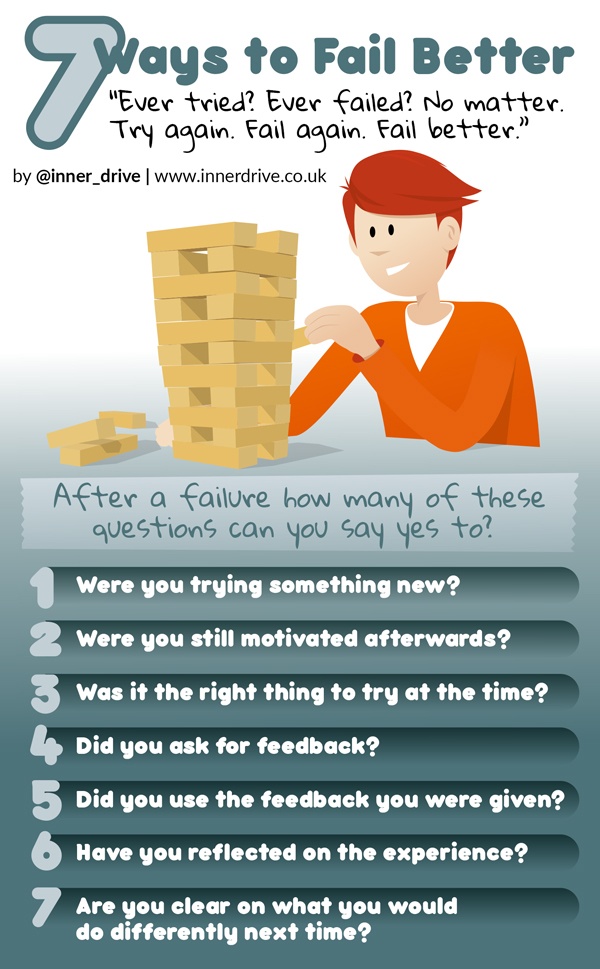
So how can we help students fail better? It is important to note that failing better is different from aiming to fail. The former focuses on learning and development; the latter suggests low expectations and lack of effort (which is the opposite mindset of what we promote). Students ‘fail better’ if they can answer yes to these questions…

Were they trying something new?

Being open and enthusiastic about new and challenging situations is a key characteristic of having a growth mindset. We want to help students shift away from focusing on ‘proving myself’ and more towards ‘improving myself’.

The teenage years offer a unique window of self-discovery and improving self-awareness. It can be when people discover what they are passionate about. Part of this process is trying new things, experimenting, and finding out what one’s strengths/weaknesses might be. Failures are integral to this. Helping students understand this can help aid their learning and development.

Were they still motivated after the setback?

Research on teenagers has found that those who are motivated by learning and mastering a subject, compared to those who are extrinsically motivated by rewards, display higher levels of emotional control before an exam, have higher levels of confidence, and achieve better academic performance.

Doing well at school is more akin to a marathon, rather than a sprint. Motivation needs to be robust and durable in order to aid resilience. Focusing on improvement, on learning, and on getting better should ensure that this happens.

Was it the right thing to try at the time?

It is easy for students to judge how good their decisions are based on the outcome (i.e. if it ended up well, it was a good decision; if it ended up badly, it was a bad one). This is a mistake, as sometimes the result may be down to randomness, luck, or a million other factors. This can lead to people throwing the baby out with the bath water.

Statistician Nate Silver, the only man in America who correctly predicted how each of the 50 states would vote in the 2012 Presidential election, states that instead of judging decisions based on the eventual outcome, it is far better to judge them based on the information you had at the time.

If students make the best decision possible from the information available, then perhaps the mistake was down to execution of the skill and not the thought process going into it. This is an important distinction to make, as it can help identify which part of the process to target for improvement next time.

Did they ask for feedback (and then use it)?

There is a great quote that says, “Real failure is a man who has blundered, but not cashed in on the experience.” If students are going to suffer from setbacks (and it is a certainty that they will at some stage), then there is a three-part way to ensure they learn the most from it.

First is the act of asking for feedback. This is a great behaviour to praise, as it is the behaviour you want them repeat after future failures. Second is being open to the feedback. This is a fundamental part of learning. If students feel that they are being judged or attacked, it is unlikely that they will heed the feedback, no matter how helpful. Third is getting them to action the feedback. It is not enough to have good intentions; behaviour change comes from doing, not just thinking about it.

Did they reflect on the experience and know what they would do differently?

Setbacks can aid the learning process, but only if the person experiencing it takes the time to reflect on what has happened and as a result, is clear on what they would do differently next time. Otherwise, it is likely that they will repeat the same mistakes again and again in the future. It is ok to make mistakes. To keep making the same one is criminal.

Having students ask themselves ‘what would I do differently next time?’ is a great question for two reasons. First, it stops them dwelling on the past, which can reduce student stress. Second, it gives them a sense of control over the situation, which will help boost their confidence and motivation when moving forward into the future.

FINAL THOUGHT

We all want the students we work with to be successful; however, it would be foolish to think that they will never fail. We don’t want students to fail more, but if (and when) some of them do fail, we want them to fail better. Helping them fail better isn’t negative; if anything, it may be one of the most positive skills we could teach them.

About Inner Drive

InnerDrive is a mental skills training company coveing the traditional areas of sports psychology and mindset training.

Their work covers the traditional areas of performance psychology, sports psychology and neuroscience. They work with over 120 schools in England and last year worked with over 25,000 students, teachers and parents.

The company is led by Edward Watson, a retired Army major and Bradley Busch, a HCPC registered psychologist.

Filed Under: Motivation

Five Things to Avoid Saying to Your Athletes

September 23, 2016 by

This article is courtesy of Coaches Network

Coaches can often walk a fine line when trying to motivate their young athletes. Choosing the right words to get the most out of your players can be challenging when also trying to instill lessons that go beyond winning and losing. Janis Meredith of CouchUp.com outlines various ways that coaches can inspire their team without creating tension or emotional harm. Specifically, Meredith identifies five phrases that can put undue pressure on young athletes and should therefore be avoided.

1. “This is a MUST win!”

Even if your team is about to compete in a playoff or tournament game, it does not usually help to emphasize that winning is all that matters. Players already understand that it’s an important game that needs to be one if they want to keep playing, reiterating this probably wont help them. There is so much more to be gained from such a competitive game that focusing only on winning can keep your athletes from getting the most out of the experience. “They will play another season, other games, and reminding them that this is a “must-win” will not help them play any better; it will only help them worry all the more about messing up,” writes Meredith.

2. “Watch how (insert name here) does it! You can do it too!”

It makes sense to occasionally use players on your team as examples when trying to teach a certain skill or technique. Yet this type of tactic can also have a negative psychological effect on the other players. Though coaching tactics like this usually come from good intentions, they can easily do more harm than good. Try to avoid comparing players to each other, or singling out a certain person. Instead, motivate the entire team to get better together.

3. “You’re the best player out there! Go show them how it’s done!”

Even if the athlete is the best player on the team, telling them that they need to prove this can put provide unnecessary pressure. Meredith writes, “That mindset may work for older athletes, but for young athletes it is an unnecessary burden to bear.” Keep in mind that it is easy for young athletes to feel overburdened by pressure from their coaches, making it important to avoid singling out specific players. Provide this type of encouragement to the entire team and they will likely share the responsibility together instead of one person feeling like they have to do it all themselves.

4. “Remember what happened last game?”

Most of the time, players remember their mistakes and therefore coaches don’t need to provide constant reminders. Mistakes should be addressed in a way that athletes can learn from them, and one of the main responsibilities of coaches is to help in the learning process. Don’t let your players dwell on their mistakes by reminding them what happened. Instead, give them the knowledge and confidence needed to avoid those mistakes in the future.

5. “Destroy the other team!”

This puts the focus on the opponent instead of the actual performance of your own team. It may just seem like a classic way to motivate your players and get them fired up, but it does nothing to help them visualize succeeding. Encourage your team to play their best, regardless of the opponent. “The object of the game is to win (with integrity) and not to intentionally hurt opponents,” writes Meredith.

Instead of focusing energy towards these last minute motivational speeches, try to just encourage your young athletes to play their best and enjoy the game.

Filed Under: Motivation

  • « Previous Page
  • 1
  • 2
  • 3
  • 4
  • …
  • 6
  • Next Page »

© Copyright 2026 Athletic Performance Toolbox

Design by BuzzworthyBasketballMarketing.com

Privacy Policy