Athletic Directors Toolbox

  • Home
  • Leadership
  • Mental Toughness
    • Mental Skills
  • Motivation
  • Professional Development
  • Program Building
  • Sports Performance
  • Team Building

A Creed for Self-Discipline

September 9, 2015 by

A Creed for Self-Discipline

by Napoleon Hill

Willpower:

Recognizing that the power of will is the supreme court over all other departments of my mind, I will exercise it daily, when I need the urge to action for any purpose; and I will form habits designed to bring the power of my will into action at least once daily.

Emotions:

Realizing that my emotions are both positive and negative I will form daily habits which will encourage the development of the positive emotions, and aid me in converting the negative emotions into some form of useful action.

Reason:

Recognizing that both my positive emotions and my negative emotions may be dangerous if they are not controlled and guided to desirable ends, I will submit all my desires, aims and purposes to my faculty of reason, and I will be guided by it in giving expression to these.

Imagination:

Recognizing the need for sound plans and ideas for the attainment of my desires, I will develop my imagination by calling upon it daily for help in the formation of my plans.

Conscience:

Recognizing that my emotions often err in their over-enthusiasm, and my faculty of reason often is without the warmth of feeling that is necessary to enable me to combine justice with mercy in my judgments, I will encourage my conscience to guide me as to what is right and what is wrong, but I will never set aside the verdicts it renders, no matter what may be the cost of carrying them out.

Memory:

Recognizing the value of an alert memory, I will encourage mine to become alert by taking care to impress it clearly with all thoughts I wish to recall, and by associating those thoughts with related subjects which I may call to mind frequently.

Subconscious Mind:

Recognizing the influence of my subconscious mind over my power of will, I shall take care to submit to it a clear and definite picture of my major purpose in life and all minor purposes leading to my major purpose, and I shall keep this picture constantly before my subconscious mind by repeating it daily.

Discipline over the mind is gained, little by little, by the formation of habits which one may control. Habits begin in the mind; therefore, a daily repetition of this creed will make one habit-conscious in connection with the particular kind of habits which are needed to develop and control the six departments of the mind.

The mere act of repeating the names of these departments has an important effect. It makes one conscious that these departments exist; that they are important; that they can be controlled by the formation of thought-habits; that the nature of these habits determines one’s success or failure in the matter of self-discipline.
 

Filed Under: Mental Toughness

Positive Self Talk for Your Athletes

July 28, 2015 by

This article was written by Lindsey Wilson. Lindsey is the Co-Founder of Positive Performance Mental Training Zone. Lindsey played basketball at Iowa State and then played professionally overseas. She has been teaching, writing and speaking about mental training for the last 6 years.

The Truth About Positive Self-Talk

By Lindsey Wilson

There’s a lot out there about positivity and the importance of having a positive mindset: talking to yourself positively, talking to your kids positively, even talking to your pets positively. (Groan… Yes, it’s a thing!)

All this positivity can be a bit much.

And that’s saying a lot, especially coming from someone like me who’s a BIG believer in the power of the glass-is-half-full mentality. The complication with positivity is that it can be hard to distinguish what is actually helpful and what is just, well, fluff.

That’s why I want to talk specifically about self-talk today because, in my opinion, self-talk serves as the basis for so many things in our lives: our beliefs, our outlook, our confidence, how we interact with others, and much, much more. But, I don’t just want to talk about self-talk alone; I also want to dive into the research behind it to make sure this isn’t just another ‘positive self-talk is great’ article. Yay!

Seeing as our focus is athletics, I want to specifically analyze the research looking into the relationship between self-talk and performance. Basically, my big question is:

Is teaching athletes positive self-talk worth it?

So, here we go! This is what I found:

  • Positive self-talk can improve confidence.
  • Positive self-talk does positively affect performance.
  • Self-talk effects motor skill performance more than cognitive performance.
  • Self-talk is best scripted ahead of time and practiced.
  • Research shows there are differences in what type of statements you should say at different times, but…
  • What works for each person is fundamentally a matter of personal preference.
  • Addressing yourself by name or ‘you’ is found to be more powerful than ‘I’ statements.
  • Self-talk should focus on what you should do rather than what you should not do.

First, before we can talk about self-talk in depth, we need to establish a solid definition. More specifically, we need to be able to answer the following questions:

  1. What IS self-talk?
  2. What different types of self-talk are there?
  3. Are there types that are more helpful in certain situations than others?

These questions get really specific, really fast, so let’s start with a basic overview of self-talk and go from there.

Defining Self-Talk

The Mayo Clinic defines self-talk as “the endless stream of unspoken thoughts that run through your head… [that] can be positive or negative.” Furthermore, “[i]f your thoughts are mostly positive, you’re likely an optimist — someone who practices positive thinking.”

Positive thinking, therefore, is the result of positive self-talk, and those can offer multiple health benefits, such as increased life span and increased immunity.

The Mayo Clinic then gives us examples of both positive and negative self-talk:

Putting Positive Thinking Into Practice

Negative self-talk


Positive Self Talk


I’ve never done it before. It’s an opportunity to learn something new.
It’s too complicated. I’ll tackle it from a different angle.
I don’t have the resources. Necessity is the mother of invention.
I’m too lazy to get this done. I wasn’t able to fit it into my schedule, but I can re-examine some priorities.
There’s no way it will work. I can try to make it work.
It’s too radical a change. Let’s take a chance.
No one bothers to communicate with me. I’ll see if I can open the channels of communication.
I’m not going to get any
better at this.
I’ll give it another try.

The Mayo’s cover-all rule: “Don’t say anything to yourself that you wouldn’t say to anyone else.”

Simple enough right? Not so fast. Let’s dive into this a little deeper…

TYPES Of SELF-TALK

Research shows there are 4 specific categories of performance-based self-talk:

  • Calming/relaxing (“Take a deep breath.”)
  • Instructional (“Bend your knees.”)
  • Motivational (“Yes! Come on, let’s go!”)
  • Focus (“Don’t think about anything. Just concentrate.”)

This list got me paying attention. Why? Because these categories are all so different. Even for myself, I can see one type of statement working in a certain situation and not working in another. (Leaving the research aside for a moment, this is where I encourage athletes to build up self-awareness and to practice what works with some trial and error.)

But, back to the research…

WHAT TO SAY, WHEN

In Perspectives on Psychological Science[i], a journal of the Association for Psychological Science, researchers at the University of Thessaly did a meta-analysis on 62 research studies on self-talk. Their analysis revealed that, not only did self-talk improve sports performance, but different self-talk cues work differently in certain situations.

Here is what they found:

    • Instructional self-talk (i.e. “Elbow-up”) is most helpful for tasks requiring fine skills or for improving technique.

Motivational self-talk (i.e. “Give it your all”) seems to be more effective in tasks requiring strength or endurance, boosting confidence and psyching-up athletes for competition.

It is a matter of personal preference or what works for each person; but generally, it is advised that self-talk is positively rather than negatively phrased and focuses on what you should do rather than on what you should avoid…”
Antonis Hatzigeorgiadis, researcher at the University of Thessaly

A SMALL TRICK

According to an article in Journal of Personality and Social Psychology[ii], a researcher by the name of Kross and his associates at the University of Michigan did an experiment with one small caveat: participants would either use the word ‘I’ or ‘You/[their name]’ when addressing themselves with their self-talk.

This is what the experiment looked like:

Kross asked volunteers to give a speech. Catch: they were only given five minutes of mental preparation. During the five minutes, he told some to talk to themselves and to address themselves as ‘I’. For the rest of them, their five minutes was spent using ‘you’ or by addressing themselves in the third person (using their own names).

At the close of the study, this is what Kross found:

  • People who used ‘I’ said things like ‘Oh, my god, how am I going do this? I can’t prepare a speech in five minutes without notes. It takes days for me to prepare a speech!’
  • People who used ‘you’ or their own names said things like, “Ethan, you can do this. You’ve given a ton of speeches before.”

Positive self-talk effects your everyday life. Clearly, the people who used ‘you’ or their names sounded more rational and less emotional—perhaps because they were able to get some distance from themselves.

Truly, it sounds like they are coaching themselves.

SELF-TALK CAN INFLUENCE RESULTS!

Research done out of Waseda University in Japan[iii] shows again that motor skills especially are greatly affected by self-talk. The results of their research show that positive self-talk improved physical performance by 11%.

Their research was based around a simple balancing exercise. Students completed the exercise then were given 30 seconds to rest before completing it a second time. In between the sets, students were told to pay attention to their self-talk. Some students reported having negative self talk; others reported positive self-talk; still another group reported using a combination of positive and negative self-talk.

The results were shocking.

Students that reported using positive self-talk exclusively during those 30 seconds were able to hold their balance a full second longer than those who used exclusively negative or had a mix of both negative and positive self-talk.

The positive self-talk resulted in an average balance time of 9.29 seconds, while the other two groups averaged out at 8.29 seconds. This is more than an 11% increase in performance, really close to the proven 15% increase in athletic performance we see with Positive Performance’s mental training.

CONCLUSION

Based on the above findings it’s obvious that teaching athletes how and when to use positive self-talk—that is, using positive self-talk appropriately—is not only a good time investment, but a worthwhile one.

While talking about positive self-talk can seem merely warm and fuzzy, research shows that it is a powerful, actionable tool in achieving one’s peak performance. And, based on our own work with athletes, here are some simple best practices for self-talk education:

6 TIPS FOR EFFECTIVE POSITIVE SELF-TALK

  • Self-talk should be practiced ahead of time (outside of competition).
  • While there are best practices, the focus should be less about negative/positive, or good/bad self-talk, and more about what is PRODUCTIVE for athletes in certain situations.
  • Individual preferences are okay.
  • Self-talk should be focused on what should be done, rather than what should be avoided.
  • Different situations might call for different types of self-talk.
  • It is difficult to turn off self-talk. For most people, self-talk is going to happen, for the good or the bad, regardless of whether you work on it. Knowing that, you may as well make the monologue in your head helpful… and positive!

Here’s to athletes everywhere, using self-talk as a tool to find their peak performance every time they step onto the playing field.

P.S. Want to pump up your performance even more? Click HERE to learn about our Competition MasteryTM training and get a FREE sample training.

REFERENCES:

[i] Girodo & Wood, 1979; Goodhart, 1986; Mahoney & Avener, 1977; Van Raalte et al., 1994; Weinberg, 1985

[ii] Kross, E., Bruehlman-Senecal, E., Park, J., Burson, A., Dougherty, A., Shablack, H., Bremner, R., Moser, J., & Ayduk, O. (2014). Self-talk as a regulatory mechanism: How you do it matters. Journal of Personality and Social Psychology.

[iii] Belief in Self-Talk and Dynamic Balance Performance.Kaori Araki (Waseda University, Japan), Joseph K. Mintah (Azusa Pacific University), Mick G. Mack, Sharon Huddleston, Laura Larson, and Kelly Jacobs (University of Northern Iowa).

Athlete Coach-Ability Checklist

I originally made contact with Lindsey after finding her Athlete Coach-Ability Checklist.

I like this resource because:

• There are concrete actionable steps for your athletes to take to improve their coach-ability
• It’s another voice (not yours, not their parents) that just so happens to be a former professional basketball player
• It helps your athletes be more self-aware of things they may not even know they are doing (rolling their eyes for instance!)

The checklist has been downloaded over 3000 times by coaches all across the country! Better yet, it’s FREE and comes in a nice, printable PDF format that you can share with your team. Click here to download it.

Filed Under: Mental Toughness

The Winning Attitude

May 13, 2015 by

Some thoughts on the mindset of a winner to share with your athletes. I hope you can find a few that are useful…

What makes one person a winner and other people losers? How they think! Your self image determines your ability and your success. You will be ready mentally if you are thinking success. For instance:

A WINNER is always ready to tackle something new… a loser is prone to believe it can’t be done.

A WINNER isn’t afraid of competition… losers excuse themselves with the idea that the competition can beat them.

A WINNER makes a mistake and says, “I was wrong”… a loser makes a mistake and says, “It wasn’t my fault,” and blames someone else.

A WINNER is challenged by a problem and goes through it.. a loser does not want to face it, tries to go around it, but never gets by it.

A WINNER realizes there is no time like the present to get a job done… a loser is prone to procrastinate with the hope that things will get better tomorrow.

A WINNER thinks positively, acts positively, and lives positively… a loser usually has a negative attitude and a negative approach to everything.

A WINNER says “Let’s find out…” a loser says, “Nobody knows.”

A WINNER makes commitments… a loser makes empty promises.

A WINNER says, “I’m good, but not as good as I should be…”· a loser says, “I’m not as bad as a lot of other people.”

A WINNER learns from those who are superior… a loser tries to tear down those who are superior.

A WINNER credits his “good luck” for winning-even though It isn’t good luck; a loser blames “bad luck” for losing-even though it isn’t bad luck.

A WINNER knows how and when to say “Yes” and “No”; a loser says, “Yes, but’ and “Perhaps not” at the wrong times, for the wrong reasons.

A WINNER Isn’t nearly as afraid of losing as a loser is secretly afraid of winning.

A WINNER works harder than a loser, and has more time; a loser Is always “Too busy” to do what is necessary.

A WINNER shows he’s sorry by making up for it, a loser says, “I’m sorry,” but does the some thing the next time.

A WINNER knows what to fight for, and what to compromise on; a loser compromises on what he shouldn’t and fights for what isn’t worthwhile fighting about.

A WINNER listens a loser just waits until it’s his turn to talk.

A WINNER, would rather be admired than liked, although he would prefer both; a loser would rather be liked than admired, and Is even willing to pay the price of mild contempt for It.

A WINNER feels strong enough to be gentle; a loser Is never gentle-he Is either weak or petty tyrannous by turns.

A WINNER feels responsible for more than his Job: a loser says, “I only work here.”

A WINNER says, “There ought to be a better way to do It,” a loser says, “That’s the way It’s always been done here.”

A WINNER paces himself; a loser has only two speeds: hysterical & lethargic.

A WINNER works hard to achieve his goals, a loser just gets by.

The Winner is always part of the answer; The Loser is always part of the problem.

The Winner always has a program; The Loser always has an excuse.

The Winner says,”Let me do it;” The Loser says;” That is not my job.”

The Winner sees an answer for every problem; The Loser sees a problem for every answer.

The Winner says,” It may be difficult but it is possible”; The Loser says,”It may be possible but it is too difficult.”

Winners have dreams; Loser have schemes.

Winners say,” I must do something”; Losers say,”Something must be done.”

Winners are a part of the team; Losers are apart from the team.

Winners see the gain; Losers see the pain.

Winners see possibilities; Losers see problems.

Winners believe in win/win; Losers believe for them to win someone has to lose.

Winners see the potential; Losers see the past.

Winners are like a thermostat; Losers are like thermometers.

Winners choose what they say; Losers say what they choose.

Winners use hard arguments but soft words; Losers use soft arguments but hard words.

Winners stand firm on values but compromise on petty things; Losers stand firm on petty things but compromise on values.

Winners follow the philosophy of empathy: “Don’t do to others what you would, not want them to do to you”;
Losers follow the philosophy, “Do it to others before they do it to you.”

Winners make it happen; Losers let it happen.

SO IF YOU, WANT TO BE A WINNER, THINK LIKE A WINNER… ACT LIKE A WINNER… AND SOONER THAN YOU THINK, YOU’LL BE A WINNER TOO!

Filed Under: Mental Toughness

The 4 C’s of Peak Performance

April 15, 2015 by

These thoughts on clutch performance are from Spencer Wood Icebox Sports Performance Resources.

Click the link below to see his Mental Toughness Edge website. There are some articles on mental training and other resources as well. Mental Toughness Edge

Developing a Mental Skills & Toughness Training Plan of Action

By Spencer Wood

Ask any athlete, coach or sports fan ‘of all the athletic attributes, which is the most important?’ Even the most casual athlete, coach or sports fan will provide an answer that in some way relates to the mental toughness, potential and power locked away in our mind. Yet, for so many coaches and athletes, unlocking the incredible athletic potential and power held in our minds is sometimes as much a mystery as it is a source of constant heartache and frustration. Many teams and individual athletes know what it feels like to bring their ‘A’ game against one program one day, and then almost unexplainably, they bring their ‘C’ or ‘D’ game against the very next program. Even worse, for those athletes who have experienced a major performance or skills slump in a big game or even over the course of a season – the frustration can feel like a slow death. Unfortunately, far too many coaches and athletes know this feeling all too well. For the progressive coach the response to these challenges is more than just extra running or longer practices.

While extra running, longer drills and additional conditioning can build certain aspects of mental toughness, and under a select few conditions may be suitable response for a lack of effort, games are not always won or lost because of a lack of effort. Games are often won or lost due to a lack of execution vs. lack of effort. The smart response then is to develop a mental skills and toughness training program that pinpoints the particular components of mental toughness that resulted in a lack of execution FOR EACH ATHLETE. Better still, coaches who proactively put such a plan in place before the start of the season will experience greater consistency and a significant competitive edge.

So how does a coach and team begin to implement a mental skills and toughness training program for clutch performance? It has been said that “sometimes things do not go according to plan because a plan did not exist in the first place.” For mental skills this plan begins with an honest assessment of each athlete’s mental skills and toughness strengths and weaknesses. But what kind of mental skills and toughness traits should you assess? While a seemingly endless stream of words and phrases can be used to broadly describe mental skills and athletic toughness traits, a useful summary traces each of these traits to one of more of the 4 C’s of Peak Performance – Composure, Concentration, Confidence and Commitment.

The 4 C’s of Peak Performance

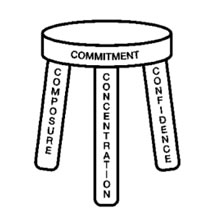
Together, these “4 C’s of Peak Performance,” Composure, Concentration, Confidence, and Commitment – work like a model of a 3 leg stool. The first 3 C’s of Peak Performance – Composure, Concentration, and Confidence are like the legs of the stool. Lose one or more legs and the integrity and balance of the stool is compromised. Translation – our performance suffers. And the 4th C of Peak Performance – Commitment – is the seat or platform of the stool that takes our weight and sustains us. No commitment or motivation, no stool. Each of these 4 C’s of Peak Performance profoundly affects the others. Developing tremendous composure allows us to better perform our concentration skills. A composed athlete who is able to effectively concentrate whenever necessary, will be a confident and highly effective athlete. And finally, a fully committed athlete will have harnessed the necessary drive and motivation to passionately pursue their mental and physical potential – committing to the necessary physical and mental training, maximizing their composure, concentration and confidence, and striving for Peak Performance. The “4 C’s Stool” diagram illustrates this Peak Performance Model.

4 C’s of Peak Performance

Mental Toughness for Basketball

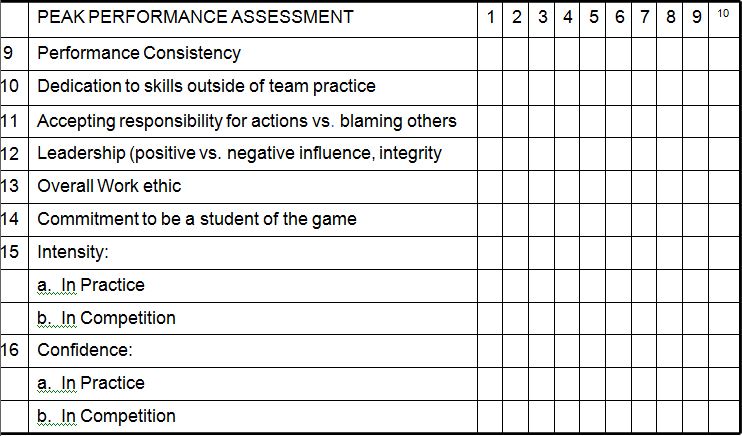
The Peak Performance Assessment examines current levels of practice and competitive composure, concentration, confidence and commitment, in addition to a number of other factors that can profoundly affect each of the 4 C’s of Peak Performance. These questions are scored on a scale from 1-10. A score of 1 = a “strongly disagree/very low” score. A score of 9 = a “strongly agree/very high” score. A score of 10 is a very rare “near perfect” score and should only be used sparingly. Encourage each of your players to complete the Peak Performance Assessment with complete honesty. Great athletes are great because they work on their strengths AND their weaknesses.Only complete honesty will allow your players to objectively identify these strengths and weaknesses before they are able to effectively improve these skills. The coach should also complete an assessment on each player, and should be compared with the player’s self-assessment in a one-on-one meeting with each player.

Any question with a score below a 7 should send up a ‘red flag’ and you should strongly consider working on this weakness with the athlete in question and turning the weakness into a future goal for improvement.

Developing a mental skills and toughness training plan for your team will certainly involve a time commitment. But this critical skill set will add a new, challenging and fun component to your practice schedule. In addition, the more you continue to train your team’s competitive mental muscle and refine your player’s mental training skills, the closer you will come to your team’s real potential. The pay-off in consistent peak performance, individual player improvement and your overall win column can be significant.

Mental Toughness for Basketball

Mental Toughness for Basketball

Filed Under: Mental Toughness

13 Things Mentally Strong People Don’t Do

March 17, 2015 by

I am always looking for mental toughness resources and just finished reading the Book “13 Things Mentally Strong People Don’t Do.”

The lessons are applicable to all areas of living a happy and successful life, including athletics.

A blog post on the was the precursor to the book has some thoughts on mental toughness for us to apply to our own personal and professional lives as well as to share with our staff and players.

~by Amy Morin, LCSW
AmyMorinLCSW.com

Mentally strong people have healthy habits. They manage their emotions, thoughts, and behaviors in ways that set them up for success in life. Check out these things that mentally strong people don’t do so that you too can become more mentally strong.

1. They Don’t Waste Time Feeling Sorry for Themselves

Mentally strong people don’t sit around feeling sorry about their circumstances or how others have treated them. Instead, they take responsibility for their role in life and understand that life isn’t always easy or fair.

2. They Don’t Give Away Their Power

They don’t allow others to control them, and they don’t give someone else power over them. They don’t say things like, “My boss makes me feel bad,” because they understand that they are in control over their own emotions and they have a choice in how they respond.

3. They Don’t Shy Away from Change

Mentally strong people don’t try to avoid change. Instead, they welcome positive change and are willing to be flexible. They understand that change is inevitable and believe in their abilities to adapt.

4. They Don’t Waste Energy on Things They Can’t Control

You won’t hear a mentally strong person complaining over lost luggage or traffic jams. Instead, they focus on what they can control in their lives. They recognize that sometimes, the only thing they can control is their attitude.

5. They Don’t Worry About Pleasing Everyone

Mentally strong people recognize that they don’t need to please everyone all the time. They’re not afraid to say no or speak up when necessary. They strive to be kind and fair, but can handle other people being upset if they didn’t make them happy.

6. They Don’t Fear Taking Calculated Risks

They don’t take reckless or foolish risks, but don’t mind taking calculated risks. Mentally strong people spend time weighing the risks and benefits before making a big decision, and they’re fully informed of the potential downsides before they take action.

7. They Don’t Dwell on the Past

Mentally strong people don’t waste time dwelling on the past and wishing things could be different. They acknowledge their past and can say what they’ve learned from it. However, they don’t constantly relive bad experiences or fantasize about the glory days. Instead, they live for the present and plan for the future.

8. They Don’t Make the Same Mistakes Over and Over

They accept responsibility for their behavior and learn from their past mistakes. As a result, they don’t keep repeating those mistakes over and over. Instead, they move on and make better decisions in the future.

9. They Don’t Resent Other People’s Success

Mentally strong people can appreciate and celebrate other people’s success in life. They don’t grow jealous or feel cheated when others surpass them. Instead, they recognize that success comes with hard work, and they are willing to work hard for their own chance at success.

10. They Don’t Give Up After the First Failure

They don’t view failure as a reason to give up. Instead, they use failure as an opportunity to grow and improve. They are willing to keep trying until they get it right.

11. They Don’t Fear Alone Time

Mentally strong people can tolerate being alone and they don’t fear silence. They aren’t afraid to be alone with their thoughts and they can use downtime to be productive. They enjoy their own company and aren’t dependent on others for companionship and entertainment all the time but instead can be happy alone.

12. They Don’t Feel the World Owes Them Anything

They don’t feel entitled to things in life. They weren’t born with a mentality that others would take care of them or that the world must give them something. Instead, they look for opportunities based on their own merits.

13. They Don’t Expect Immediate Results

Whether they are working on improving their health or getting a new business off the ground, mentally strong people don’t expect immediate results. Instead, they apply their skills and time to the best of their ability and understand that real change takes time.

You can see a portion of the contents of the book by clicking the cover of the book.

Filed Under: Mental Toughness

  • « Previous Page
  • 1
  • 2
  • 3
  • 4

© Copyright 2026 Athletic Performance Toolbox

Design by BuzzworthyBasketballMarketing.com

Privacy Policy